
















Copyright: ©Author(s) 2026.
World J Transl Med. Sep 28, 2026; 12(3): 124390
Published online Sep 28, 2026. doi: 10.5528/wjtm.124390
Published online Sep 28, 2026. doi: 10.5528/wjtm.124390
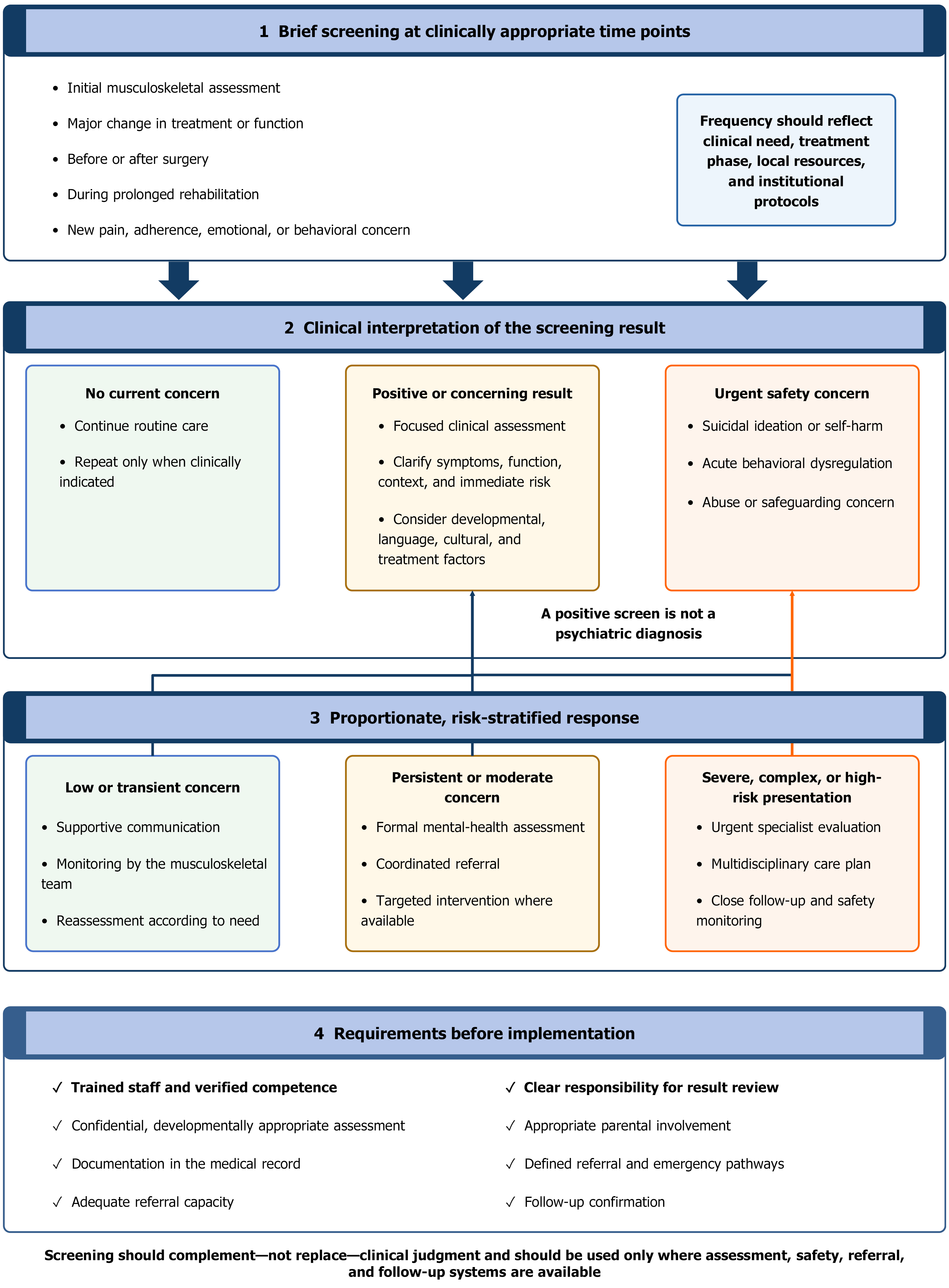
Figure 2 Proposed and adaptable risk-stratified pathway for psychological screening, clinical assessment, and referral in adolescent musculoskeletal care.
The numbered sections represent the proposed operational sequence from screening at clinically appropriate time points to clinical interpretation, proportionate risk-stratified response, and implementation requirements. Solid directional arrows indicate the intended clinical workflow and should not be interpreted as evidence of causal relationships or as mandatory transitions between levels of care. Green indicates no current concern or a low or transient concern; amber indicates a positive, persistent, or moderate concern requiring further assessment; red indicates an urgent, severe, complex, or high-risk presentation; and blue identifies the general workflow and organizational requirements. This conceptual pathway synthesizes evidence from adolescent orthopedic settings, pediatric musculoskeletal care, and related implementation literature and should not be interpreted as a validated clinical algorithm or universal standard of care. The timing and frequency of screening and reassessment should be adapted to the clinical condition, treatment phase, level of psychological risk, local resources, and institutional protocols. A positive screening result does not establish a psychiatric diagnosis but indicates the need for proportionate clinical assessment. Any endorsement of suicidal ideation, self-harm, or another urgent safety concern requires immediate evaluation according to local emergency and safeguarding procedures. Screening should be implemented only where systems are available for score interpretation, documentation, confidentiality management, referral, and follow-up. OpenAI ChatGPT Work (accessed July 24, 2026) was used to assist with the graphic layout and construction of editable PowerPoint vector elements. No third-party templates, icon libraries, or externally licensed graphic resources were used. All scientific content, labels, relationships, and final design decisions were independently reviewed and approved by the authors, who assume full responsibility for the accuracy of the Figure 2.
- Citation: Marano G, Del Prete PM, Mazza O, Traversi G, Mazza M. Orthopedic and musculoskeletal conditions in adolescence: The role of psychological screening in clinical care. World J Transl Med 2026; 12(3): 124390
- URL: https://www.wjgnet.com/2220-6132/full/v12/i3/124390.htm
- DOI: https://dx.doi.org/10.5528/wjtm.124390