
















Copyright: ©Author(s) 2026.
World J Cardiol. Oct 26, 2026; 18(10): 125900
Published online Oct 26, 2026. doi: 10.4330/wjc.125900
Published online Oct 26, 2026. doi: 10.4330/wjc.125900
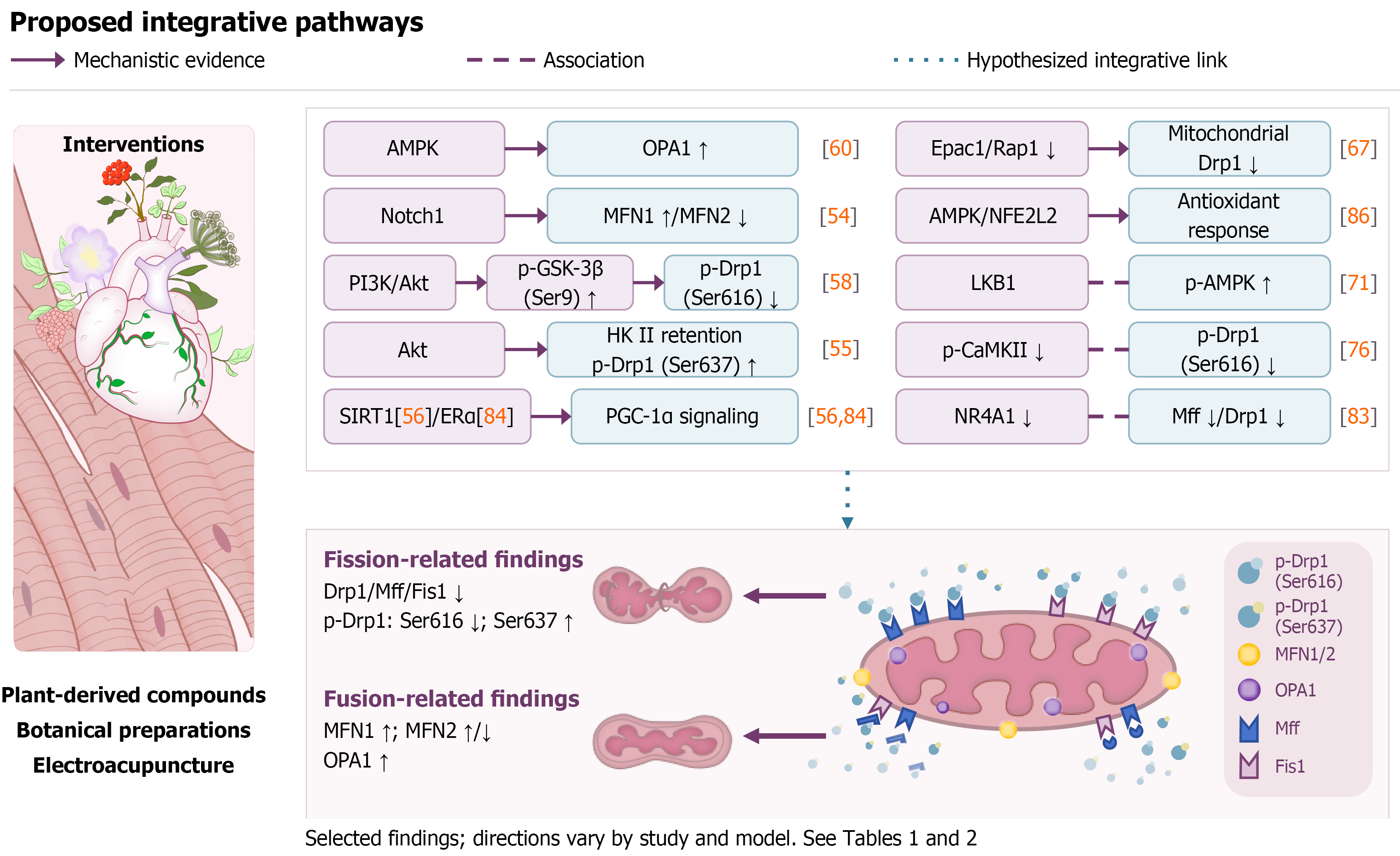
Figure 2 Proposed pathways through which plant-derived interventions and electroacupuncture may influence fission-dominant mitochondrial disruption in myocardial ischemia/reperfusion injury and related experimental models.
This integrative schematic summarizes reported pathways and molecular findings for chemically defined plant-derived compounds, multi-component botanical preparations and electroacupuncture in myocardial ischemia/reperfusion injury and related models. Reported upstream or associated routes include phosphoinositide 3-kinase/protein kinase B/glycogen synthase kinase 3β signaling and mitochondrial hexokinase II retention; liver kinase B1/AMP-activated protein kinase; sirtuin 1/peroxisome proliferator-activated receptor-γ coactivator 1α (PGC-1α) signaling associated with nuclear respiratory factors 1 and 2 and mitochondrial transcription factor A; estrogen receptor α/PGC-1α; AMPK-nuclear factor erythroid 2-related factor 2-associated antioxidant signaling; Notch1; exchange protein directly activated by cyclic adenosine monophosphate 1/Ras-related protein 1; nuclear receptor subfamily 4 group A member 1/mitochondrial fission factor (Mff); and Ca2+/calmodulin-dependent protein kinase II. Fusion-related findings include increased mitofusin 1 (MFN1) or optic atrophy 1 and context-dependent changes in MFN2. Fission-related findings include reduced Mff, mitochondrial fission 1 protein or dynamin-related protein 1 (Drp1), reduced Drp1 Ser616 phosphorylation and increased Drp1 Ser637 phosphorylation. Solid lines indicate within-study mechanistic support, dashed lines indicate associative relationships, and dotted blue lines indicate cross-study integrative or hypothesized links. This schematic does not represent a single experimentally validated causal network. Connections to grouped findings indicate pathway-level convergence rather than regulation of every marker; study-specific molecular associations, model directness, mechanistic causality and intervention timing are detailed in Tables 1 and 2. AMPK: AMP-activated protein kinase; OPA1: Optic atrophy 1; Epac1: Exchange protein directly activated by cyclic adenosine monophosphate 1; Rap1: Ras-related protein 1; Drp1: Dynamin-related protein 1; MFN1: Mitofusin 1; NFE2L2: Nuclear factor erythroid 2-related factor 2; PI3K: Phosphoinositide 3-kinase; Akt: Protein kinase B; GSK-3β: Glycogen synthase kinase 3β; LKB1: Liver kinase B1; HK II: Hexokinase II; CaMKII: Calmodulin-dependent protein kinase II; SIRT1: Sirtuin 1; PGC-1α: Peroxisome proliferator-activated receptor-γ coactivator 1α; NR4A1: Nuclear receptor subfamily 4 group A member 1; Mff: Mitochondrial fission factor; Fis1: Fission 1 protein.
- Citation: Sun L, Sun XY, Na ZH, Liu YJ, Li L, Cao TY, Li XR, Fan YD, Hu GP, Wang S. Excessive mitochondrial fission in myocardial ischemia/reperfusion injury: Pathophysiological relevance and potential cardioprotective modulation by plant-derived interventions and electroacupuncture. World J Cardiol 2026; 18(10): 125900
- URL: https://www.wjgnet.com/1949-8462/full/v18/i10/125900.htm
- DOI: https://dx.doi.org/10.4330/wjc.125900