
















Copyright: ©Author(s) 2026.
World J Gastroenterol. Aug 21, 2026; 32(31): 119570
Published online Aug 21, 2026. doi: 10.3748/wjg.119570
Published online Aug 21, 2026. doi: 10.3748/wjg.119570
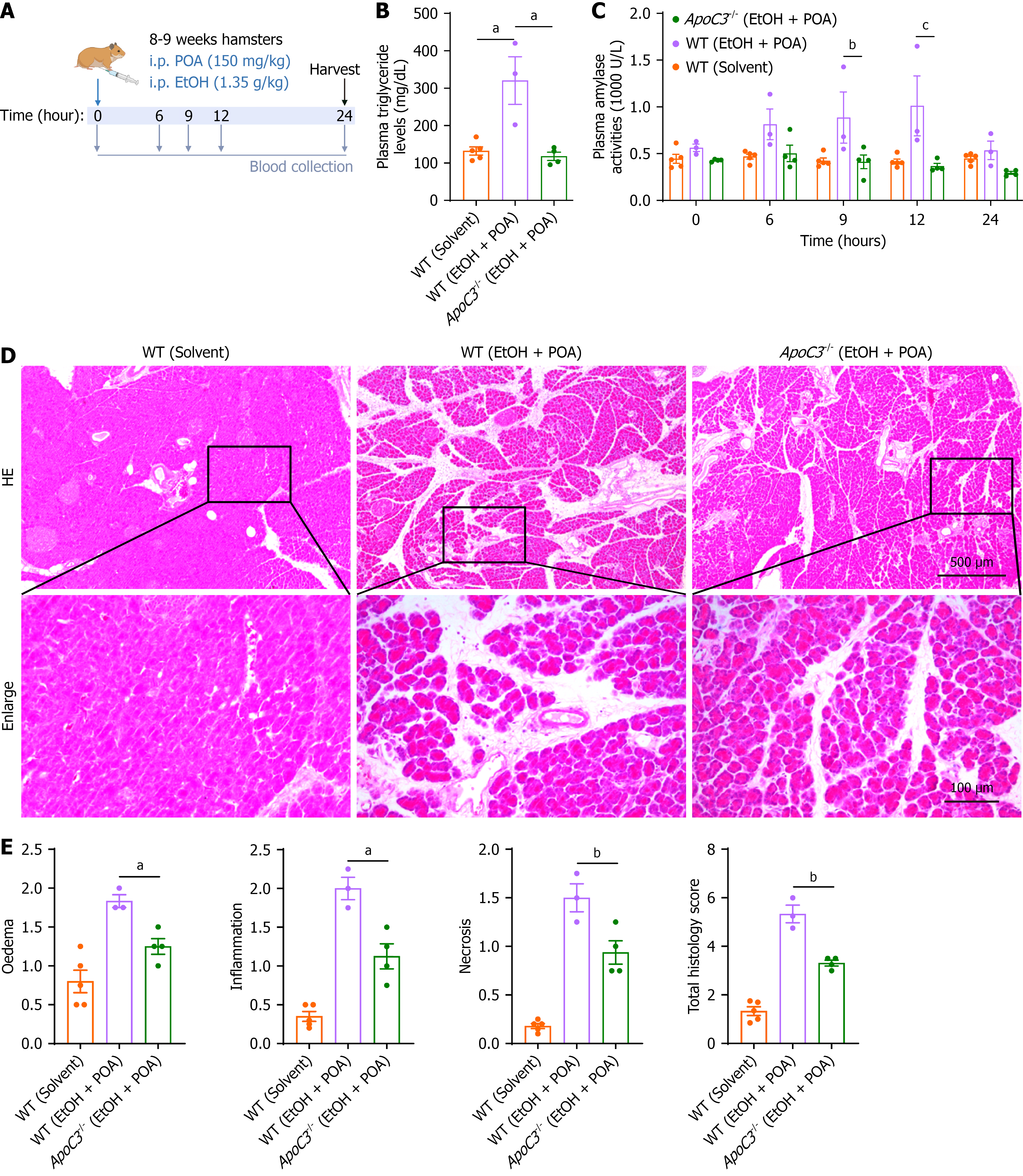
Figure 3 Apolipoprotein C3 deficiency alleviates ethanol + palmitoleic acid-induced acute pancreatitis in hamsters.
A: Schematic of the experimental protocol: 8- to 9-week-old male hamsters were intraperitoneally injected with ethanol (EtOH) (1.35 g/kg) and palmitoleic acid (POA) (150 mg/kg) to induce pancreatitis. Blood samples were collected at 0, 6, 9, 12, and 24 hours, and the animals were sacrificed at 24 hours; B: Plasma triglyceride levels were measured across treatment groups, n = 3-5; C: Plasma amylase activity was assessed at multiple time points in wild type and apolipoprotein C3 knockout hamsters with or without EtOH + POA, n = 3-5; D: Representative hematoxylin and eosin-stained pancreatic tissue sections, with enlarged views shown below; E: Quantitative histological scoring of pancreatic tissue, evaluating oedema, inflammation, necrosis, and total pathology score, n = 3-5. Data are presented as the mean ± SEM. aP < 0.05, bP < 0.01 and cP < 0.001. ApoC3: Apolipoprotein C3; ApoC3-/-: Apolipoprotein C3 knockout; AP: Acute pancreatitis; EtOH: Ethanol; POA: Palmitoleic acid; HE: Hematoxylin and eosin.
- Citation: Chen GL, Lu KK, Zhang WX, Lai PP, Xu YT, Han YF, Zhou ZH, Huang W, Wang YH, Zhang Y, Xian XD. Depleting apolipoprotein C3 alleviates acute pancreatitis in hamsters but not in mice. World J Gastroenterol 2026; 32(31): 119570
- URL: https://www.wjgnet.com/1007-9327/full/v32/i31/119570.htm
- DOI: https://dx.doi.org/10.3748/wjg.119570