
















Copyright: ©Author(s) 2026.
World J Gastroenterol. Aug 21, 2026; 32(31): 117409
Published online Aug 21, 2026. doi: 10.3748/wjg.117409
Published online Aug 21, 2026. doi: 10.3748/wjg.117409
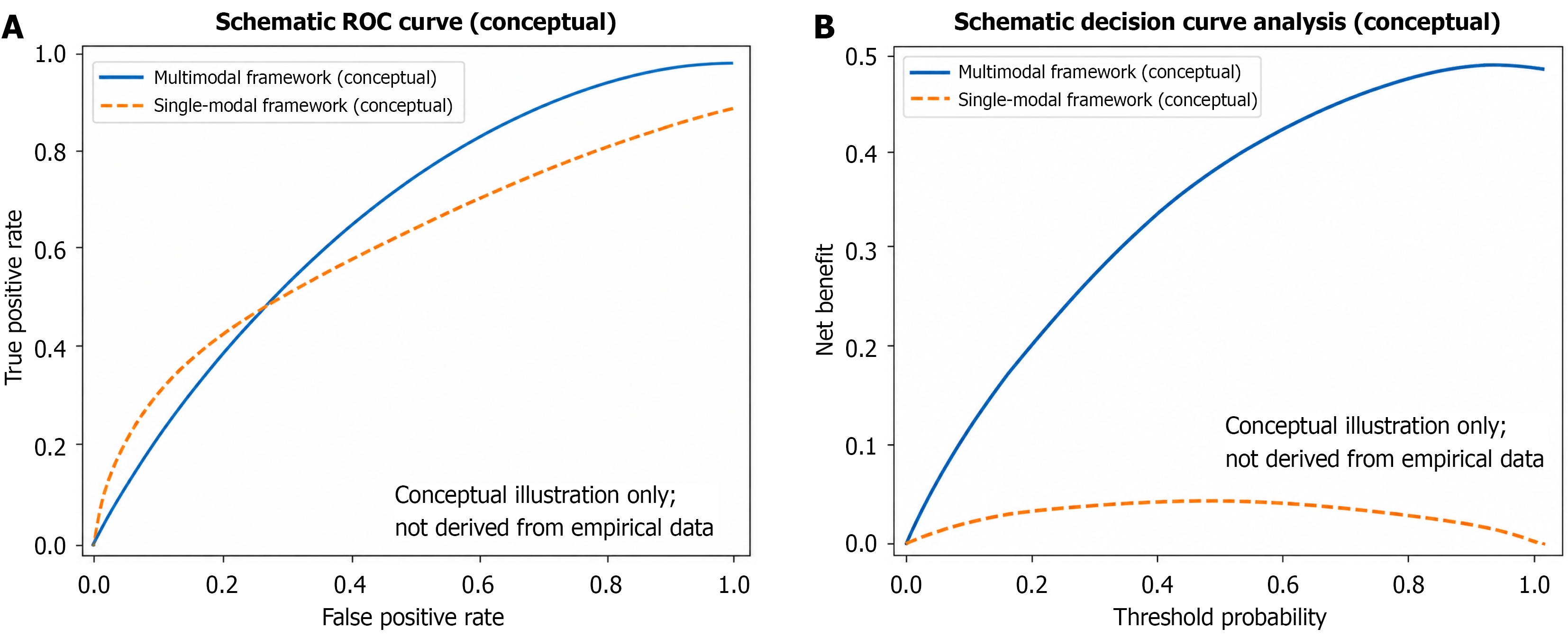
Figure 3 Conceptual comparison of single-modal vs multimodal prediction frameworks: Schematic receiver operating characteristic discrimination and decision-curve utility.
A: Schematic receiver operating characteristic curves illustrate the conceptual gain in discrimination when artificial intelligence pathology is hypothetically combined with clinical and host systemic variables; B: Schematic decision curve analysis illustrates the conceptual increase in net benefit across a range of threshold probabilities for hypothetical clinical decision scenarios. All curves are purely illustrative and are not derived from any empirical dataset; they do not report observed area under the curve, calibration, net benefit, or any other performance metric. Accordingly, the axes and curve shapes are intended only to convey qualitative relationships and should not be interpreted as dataset-specific evidence or quantitative support for any clinical action. The morphology-only curve is shown for conceptual reference to the multiple instance learning-based approach discussed by Zou et al[6]; the multimodal curves illustrate the proposed extended capabilities of an integrated predictive framework. Examples of potential decision contexts (e.g., surgical planning, neoadjuvant strategy, surveillance intensity) are provided for illustration only and do not imply validated thresholds or prescriptive recommendations. ROC: Receiver operating characteristic.
- Citation: Wang G, Pan SJ. Artificial intelligence morphology and host complexity for precision prediction of nodal metastasis in colorectal cancer. World J Gastroenterol 2026; 32(31): 117409
- URL: https://www.wjgnet.com/1007-9327/full/v32/i31/117409.htm
- DOI: https://dx.doi.org/10.3748/wjg.117409