
















Copyright: ©Author(s) 2026.
World J Gastroenterol. Aug 21, 2026; 32(31): 117409
Published online Aug 21, 2026. doi: 10.3748/wjg.117409
Published online Aug 21, 2026. doi: 10.3748/wjg.117409
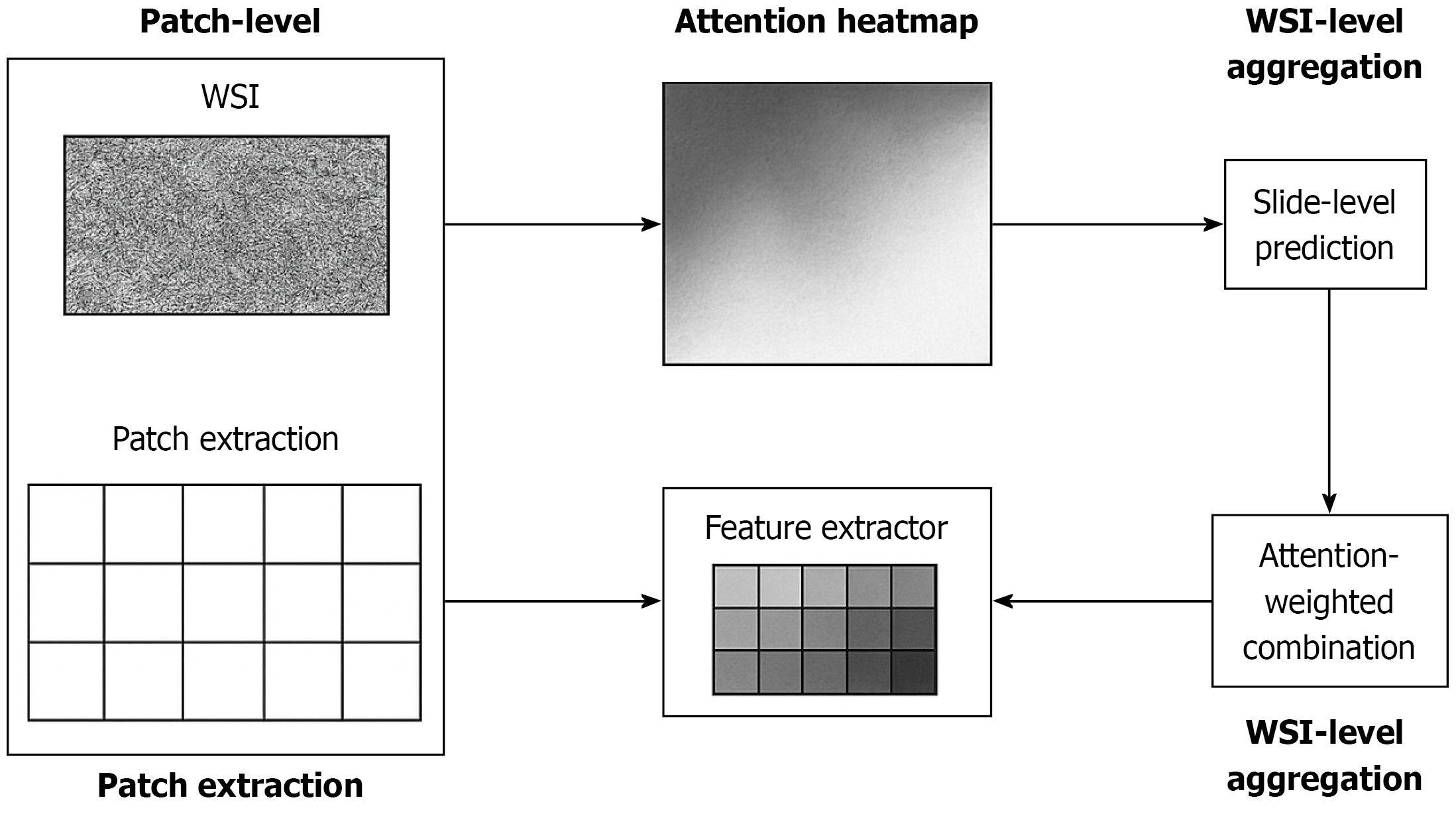
Figure 1 Patch-level feature extraction, attention-weighted aggregation, and slide-level prediction in a multiple instance learning pipeline for whole-slide pathology.
Whole-slide images are partitioned into patches, which are encoded into feature embeddings by a convolutional or transformer-based extractor. An attention module assigns weights reflecting each patch’s morphological relevance to metastatic biology, producing an interpretable attention heatmap. Weighted patch embeddings are aggregated into a slide-level representation supporting final lymph node metastasis prediction. This mechanism illustrates how multiple instance learning preserves spatial heterogeneity, highlights diagnostically salient regions, and enhances interpretability. The workflow reflects the methodological strategy implemented by Zou et al[6], forming the morphologic pillar upon which multimodal fusion with clinical and host systemic variables can be constructed. WSI: Whole-slide images.
- Citation: Wang G, Pan SJ. Artificial intelligence morphology and host complexity for precision prediction of nodal metastasis in colorectal cancer. World J Gastroenterol 2026; 32(31): 117409
- URL: https://www.wjgnet.com/1007-9327/full/v32/i31/117409.htm
- DOI: https://dx.doi.org/10.3748/wjg.117409