
















©The Author(s) 2025.
World J Gastroenterol. Oct 7, 2025; 31(37): 111327
Published online Oct 7, 2025. doi: 10.3748/wjg.v31.i37.111327
Published online Oct 7, 2025. doi: 10.3748/wjg.v31.i37.111327
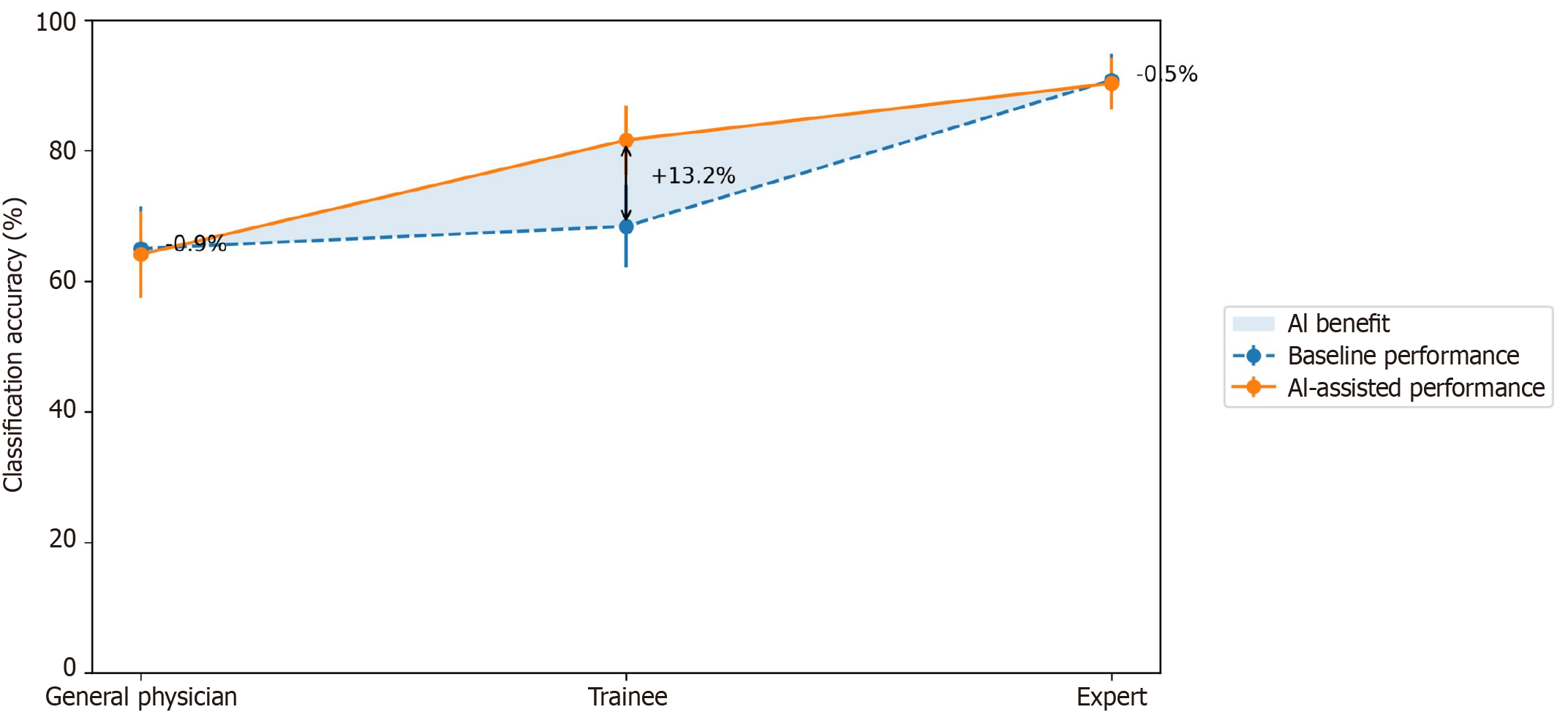
Figure 2 Inverse relationship between endoscopist experience and artificial intelligence assistance benefits in gastric endoscopy.
The curve demonstrates the differential benefit of artificial intelligence assistance across expertise levels based on our analysis of endoscopic images in the prediction of submucosal invasion[7]. Error bars represent 95% confidence intervals (CI) for each performance measurement. Maximum benefit occurs at moderate expertise levels (trainees: +13.2%, 95%CI: 10.1%-16.3%), while general physicians show decreased performance (-2.9%, 95%CI: -5.2% to -0.6%) and experts show minimal change (-0.5%, 95%CI: -2.1% to 1.1%). Data derived from Bang et al[7].
- Citation: Gong EJ, Woo J, Lee JJ, Bang CS. Role of artificial intelligence in gastric diseases. World J Gastroenterol 2025; 31(37): 111327
- URL: https://www.wjgnet.com/1007-9327/full/v31/i37/111327.htm
- DOI: https://dx.doi.org/10.3748/wjg.v31.i37.111327