
















©The Author(s) 2025.
World J Gastroenterol. Sep 14, 2025; 31(34): 110051
Published online Sep 14, 2025. doi: 10.3748/wjg.v31.i34.110051
Published online Sep 14, 2025. doi: 10.3748/wjg.v31.i34.110051
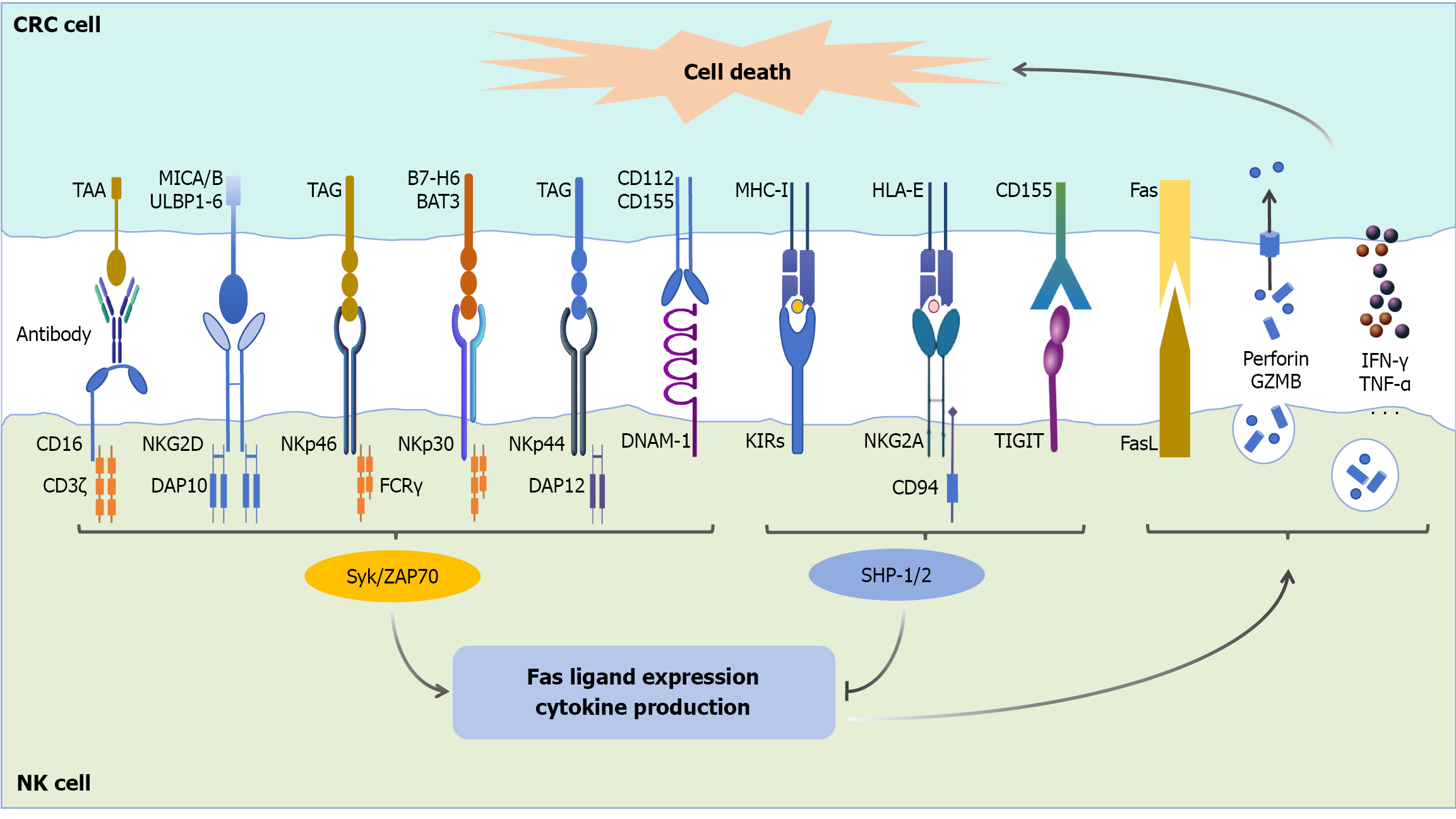
Figure 1 Receptor-mediated interactions between natural killer cells and colorectal cancer cells.
Natural killer (NK) cells engage with colorectal cancer (CRC) cells through a complex network of activating and inhibitory receptor-ligand interactions[16,17,22,25-36]. The activating receptors on NK cells, including CD16, NK group 2, member D, NKp46, NKp30, NKp44, and DNAX accessory molecule-1, recognize specific ligands expressed on CRC cells. These ligands include CD112, CD155, tumor-associated glycoproteins, human leukocyte antigen-B-associated transcript 3, BT-H6, major histocompatibility complex class I chain-related proteins A and B, UL16-binding proteins 1-6, and tumor-associated antigens. Upon receptor-ligand binding, NK cells become activated and initiate antitumor responses through multiple mechanisms: (1) The upregulation of Fas ligand; (2) The release of cytotoxic granules containing perforin and granzyme B; and (3) The secretion of pro-inflammatory cytokines such as interferon-γ and tumor necrosis factor-α. These effector functions collectively lead to CRC cell death. Conversely, inhibitory receptors on NK cells, including killer-cell immunoglobulin-like receptors, NK group 2, member A, and tyrosine-based inhibitory motif domain, interact with their corresponding ligands (major histocompatibility complex class I molecules, human leukocyte antigen-E, and CD155, respectively) on CRC cells. These interactions drive inhibitory signals that suppress NK cell activation and consequently impair their antitumor cytotoxicity. NK: Natural killer; CRC: Colorectal cancer; TAA: Tumor-associated antigen; MICA/B: Major histocompatibility complex class I chain-related proteins A and B; ULBP1-6: UL16-binding proteins 1-6; TAG: Tumor-associated glycoprotein; BAT3: Human leukocyte antigen-B-associated transcript 3; MHC-I: Major histocompatibility complex class I; HLA: Human leukocyte antigen; NKG2D: Natural killer group 2, member D; DAP10: DNAX-activating protein of 10 kDa; FCR: Fc receptor; DAP12: DNAX-activating protein of 12 kDa; DNAM-1: DNAX accessory molecule-1; KIRs: Killer-cell immunoglobulin-like receptors; TIGIT: Tyrosine-based inhibitory motif domain; FasL: Fas ligand; GZMB: Granules containing perforin and granzyme B; IFN-γ: Interferon-gamma; TNF-α: Tumor necrosis factor-α; Syk: Spleen tyrosine kinase; ZAP70: Zeta-chain associated protein 70; SHP: Src homology 2 domain-containing phosphatase.
- Citation: Zhang XJ, Yu Y, Li JY, Yan YZ, Jiang SS, Zhang Y, Fei Q, Zhang YR, Zhao YX, Guo L, Lv J, Zhao HP. Natural killer cell-based immunotherapies for colorectal cancer: Current strategies, challenges, and future perspectives. World J Gastroenterol 2025; 31(34): 110051
- URL: https://www.wjgnet.com/1007-9327/full/v31/i34/110051.htm
- DOI: https://dx.doi.org/10.3748/wjg.v31.i34.110051