
















Copyright: ©Author(s) 2026.
World J Radiol. May 28, 2026; 18(5): 120146
Published online May 28, 2026. doi: 10.4329/wjr.v18.i5.120146
Published online May 28, 2026. doi: 10.4329/wjr.v18.i5.120146
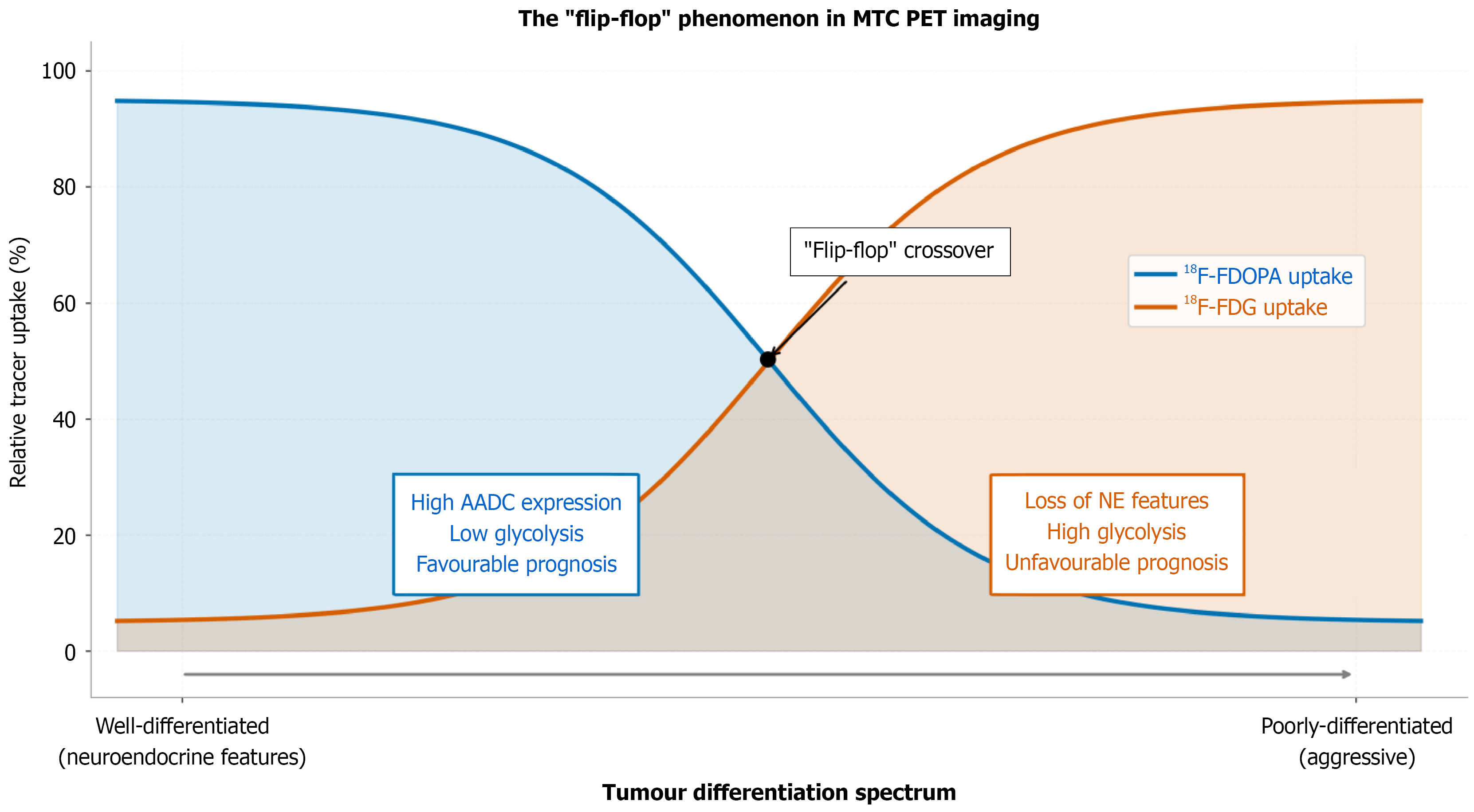
Figure 1 The “flip-flop” phenomenon in medullary thyroid carcinoma imaging.
As tumours dedifferentiate along the spectrum from well-differentiated (left) to poorly-differentiated (right), 18F-fluorodihydroxyphenylalanine uptake (blue curve) progressively decreases while 18F-fluorodeoxyglucose uptake (orange curve) reciprocally increases. The crossover point represents the transition where fluorodeoxyglucose becomes more informative than fluorodihydroxyphenylalanine. MTC: Medullary thyroid carcinoma; PET: Positron emission tomography; 18F-FDOPA: 18F-fluorodihydroxyphenylalanine; 18F-FDG: 18F-fluorodeoxyglucose; AADC: Aromatic L-amino acid decarboxylase; NE: Neuroendocrine.
- Citation: Ahmed FW, Ahmed F. Positron emission tomography tracers in medullary thyroid carcinoma: Current evidence and emerging targets. World J Radiol 2026; 18(5): 120146
- URL: https://www.wjgnet.com/1949-8470/full/v18/i5/120146.htm
- DOI: https://dx.doi.org/10.4329/wjr.v18.i5.120146