
















Copyright: ©Author(s) 2026.
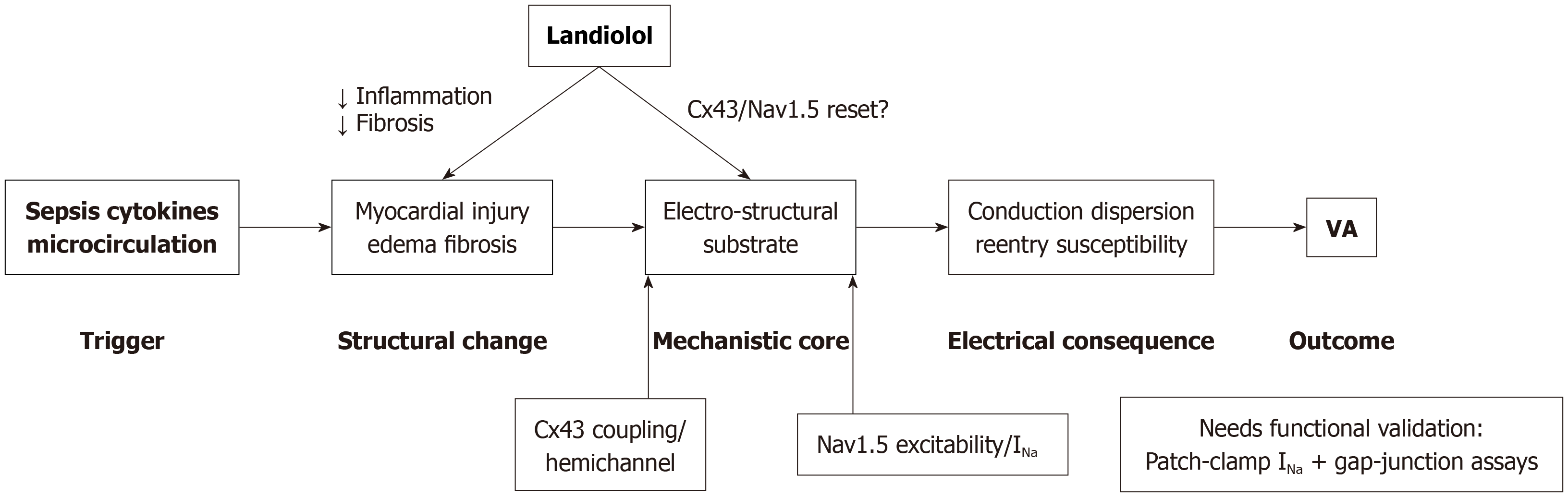
Figure 1 Inflammation-fibrosis-Nav1.
5/Cx43 electro-structural axis in septic ventricular arrhythmias and putative landiolol-mediated modulation. Sepsis triggers inflammatory cytokine excess and microcirculatory maldistribution, leading to cardiomyocyte injury, interstitial edema, and extracellular matrix remodeling and fibrosis, thereby generating a structurally heterogeneous substrate. In parallel, remodeling of Cx43-including gap-junction coupling and potential hemichannel activity, both influenced by subcellular localization and phosphorylation-and remodeling of Nav1.5, a key determinant of membrane excitability and conduction safety, may alter propagation dynamics, increase conduction dispersion, and enhance reentry susceptibility, ultimately promoting ventricular arrhythmias. The study discussed here supports associations between landiolol treatment, reduced inflammation and fibrosis, reciprocal changes in Cx43 and Nav1.5 expression, and improved electrophysiologic heterogeneity, consistent with a putative modulation of this electro-structural axis. However, direct functional validation by patch-clamp assessment of INa and by gap-junction or hemichannel assays is still required to establish causality. In the final artwork, evidence-based links should be depicted with solid arrows and more speculative links with dashed arrows. VA: Ventricular arrhythmias.
- Citation: Tang J, Deng X, Luo T, Gesang Z, Jia ZR, Danzeng Q, Wang T. Landiolol and septic ventricular arrhythmias: Revisiting the inflammation-fibrosis-Nav1.5/Cx43 electro-structural axis. World J Cardiol 2026; 18(9): 120433
- URL: https://www.wjgnet.com/1949-8462/full/v18/i9/120433.htm
- DOI: https://dx.doi.org/10.4330/wjc.120433