
















Copyright: ©Author(s) 2026.
World J Transl Med. Sep 28, 2026; 12(3): 124965
Published online Sep 28, 2026. doi: 10.5528/wjtm.124965
Published online Sep 28, 2026. doi: 10.5528/wjtm.124965
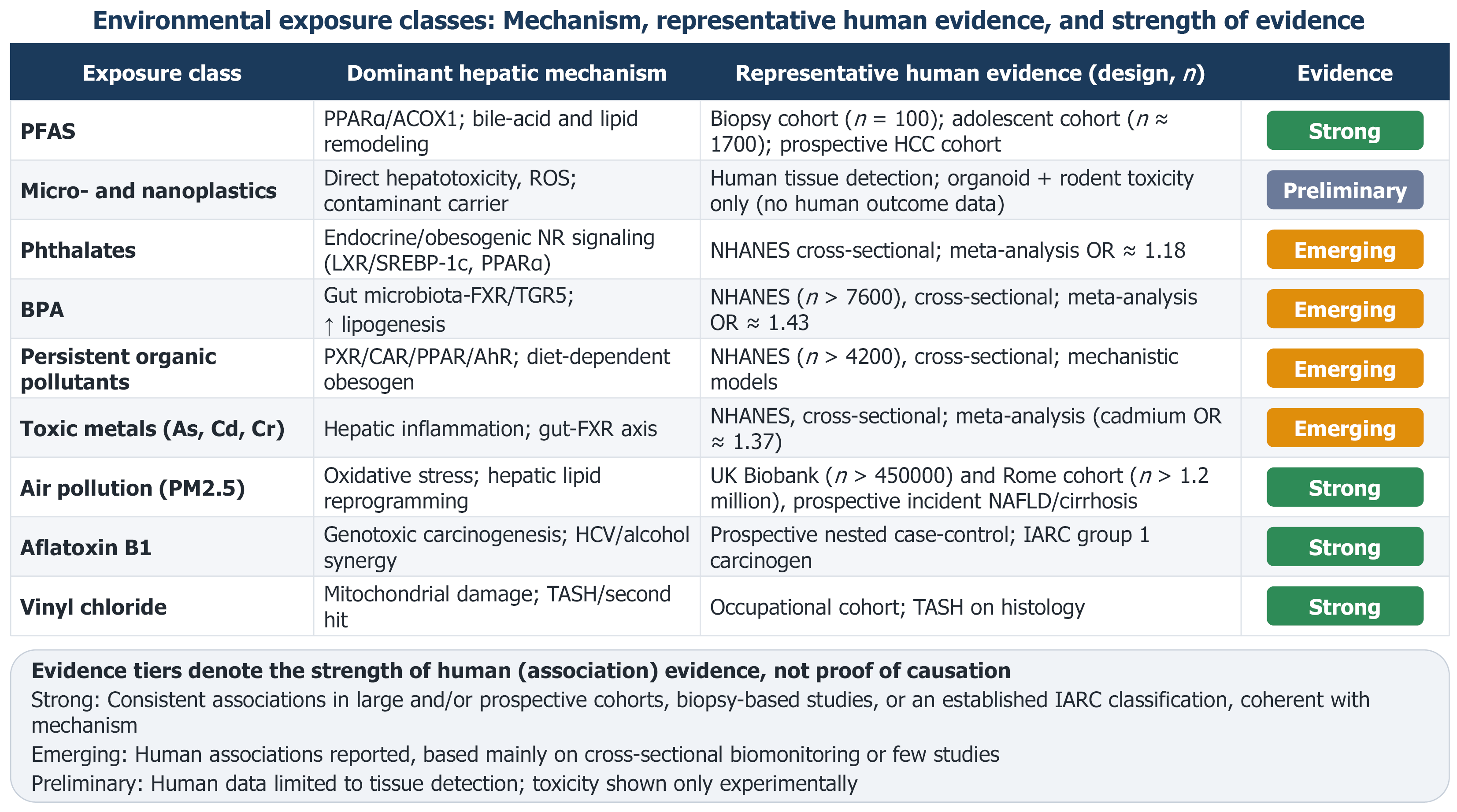
Figure 2 Environmental exposure classes mapped to dominant hepatic mechanism, representative human evidence, and current strength of evidence.
For each class, this figure lists the dominant mechanism in the liver, a representative study in humans, the study design, approximate sample size, and evidence tier. Evidence tiers describe the strength of human (association) evidence, not proof of causation, and are defined as follows: Strong, consistent associations in large and/or prospective human cohorts, biopsy-based studies, or an established carcinogen classification, consistent with experimental mechanism (per- and polyfluoroalkyl substances, air pollution, aflatoxin B1, and vinyl chloride/toxicant-associated steatohepatitis); emerging, human associations reported but based mainly on cross-sectional biomonitoring or few studies (bisphenols, phthalates, persistent organic pollutants, and toxic metals); and preliminary, human data limited to tissue detection with toxicity demonstrated only experimentally (micro- and nanoplastics). Representative studies and sizes are: Per- and polyfluoroalkyl substances, biopsy cohort (n = 100) and adolescent cohort (n ≈ 1700); air pollution, UK Biobank (n > 450000) and a Rome cohort (n > 1.2 million); bisphenols, National Health and Nutrition Examination Survey (n > 7600); persistent organic pollutants, National Health and Nutrition Examination Survey (n > 4200); aflatoxin B1, prospective nested case-control and International Agency for Research on Cancer group 1 classification; and micro- and nanoplastics, human tissue detection with organoid and rodent toxicity only. PFAS: Per- and polyfluoroalkyl substances; PM2.5: Particulate matter < 2.5 μm; BPA: Bisphenol A; FXR: Farnesoid X receptor; TGR5: Takeda G protein-coupled receptor 5; HCV: Hepatitis C virus. NR: Nuclear receptor; HCC: Hepatocellular carcinoma; NHANES: National Health and Nutrition Examination Survey; OR: Odds ratio; IARC: International Agency for Research on Cancer; TASH: Toxicant-associated steatohepatitis; As: Arsenic; Cd: Cadmium; Cr: Chromium; PPARα: Peroxisome proliferator-activated receptor alpha; ACOX1: Acyl-CoA oxidase 1; ROS: Reactive oxygen species; LXR: Liver X receptor; SREBP-1c: Sterol regulatory element-binding protein 1c.
- Citation: Salman A, Elewa A, Marwan A, Salman MA. Hepatic exposome as an emerging contributor to metabolic dysfunction-associated steatotic liver disease. World J Transl Med 2026; 12(3): 124965
- URL: https://www.wjgnet.com/2220-6132/full/v12/i3/124965.htm
- DOI: https://dx.doi.org/10.5528/wjtm.124965