
















Copyright: ©Author(s) 2026.
World J Crit Care Med. Sep 9, 2026; 15(3): 120314
Published online Sep 9, 2026. doi: 10.5492/wjccm.120314
Published online Sep 9, 2026. doi: 10.5492/wjccm.120314
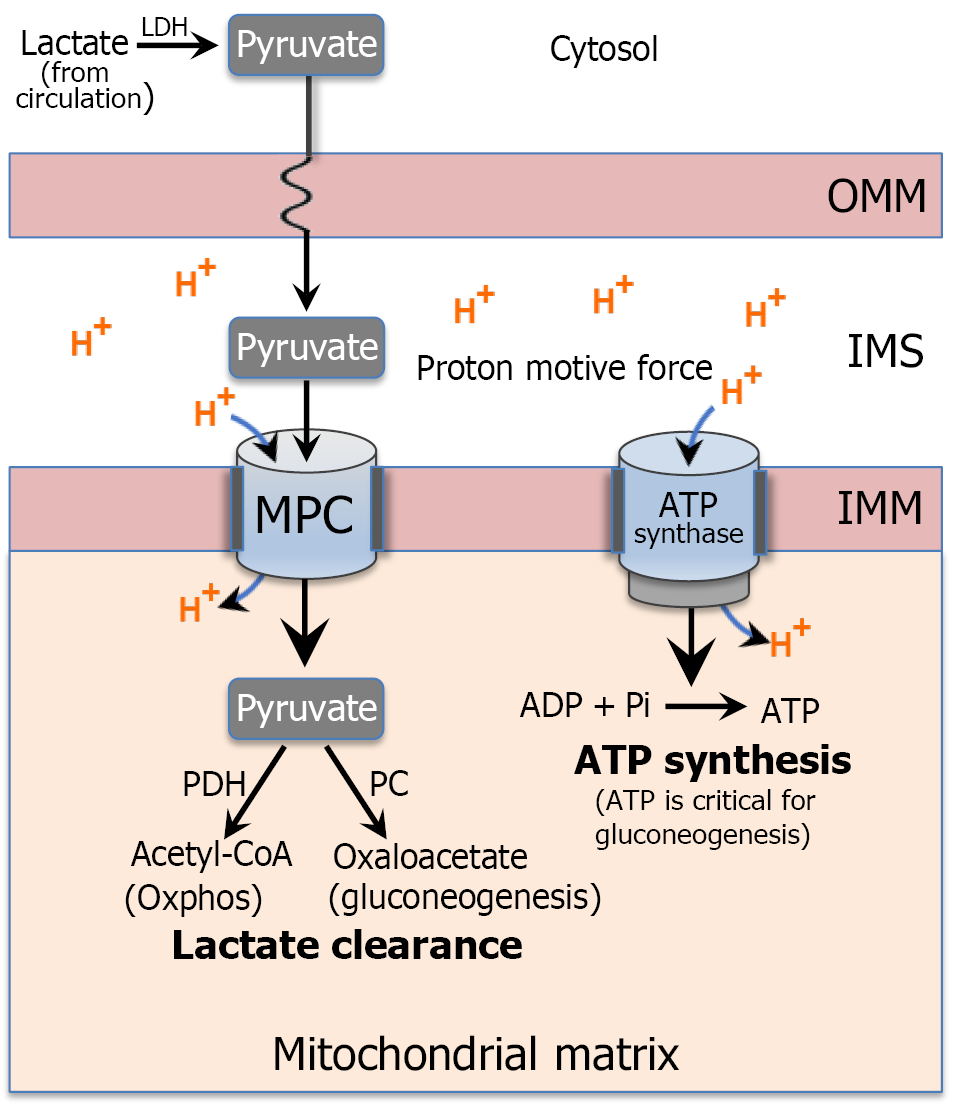
Figure 5 Hepatic lactate clearance depends on the proton motive force: Hepatic clearance of serum lactate requires its reduction to pyruvate within hepatocytes, followed by either conversion of pyruvate to glucose through gluconeogenesis (the Cori cycle) or oxidation of pyruvate after its transport into mitochondria.
Gluconeogenesis depends on an intact proton motive force (PMF) because pyruvate must be transported into the mitochondrial matrix by the mitochondrial pyruvate carrier (mitochondrial phase of gluconeogenesis), a process driven directly by the PMF. Dissipation of the PMF impairs this transport step, blocking both pyruvate oxidation and the mitochondrial phase of gluconeogenesis. PMF loss also reduces ATP synthesis by ATP synthase, limiting the ATP required for several energy dependent reactions in the gluconeogenesis pathway. Each glucose molecule produced requires 2 lactate molecules and consumes 6 ATP equivalents, linking gluconeogenesis tightly to mitochondrial bioenergetics. Therefore, hepatic lactate clearance is fundamentally dependent on the integrity of the proton motive force, and its dissipation can lead to impaired lactate metabolism (clearance) and subsequent hyperlactatemia. LDH: Lactate dehydrogenase; OMM: Outer mitochondrial membrane; IMS: Mitochondrial intermembrane space; MPC: Pyruvate carrier; IMM: Inner mitochondrial membrane; PD: Pyruvate dehydrogenase; PC: Pyruvate carboxylase.
- Citation: Pravda J. Dissipation of the mitochondrial proton motive force drives sepsis pathogenesis and explains hyperlactatemia’s predictive value in sepsis mortality. World J Crit Care Med 2026; 15(3): 120314
- URL: https://www.wjgnet.com/2220-3141/full/v15/i3/120314.htm
- DOI: https://dx.doi.org/10.5492/wjccm.120314