
















©The Author(s) 2025.
World J Crit Care Med. Dec 9, 2025; 14(4): 108638
Published online Dec 9, 2025. doi: 10.5492/wjccm.v14.i4.108638
Published online Dec 9, 2025. doi: 10.5492/wjccm.v14.i4.108638
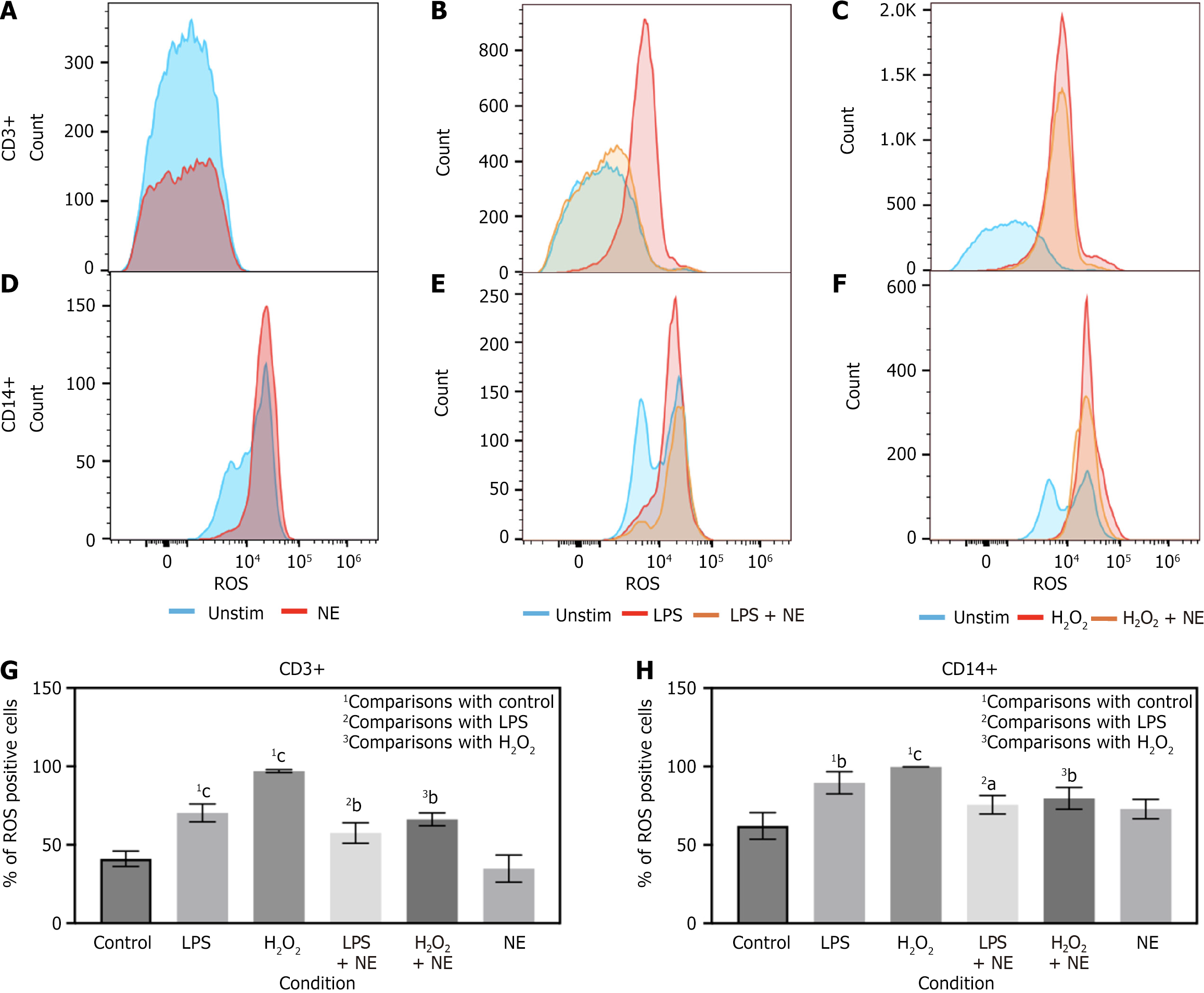
Figure 3 Norepinephrine reduces Reactive oxygen species levels in patients stimulated with lipopolysaccharide and hydrogen peroxide in CD3+ and CD14+ cells.
A–F: Representative histograms of reactive oxygen species (ROS) fluorescence intensity in CD3+ and CD14+ peripheral blood mononuclear cells from control patients following in vitro stimulation with lipopolysaccharide (100 ng/mL) or hydrogen peroxide (10 μmol/L), with or without co-treatment with norepinephrine (5 mmol/L); G and H: Quantification of ROS levels (mean ± SD) in CD3+ and CD14+ cells from 7 independent control donors. All experimental conditions were performed in biological duplicate. Statistical analysis: Two-way analysis of variance with Bonferroni post hoc correction. aP < 0.05, bP < 0.01, cP < 0.001. H2O2: Hydrogen peroxide; LPS: Lipopolysaccharide; NE: Norepinephrine; ROS: Reactive oxygen species.
- Citation: Thoppil J, Farrar JD, Sharma D, Kirby S, Mobley A, Courtney DM. Reactive oxygen species elevations in human immune cell subsets during sepsis are mitigated by norepinephrine and N-acetylcysteine. World J Crit Care Med 2025; 14(4): 108638
- URL: https://www.wjgnet.com/2220-3141/full/v14/i4/108638.htm
- DOI: https://dx.doi.org/10.5492/wjccm.v14.i4.108638