
















Copyright: ©Author(s) 2026.
World J Clin Pediatr. Jun 9, 2026; 15(2): 116726
Published online Jun 9, 2026. doi: 10.5409/wjcp.v15.i2.116726
Published online Jun 9, 2026. doi: 10.5409/wjcp.v15.i2.116726
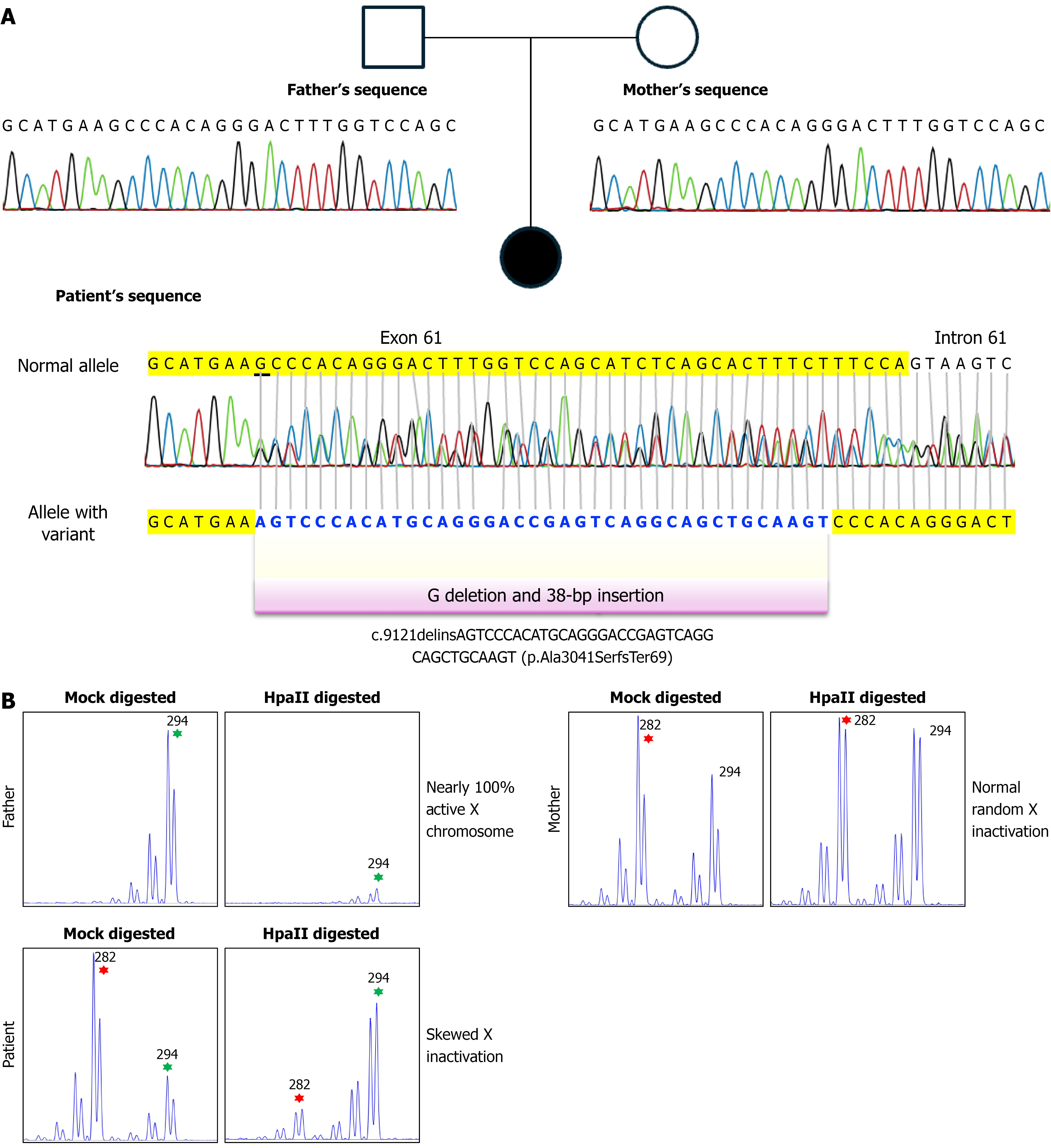
Figure 2 Molecular characterization of Case 2 Sanger sequencing confirmation of the dystrophin gene variant and X-chromosome inactivation analysis demonstrating extreme skewing.
A: Sanger sequencing of dystrophin gene exon 61. The patient’s sequence (bottom) compared with the reference sequence (top) reveals a complex deletion-insertion (delins) variant, c.9121delinsAGTCCCACATGCAGGGACCGAGTCAGGCAGCTGCAAGT. This variant involves deletion of a single guanine nucleotide at position c.9121 with concomitant insertion of a 38-bp fragment (blue sequence). The resulting frameshift is predicted to generate a premature termination codon, p.Ala3041Serfs*69. Parental testing confirmed de novo occurrence; B: X-chromosome inactivation (XCI) analysis using the androgen receptor (AR) gene methylation assay. Capillary electrophoresis profiles show HpaII-digested (methylation-sensitive; right panels) and mock-digested (left panels) DNA samples from family members. Father: Single allele (294 bp) with nearly 100% active X chromosome, as expected for a male. Mother: Balanced representation of both alleles (282 bp and 294 bp) in HpaII-digested samples, indicating normal random X-inactivation. Patient: Extremely skewed XCI (92.53%), with preferential inactivation of the paternal X chromosome. This is evidenced by predominant amplification of the 294-bp paternal allele (green star) and minimal amplification of the 282-bp maternal allele (red star) in HpaII-digested samples. The AR gene methylation assay exploits the polymorphic CAG repeat in exon 1 of the androgen receptor gene. HpaII cleaves unmethylated CpG sites on the active X chromosome, leaving methylated (inactive X) DNA intact for PCR amplification.
- Citation: Pongsakornkullachart P, Chanvanichtrakool M, Dhachpramuk D, Pho-Iam T, Yongwattana N, Kulsirichawaroj P, Tanboon J, Sanmaneechai O. Duchenne muscular dystrophy coexisting with Down syndrome or Turner syndrome: Two case reports. World J Clin Pediatr 2026; 15(2): 116726
- URL: https://www.wjgnet.com/2219-2808/full/v15/i2/116726.htm
- DOI: https://dx.doi.org/10.5409/wjcp.v15.i2.116726