















©The Author(s) 2025.
World J Clin Pediatr. Dec 9, 2025; 14(4): 111641
Published online Dec 9, 2025. doi: 10.5409/wjcp.v14.i4.111641
Published online Dec 9, 2025. doi: 10.5409/wjcp.v14.i4.111641
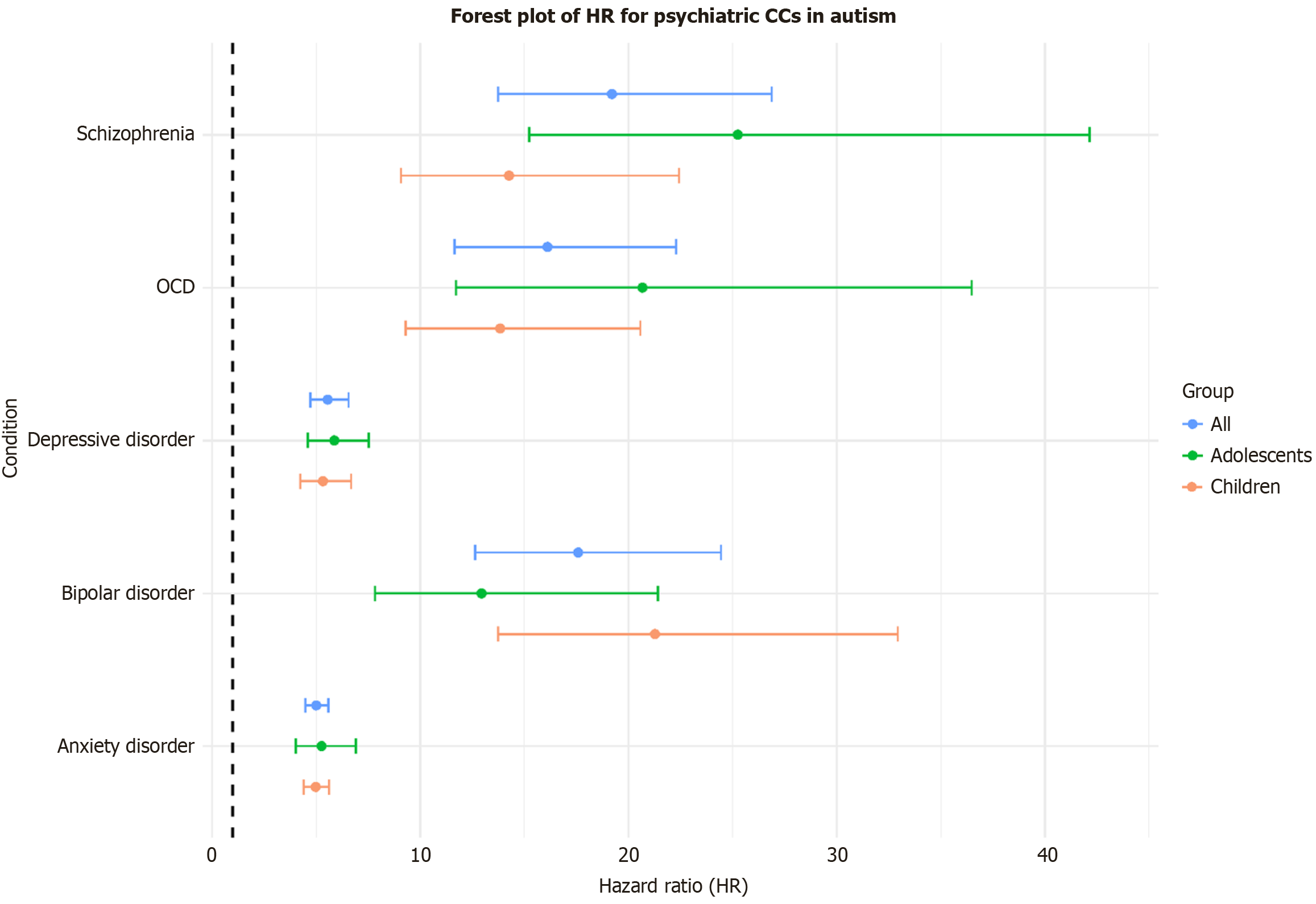
Figure 3 Forest plot of hazard ratios and 95%CIs for the risk of developing subsequent psychiatric co-occurring conditions in autism compared to neurotypical controls.
The plot includes estimates for children, adolescents, and the overall autism population across five psychiatric conditions: Anxiety disorder, obsessive-compulsive disorder, schizophrenia, bipolar disorder, and depressive disorder. Hazard ratios (HRs) greater than 1 indicate an increased risk of developing the disorder in the autism group compared to neurotypical controls. The dotted vertical line represents an HR of 1, indicating no difference in risk between autism and neurotypical controls. All results are statistically significant with a P < 0.05, indicating that the increased risks observed are unlikely due to chance. Error bars reflect the variability in the estimates, with wider intervals indicating greater uncertainty. CCs: Co-occurring condition; HR: Hazard ratio; OCD: Obsessive compulsive disorder.
- Citation: Hasan H, Hagerman R, Say DS, Nguyen AP, Babata K, Oyegbile-Chidi T, Herrera-Guerra A, Torrents C, Silver CE, Restrepo B. Parallel paths: A narrative review exploring autism and its co-occurring conditions. World J Clin Pediatr 2025; 14(4): 111641
- URL: https://www.wjgnet.com/2219-2808/full/v14/i4/111641.htm
- DOI: https://dx.doi.org/10.5409/wjcp.v14.i4.111641