
















Copyright: ©Author(s) 2026.
World J Orthop. Jun 18, 2026; 17(6): 119119
Published online Jun 18, 2026. doi: 10.5312/wjo.v17.i6.119119
Published online Jun 18, 2026. doi: 10.5312/wjo.v17.i6.119119
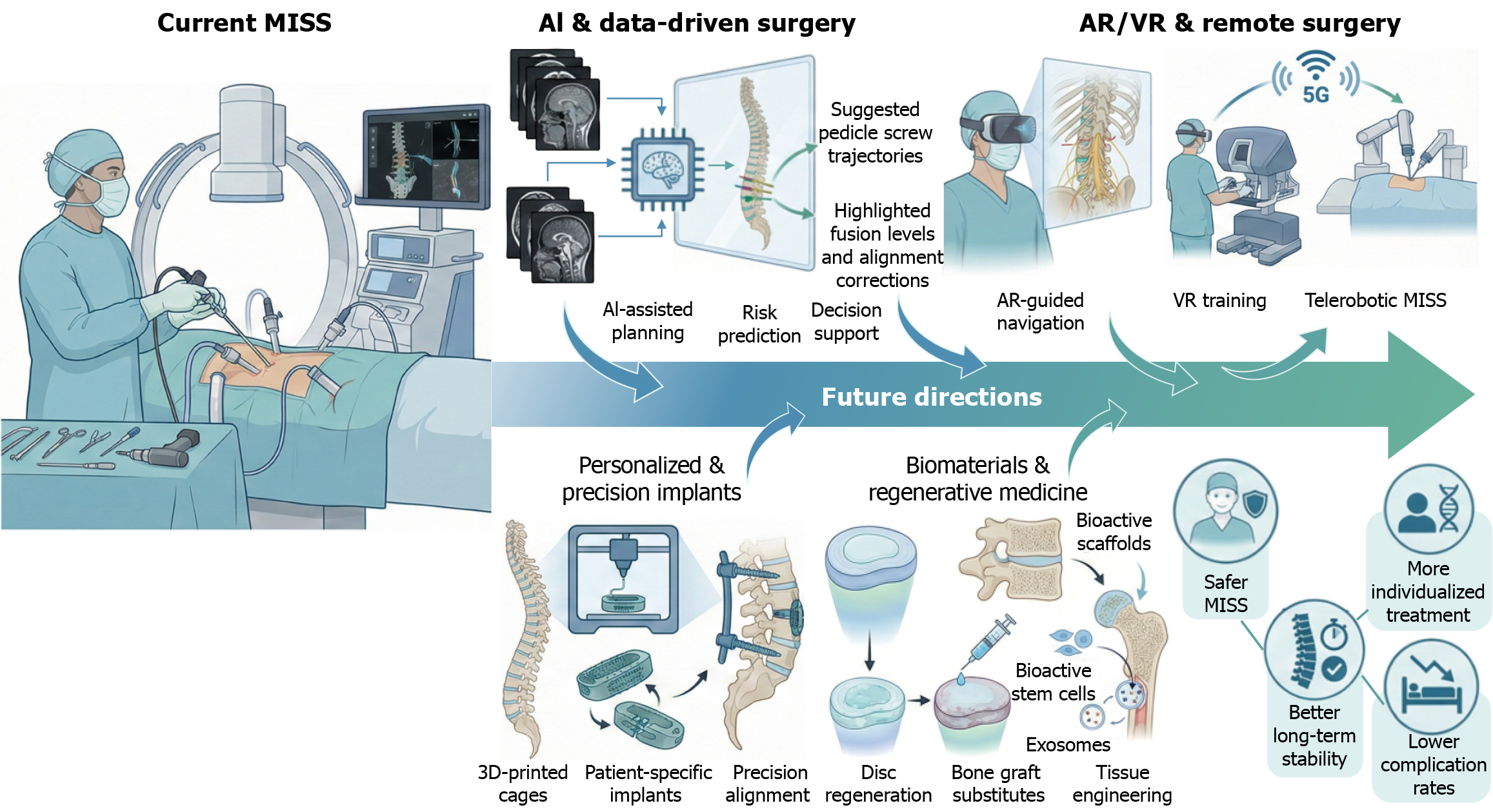
Figure 3 From current minimally invasive spine surgery to future intelligent, regenerative, and personalized minimally invasive spine surgery platforms.
The left panel depicts a representative current minimally invasive spine (MISS) surgery procedure using endoscopic visualization and fluoroscopy-based navigation. From this baseline, a forward arrow illustrates key future directions. In the upper middle, artificial intelligence- and data-driven surgery integrates multimodal preoperative and intraoperative imaging into machine-learning algorithms to assist surgical planning, predict risk, and provide decision support, including suggested pedicle screw trajectories and optimized fusion levels or alignment corrections. On the upper right, augmented/virtual-reality and remote surgery enable augmented reality-guided navigation, immersive virtual-reality training, and telerobotic MISS via high-speed 5G communication. The lower middle highlights personalized and precision implants, such as three-dimensional-printed cages, patient-specific implants, and instrumentation designed for individualized spinal alignment and segmental stability. The lower right illustrates biomaterials and regenerative medicine approaches, including disc regeneration, bone graft substitutes, bioactive scaffolds, stem cell- and exosome-based therapies, and tissue-engineering strategies. Together, these innovations aim to deliver safer MISS with more individualized treatment, better long-term biomechanical stability, and lower complication rates. MISS: Minimally invasive spine; AI: Artificial intelligence; AR/VR: Augmented/virtual-reality.
- Citation: Li D, Tang XD, Li ZP, Fu WP, Lu PY, Shi Z, Zhang Q, Fang S, Lv BK, Ruan WJ, Zhang CJ, Wang RB. Minimally invasive spine surgery with endoscopy, navigation, robotics, and artificial intelligence: Clinical evidence and future directions. World J Orthop 2026; 17(6): 119119
- URL: https://www.wjgnet.com/2218-5836/full/v17/i6/119119.htm
- DOI: https://dx.doi.org/10.5312/wjo.v17.i6.119119