
















Copyright: ©Author(s) 2026.
World J Orthop. Jun 18, 2026; 17(6): 119119
Published online Jun 18, 2026. doi: 10.5312/wjo.v17.i6.119119
Published online Jun 18, 2026. doi: 10.5312/wjo.v17.i6.119119
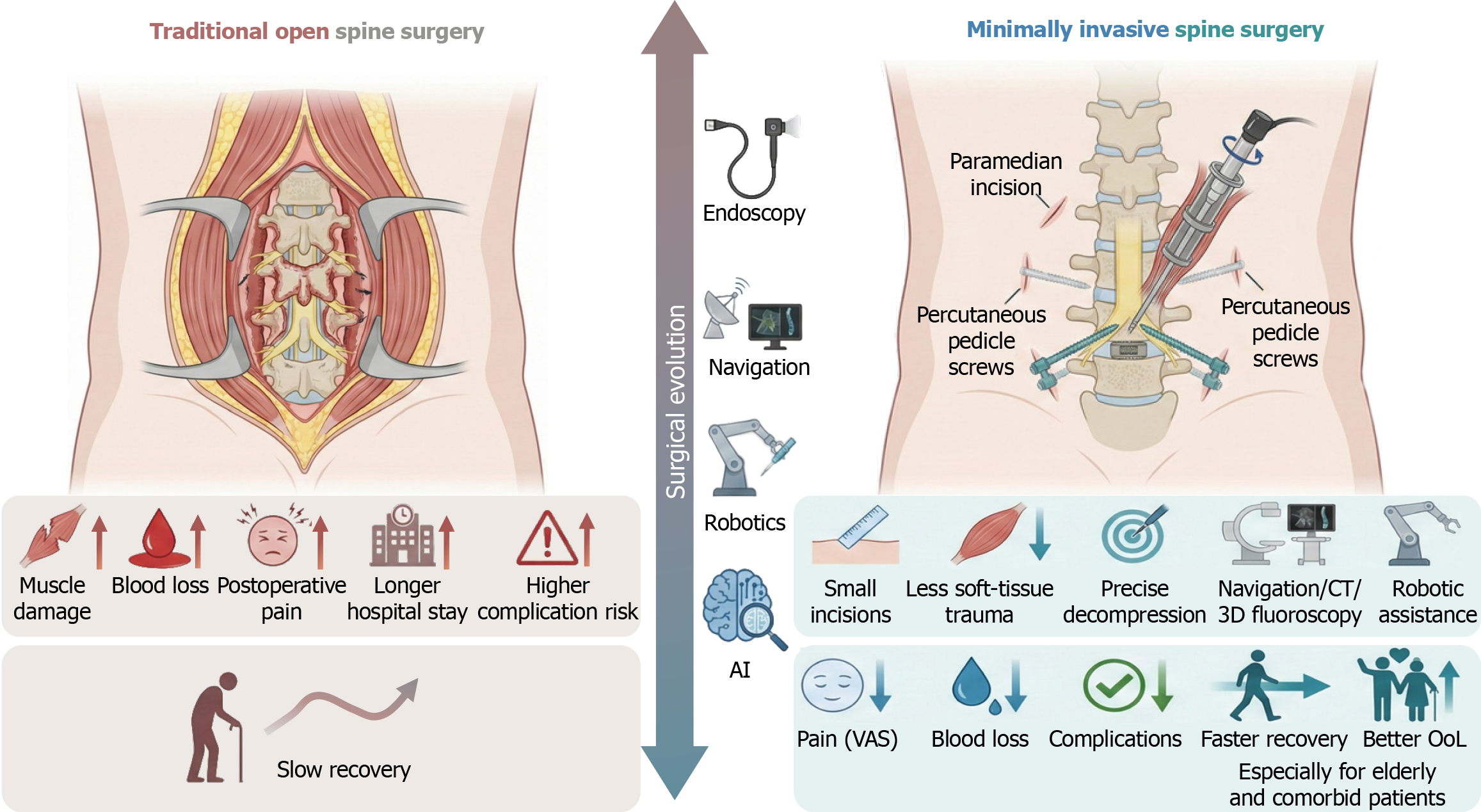
Figure 2 Comparison between traditional open spine surgery and minimally invasive spine surgery.
The left panel illustrates a traditional open posterior lumbar approach with a long midline incision, extensive paraspinal muscle stripping, and wide laminectomy exposure. These features are associated with increased muscle damage, higher intraoperative blood loss, more severe postoperative pain, longer hospital stay, and a higher risk of complications, leading to slow functional recovery, especially in elderly patients. The right panel depicts a minimally invasive spine surgery approach using a paramedian skin incision, tubular retractors, and percutaneous pedicle screw, assisted by endoscopy, image-guided navigation, intraoperative computed tomography/three-dimensional fluoroscopy, robotics, and artificial intelligence-based planning. Compared with open surgery, minimally invasive spine surgery enables small incisions, less soft-tissue trauma, and precise decompression, resulting in reduced pain (visual analogue scale), decreased blood loss and complication rates, faster postoperative mobilization, and improved quality of life, particularly for elderly and comorbid patients. CT: Computed tomography; AI: Artificial intelligence; VAS: Visual analogue scale; QoL: Quality of life.
- Citation: Li D, Tang XD, Li ZP, Fu WP, Lu PY, Shi Z, Zhang Q, Fang S, Lv BK, Ruan WJ, Zhang CJ, Wang RB. Minimally invasive spine surgery with endoscopy, navigation, robotics, and artificial intelligence: Clinical evidence and future directions. World J Orthop 2026; 17(6): 119119
- URL: https://www.wjgnet.com/2218-5836/full/v17/i6/119119.htm
- DOI: https://dx.doi.org/10.5312/wjo.v17.i6.119119