
















Copyright: ©Author(s) 2026.
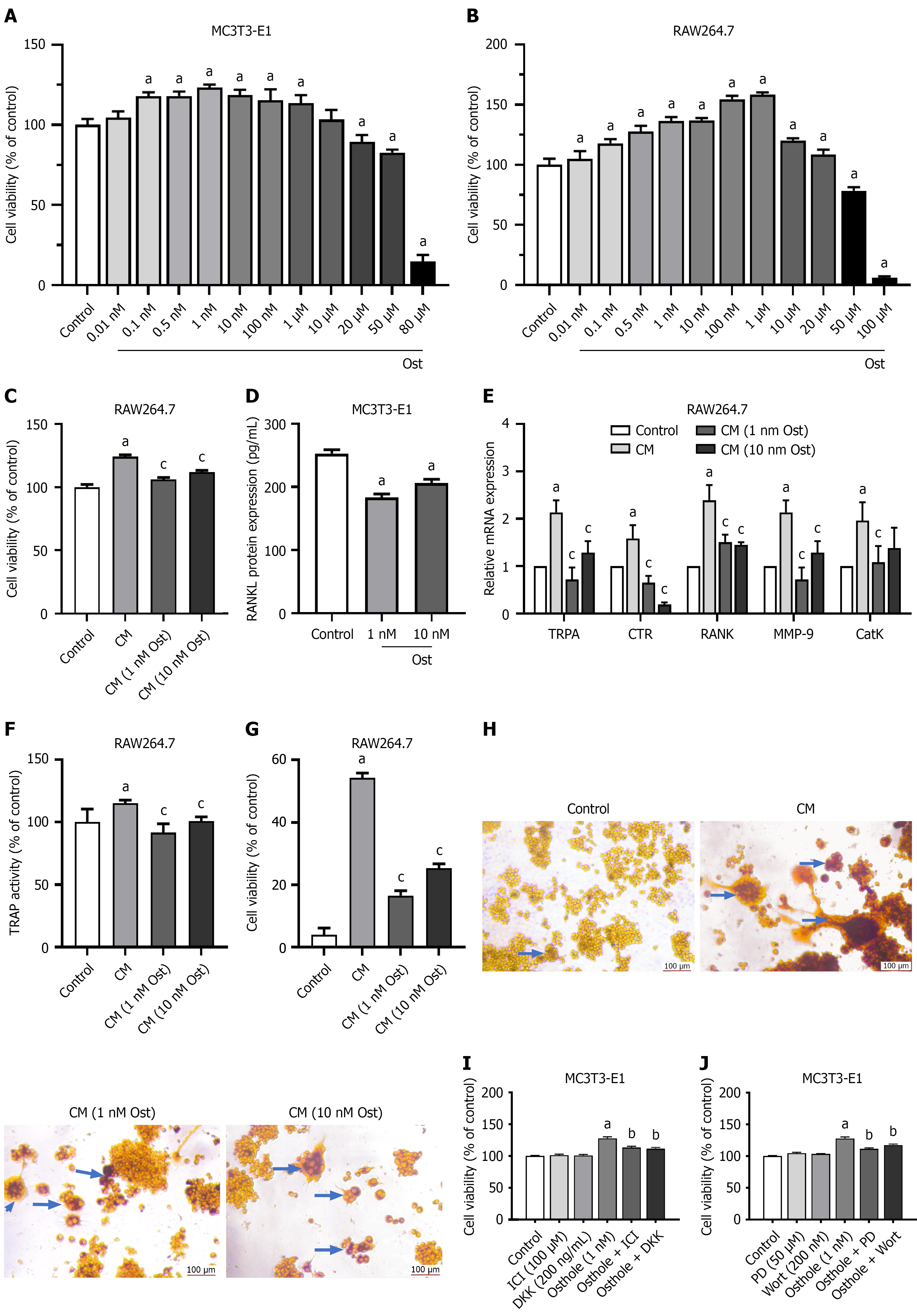
Figure 5 Effects of osthole at different concentrations on MC3T3-E1 cell viability, and impacts of conditioned medium from osthole-treated MC3T3-E1 cells on RAW264.
7 cell functions and osteoclast-related indicators.aP < 0.05 vs control; bP < 0.05 vs osthole alone; cP < 0.05 vs blank conditioned medium (CM) (one-way analysis of variance with Tukey‘s post-hoc test). Data are mean ± SD from three independent experiments (n = 3). A: Cell viability of MC3T3-E1 cells treated with various concentrations of osthole (Ost) (0.01 nM, 0.1 nM, 1 nM, 10 nM, 100 nM, 1 μM, 10 μM, 25 μM, 50 μM), assessed via a cell viability assay; results are presented as a percentage relative to the control group; B: Cell viability of RAW264.7 cells treated with various concentrations of Ost (0.01 nM to 50 μM), determined using a cell viability assay; results are presented as a percentage relative to the control group; C: Cell viability of RAW264.7 cells cultured in control medium, blank CM from untreated MC3T3-E1 cells, CM from MC3T3-E1 cells treated with 1 nM Ost [CM (1 nM Ost)], or CM from MC3T3-E1 cells treated with 10 nM Ost [CM (10 nM Ost)], measured via a cell viability assay; results are presented as a percentage relative to the control group; D: RANKL protein expression in MC3T3-E1 cells treated with 1 nM or 10 nM Ost, quantified by the corresponding detection method; data are expressed in pg/mL; E: Relative mRNA expression levels of osteoclast-specific genes (TRAP, CTR, RANK, MMP-9, CatK) in RAW264.7 cells cultured in the aforementioned CMs, analyzed by reverse transcription-quantitative polymerase chain reaction; expression levels were normalized to an appropriate housekeeping gene; F: Tartrate-resistant acid phosphatase (TRAP) activity of RAW264.7 cells cultured in different CMs, measured using a TRAP activity assay; results are presented as a percentage relative to the control group; G: Osteoclast viability per field of RAW264.7 cells cultured in different CMs, counted under a light microscope following TRAP staining; H: TRAP staining of RAW264.7 cells subjected to different treatments [control, CM, CM (1n M Ost), CM (10 nM Ost)]; blue arrows indicate TRAP-positive cells. Original magnification: × 100; scale bar = 100 μm; I and J: MC3T3-E1 cells were pretreated with 100 μM estrogen receptor inhibitor fulvestrant 182780, 50 μM PD98059, 200 nM wortmannin, 200 ng/mL dickkopf-1, or vehicle dimethyl sulfoxide in medium containing 1% fetal bovine serum for 30 minutes, followed by treatment with 1 nM Ost for 2 days. Cell proliferation was detected by 3-(4,5-dimethylthiazol-2-yl)-2,5-diphenyltetrazolium bromide assay. Ost: Osthole; CM: Conditioned medium; RANKL: Receptor activator of nuclear factor-κB ligand; ICI: Fulvestrant; DKK: Dickkopf.
- Citation: Zhu TY, Yuan M, Wen XC, Tian CC, Han YH, Zheng C, Wu YT, Xia Q, Wang Y. Osthole exerts osteoprotective effect by activating ER, PI3K/AKT, MEK/ERK, and Wnt/β-catenin signaling pathways. World J Orthop 2026; 17(10): 121526
- URL: https://www.wjgnet.com/2218-5836/full/v17/i10/121526.htm
- DOI: https://dx.doi.org/10.5312/wjo.121526