
















©The Author(s) 2025.
World J Orthop. Dec 18, 2025; 16(12): 110510
Published online Dec 18, 2025. doi: 10.5312/wjo.v16.i12.110510
Published online Dec 18, 2025. doi: 10.5312/wjo.v16.i12.110510
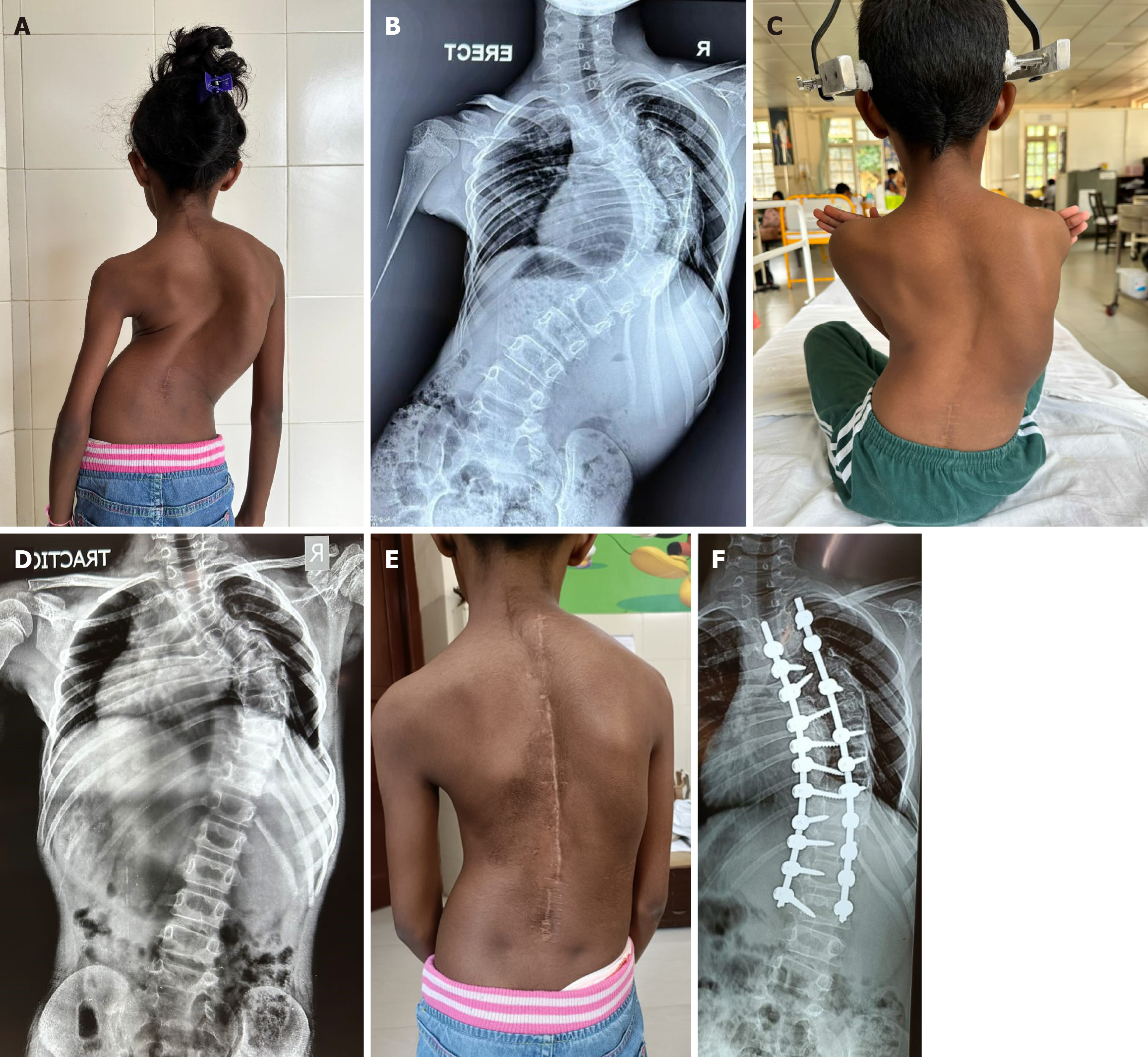
Figure 3 An eleven-year-old girl, previously operated case of spinal cord malformation type 2, was operated on for severe thoraco-lumbar scoliosis with halo gravity traction followed by posterior instrumented fusion.
No spinal osteotomies were done in this patient. A: Pre-operative clinical picture with a decompensated scoliosis; B: Preoperative radiographic image, with a Cobb angle of 96°; C: Patient with halo traction in the ward demonstrating improvement in the scoliosis; D: Radiograph taken immediately before posterior instrumented fusion, Cobb angle has improved to 61°; E: Post-operative clinical picture showing a balanced spine without spinal osteotomies; F: Radiographic image, one year after surgery, with Cobb angle of 31°.
- Citation: Jain MA, Dhawale A, Iqbal MZ, Naseem A, Sagade B, Gorain A, Nene A. Halo gravity traction for pediatric scoliosis and kyphoscoliosis: A review of current evidence and best practices. World J Orthop 2025; 16(12): 110510
- URL: https://www.wjgnet.com/2218-5836/full/v16/i12/110510.htm
- DOI: https://dx.doi.org/10.5312/wjo.v16.i12.110510