
















Copyright: ©Author(s) 2026.
World J Gastrointest Pharmacol Ther. Jun 5, 2026; 17(2): 118130
Published online Jun 5, 2026. doi: 10.4292/wjgpt.v17.i2.118130
Published online Jun 5, 2026. doi: 10.4292/wjgpt.v17.i2.118130
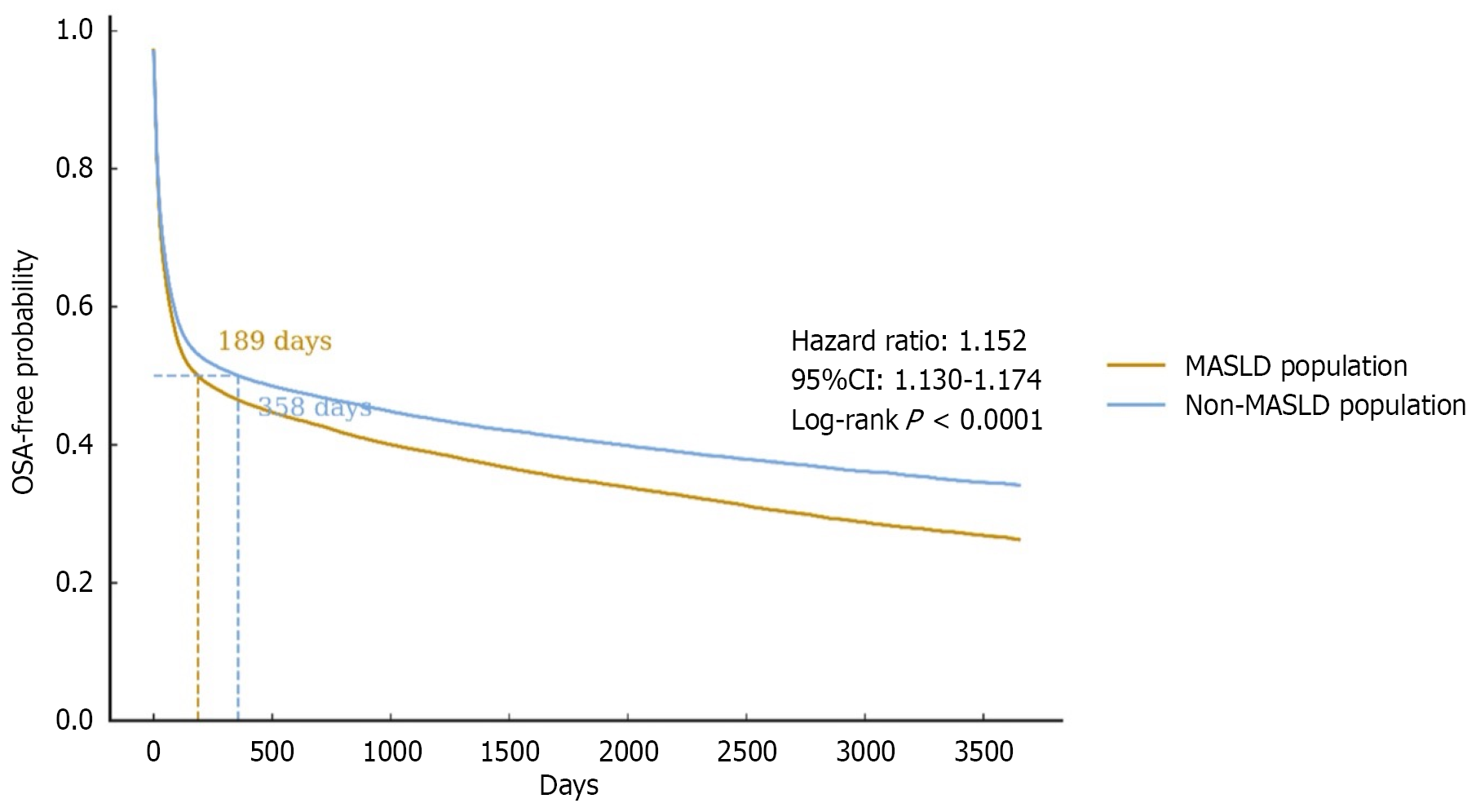
Figure 2 Kaplan-Meier curves comparing obstructive sleep apnea-free probability between metabolic dysfunction–associated steatotic liver disease and non-metabolic dysfunction-associated steatotic liver disease populations.
Kaplan–Meier survival curves demonstrating obstructive sleep apnea (OSA)-free probability over time among patients with metabolic dysfunction-associated steatotic liver disease (MASLD) compared with a propensity-matched cohort without MASLD. Vertical dashed lines indicate key timepoints at which OSA-free probabilities diverge: 189 days for the MASLD cohort and 358 days for the non-MASLD cohort. The non-MASLD cohort showed consistently higher OSA-free probability across the follow-up period. The hazard ratio for the comparison was 1.152 (95%CI: 1.130-1.174) with a log-rank P < 0.0001, indicating a statistically significant difference between groups. OSA: Obstructive sleep apnea; MASLD: Metabolic dysfunction-associated steatotic liver disease.
- Citation: Chowdhary R, Song GQ, Goyal MK, Vuthaluru AR, Arora K, Chowdhary R, Patel M, Batta A, Koo TH, Sunkesula V, Goyal R, Goyal O. Metabolic dysfunction–associated steatotic liver disease and obstructive sleep apnea: A cohort analysis of prevalence and hepatic outcomes. World J Gastrointest Pharmacol Ther 2026; 17(2): 118130
- URL: https://www.wjgnet.com/2150-5349/full/v17/i2/118130.htm
- DOI: https://dx.doi.org/10.4292/wjgpt.v17.i2.118130