
















©The Author(s) 2025.
World J Radiol. Nov 28, 2025; 17(11): 114754
Published online Nov 28, 2025. doi: 10.4329/wjr.v17.i11.114754
Published online Nov 28, 2025. doi: 10.4329/wjr.v17.i11.114754
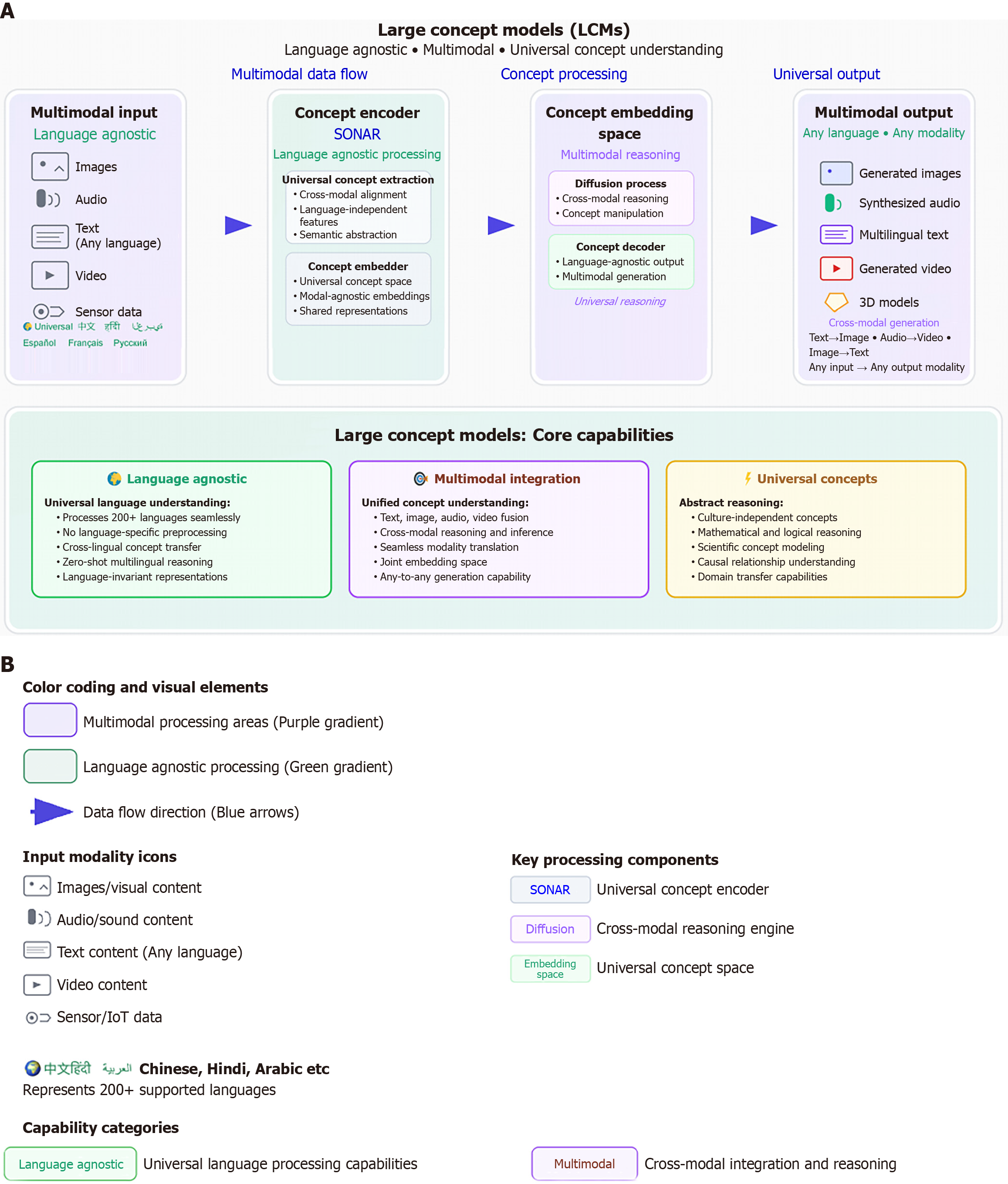
Figure 4 Large concept models.
A: Large concept models detailed architecture illustrates language-agnostic, multimodal data flow with universal concept encoding, hierarchical reasoning, and multilingual output capability. This figure details the end-to-end processing pipeline of a large concept model, contrasting it with traditional language-centric artificial intelligence. The architecture is composed of two main sections: Top (multimodal data flow): Illustrates the flow from a Language-Agnostic Multimodal Input (accepting text, images, audio, video, and sensor data) to a Concept Encoder (like SONAR) which performs universal concept extraction. This encoded concept is then processed in a Concept Embedding Space via multimodal reasoning and diffusion processes. Finally, a Concept Decoder generates a Multimodal Output in any language or modality, demonstrating a true “any-input-to-any-output” capability. Bottom (core capabilities): Summarizes the three foundational pillars that this architecture enables: (1) Language agnostic universal language understanding across hundreds of languages; (2) Multimodal integration for unified concept understanding and reasoning across diverse data types; and (3) Universal concepts, enabling high-level abstract, logical, and causal reasoning that is independent of culture or domain; B: Reveals the color coding, visual elements, input modality icons, key processing components and capability categories illustrated regarding large concept models shown in Figure 4A. LCM: Large concept model.
- Citation: Merchant SA, Merchant N, Varghese SL, Shaikh MJS. Large language models and large concept models in radiology: Present challenges, future directions, and critical perspectives. World J Radiol 2025; 17(11): 114754
- URL: https://www.wjgnet.com/1949-8470/full/v17/i11/114754.htm
- DOI: https://dx.doi.org/10.4329/wjr.v17.i11.114754