
















Copyright: ©Author(s) 2026.
World J Gastrointest Oncol. Jun 15, 2026; 18(6): 117851
Published online Jun 15, 2026. doi: 10.4251/wjgo.v18.i6.117851
Published online Jun 15, 2026. doi: 10.4251/wjgo.v18.i6.117851
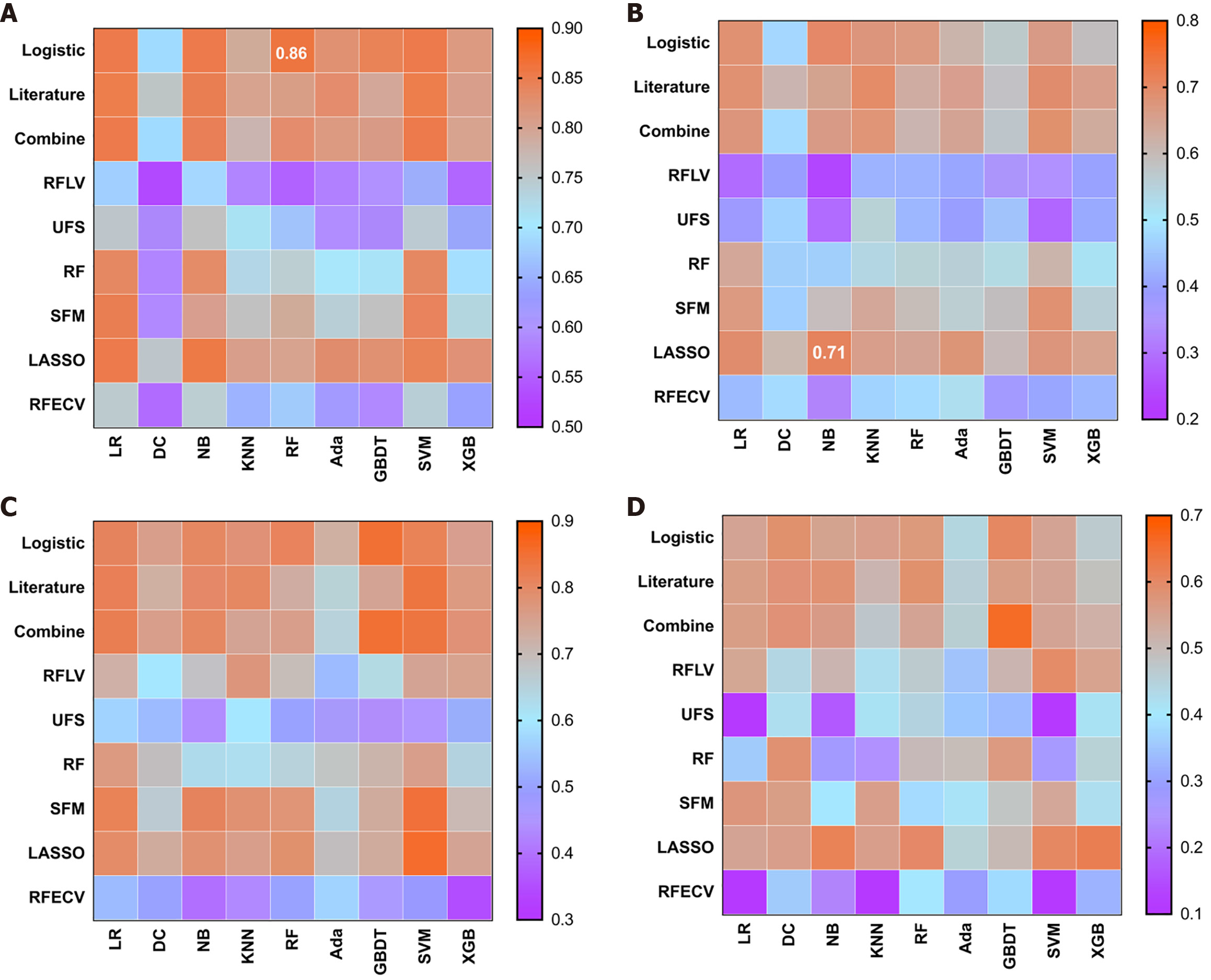
Figure 2 Performance of various models established by different feature selection strategies and machine-learning algorithms.
A and B: Area under the curve (AUC) and F1 score of the training set; C and D: AUC and F1 score of the validation cohort. Heatmap of the AUC or F1 score of each feature selection method (rows) with each machine-learning algorithm (columns). In the heatmaps below, warmer colors (orange) indicate higher performance. Ada: Adaptive; DC: Decision tree; GBDT: Gradient boosting decision tree; KNN: K-nearest neighbors; LASSO: Least absolute shrinkage and selection operator; LR: Logistic regression; NB: Naïve Bayes; RF: Random forest; RFECV: Recursive feature elimination with cross-validation; RFLV: Removing features with low variance; SFM: SelectFromModel; SVM: Support vector machine; UFS: Univariate feature selection; XGBoost: Extreme gradient boosting machine.
- Citation: Gu RT, Li X, Cheng W, Wang XW, Jin H, Liu T. Machine-learning models integrating preoperative clinical factors and circulating tumor DNA features predict lymph node metastasis in esophageal carcinoma. World J Gastrointest Oncol 2026; 18(6): 117851
- URL: https://www.wjgnet.com/1948-5204/full/v18/i6/117851.htm
- DOI: https://dx.doi.org/10.4251/wjgo.v18.i6.117851