
















Copyright: ©Author(s) 2026.
World J Gastrointest Oncol. Apr 15, 2026; 18(4): 116104
Published online Apr 15, 2026. doi: 10.4251/wjgo.v18.i4.116104
Published online Apr 15, 2026. doi: 10.4251/wjgo.v18.i4.116104
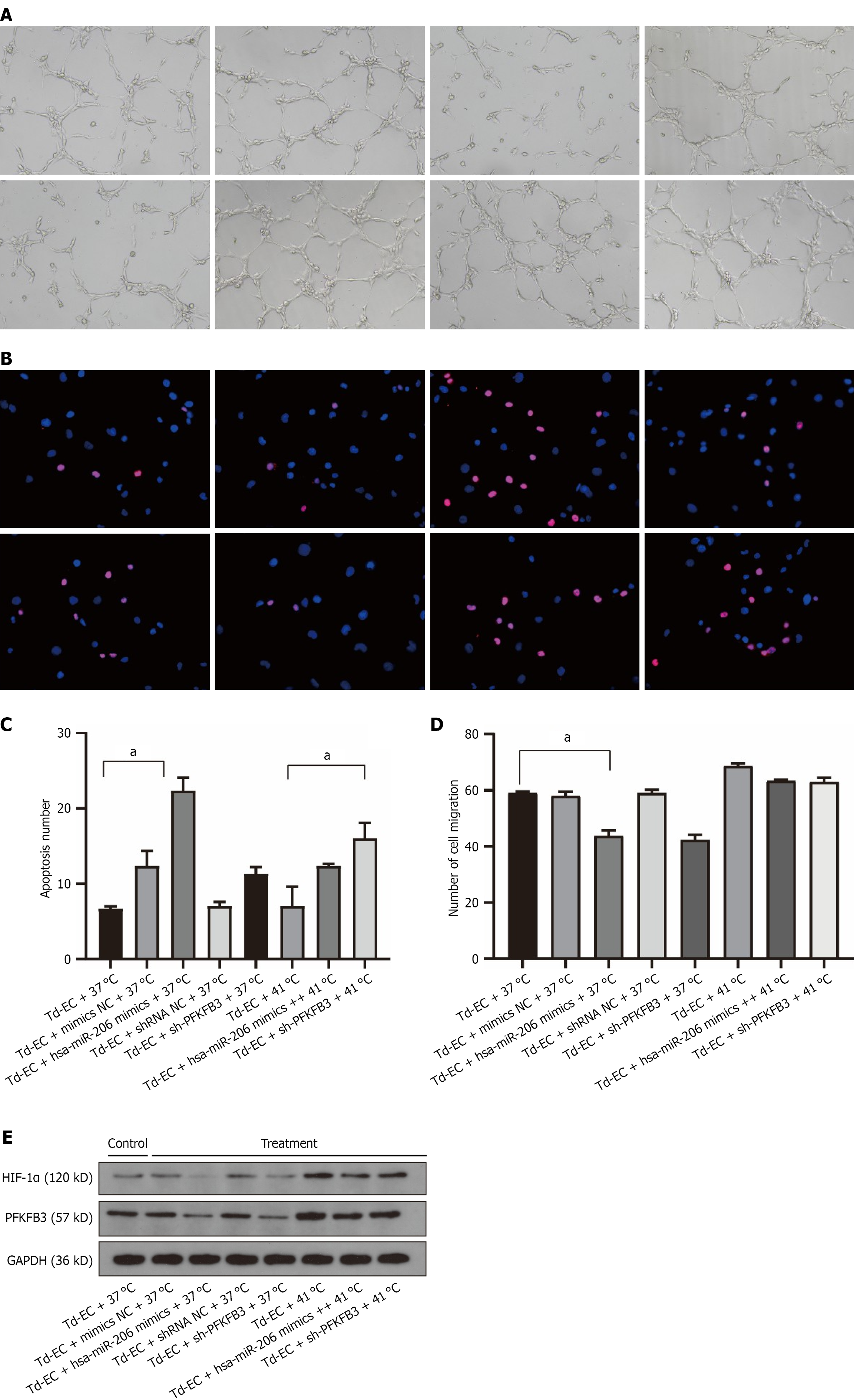
Figure 4 Effects of microRNA-206 overexpression and 6-phosphofructo-2-kinase/fructose-2,6-bisphosphatase 3 knockdown on endothelial function and glycolysis under thermal stimulation.
A: Tube-formation assay under 37 °C and 41 °C in control, mimic NC, microRNA-206 (miR-206) mimics, shRNA NC, and sh-6-phosphofructo-2-kinase/fructose-2,6-bisphosphatase 3 (PFKFB3) groups (n = 3); B and C: TUNEL apoptosis staining and quantification under the same conditions (n = 3); D: Transwell migration assay results comparing miR-206 and sh-PFKFB3 effects (n = 3); E: Western blot analysis of hypoxia-inducible factor-1α, PFKFB3, and GAPDH under all conditions (n = 3). Data represent mean ± SD; one-way ANOVA was used. aP < 0.05. Td-EC: Tumor-derived endothelial cells; HIF-1α: Hypoxia-inducible factor-1α; PFKFB3: 6-phosphofructo-2-kinase/fructose-2,6-bisphosphatase 3.
- Citation: Lu D, Wang LJ, Chai J, Jiang J, Tang YL. MicroRNA-206 suppresses hypoxia-inducible factor-1α/PFKFB3-mediated glycolysis to inhibit recurrence and metastasis of hepatocellular carcinoma after incomplete radiofrequency ablation. World J Gastrointest Oncol 2026; 18(4): 116104
- URL: https://www.wjgnet.com/1948-5204/full/v18/i4/116104.htm
- DOI: https://dx.doi.org/10.4251/wjgo.v18.i4.116104