
















Copyright: ©Author(s) 2026.
World J Gastrointest Oncol. Mar 15, 2026; 18(3): 115905
Published online Mar 15, 2026. doi: 10.4251/wjgo.v18.i3.115905
Published online Mar 15, 2026. doi: 10.4251/wjgo.v18.i3.115905
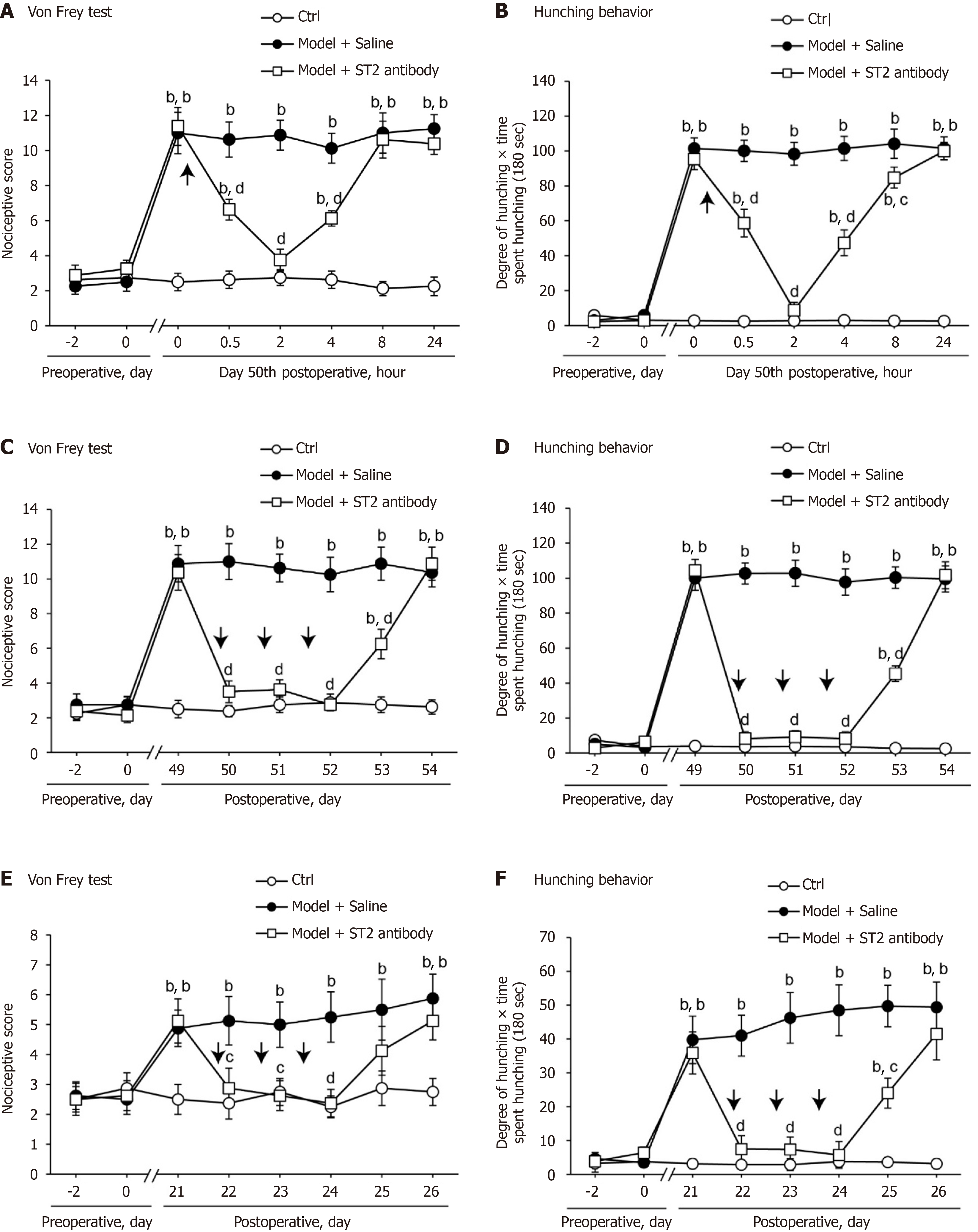
Figure 2 The intrathecal administration of an interleukin-33/suppression of tumorigenicity 2 signaling blocking agent suppressed gallbladder carcinoma-induced chronic pain in nude mice.
A and B: A single dose of an anti-suppression of tumorigenicity 2 (anti-ST2) antibody (300 ng) administered 50 days after the operation significantly inhibited the established hypersensitivity of the abdomen to mechanical stimulation and spontaneous visceral pain-related behavior; C and D: Repetitive administration of the anti-ST2 antibody (300 ng, daily for three consecutive days) at postoperative days 50, 51, and 52 abrogated the established hypersensitivity of the abdomen to mechanical stimulation and spontaneous visceral pain-related behavior; E and F: Repetitive administration of the anti-ST2 antibody (300 ng, daily for three consecutive days) at 22, 23 and 24 days after the operation abrogated the hypersensitivity of the abdomen to mechanical stimulation and spontaneous visceral pain-related behavior. Twelve mice were included in each of the groups. Drug administration is indicated by the arrow(s) on the corresponding day. Two-way ANOVA. bP < 0.01 vs control, cP < 0.05 vs control, and dP < 0.01 vs model + saline. ST2: Suppression of tumorigenicity 2.
- Citation: Ge XX, Dong XM, Yang Y, Zhang W, Zhou W, Deng XT. Activation of interleukin-33/suppression of tumorigenicity 2 signaling contributes to gallbladder carcinoma-induced chronic pain. World J Gastrointest Oncol 2026; 18(3): 115905
- URL: https://www.wjgnet.com/1948-5204/full/v18/i3/115905.htm
- DOI: https://dx.doi.org/10.4251/wjgo.v18.i3.115905