
















©The Author(s) 2026.
World J Gastrointest Oncol. Feb 15, 2026; 18(2): 113959
Published online Feb 15, 2026. doi: 10.4251/wjgo.v18.i2.113959
Published online Feb 15, 2026. doi: 10.4251/wjgo.v18.i2.113959
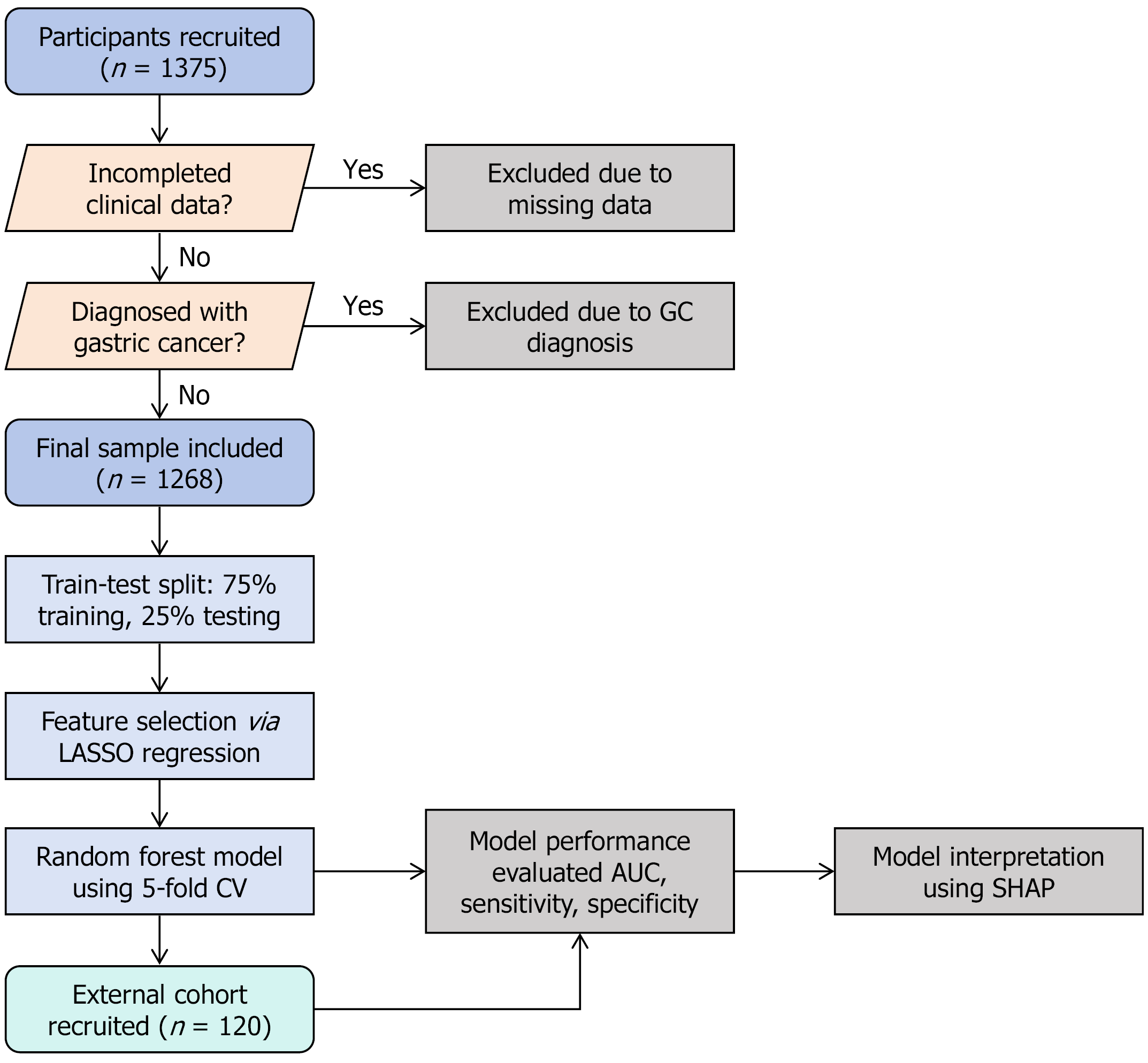
Figure 1 Study flowchart.
A total of 1375 subjects were initially recruited from a gastric cancer screening program. After participants were excluded because of missing clinical data or a diagnosis of gastric cancer, 1268 subjects were included in the final analysis. The dataset was split into a training set (75%) and a testing set (25%). Feature selection was performed using least absolute shrinkage and selection operator regression, followed by the construction of a random forest model using 5-fold cross-validation. The model's performance was evaluated, and its predictions were interpreted using SHapley Additive exPlanation. Finally, the model was validated on an independent external cohort of 120 subjects. GC: Gastric cancer; LASSO: Least absolute shrinkage and selection operator; CV: Cross-validation; AUC: Area under the curve; SHAP: SHapley Additive exPlanation.
- Citation: Cao H, Han JL, Wu H, Si SP, Ding LJ, Ji L, Zhang HZ, Yin J, Zhou ZY, Zhang YN, Lv ZF, Tian WY, Zhan Q, Wang H, An FM. Risk prediction for chronic atrophic gastritis using a random forest model: A multicenter study. World J Gastrointest Oncol 2026; 18(2): 113959
- URL: https://www.wjgnet.com/1948-5204/full/v18/i2/113959.htm
- DOI: https://dx.doi.org/10.4251/wjgo.v18.i2.113959