
















Copyright: ©Author(s) 2026.
World J Gastrointest Oncol. Dec 15, 2026; 18(12): 126440
Published online Dec 15, 2026. doi: 10.4251/wjgo.126440
Published online Dec 15, 2026. doi: 10.4251/wjgo.126440
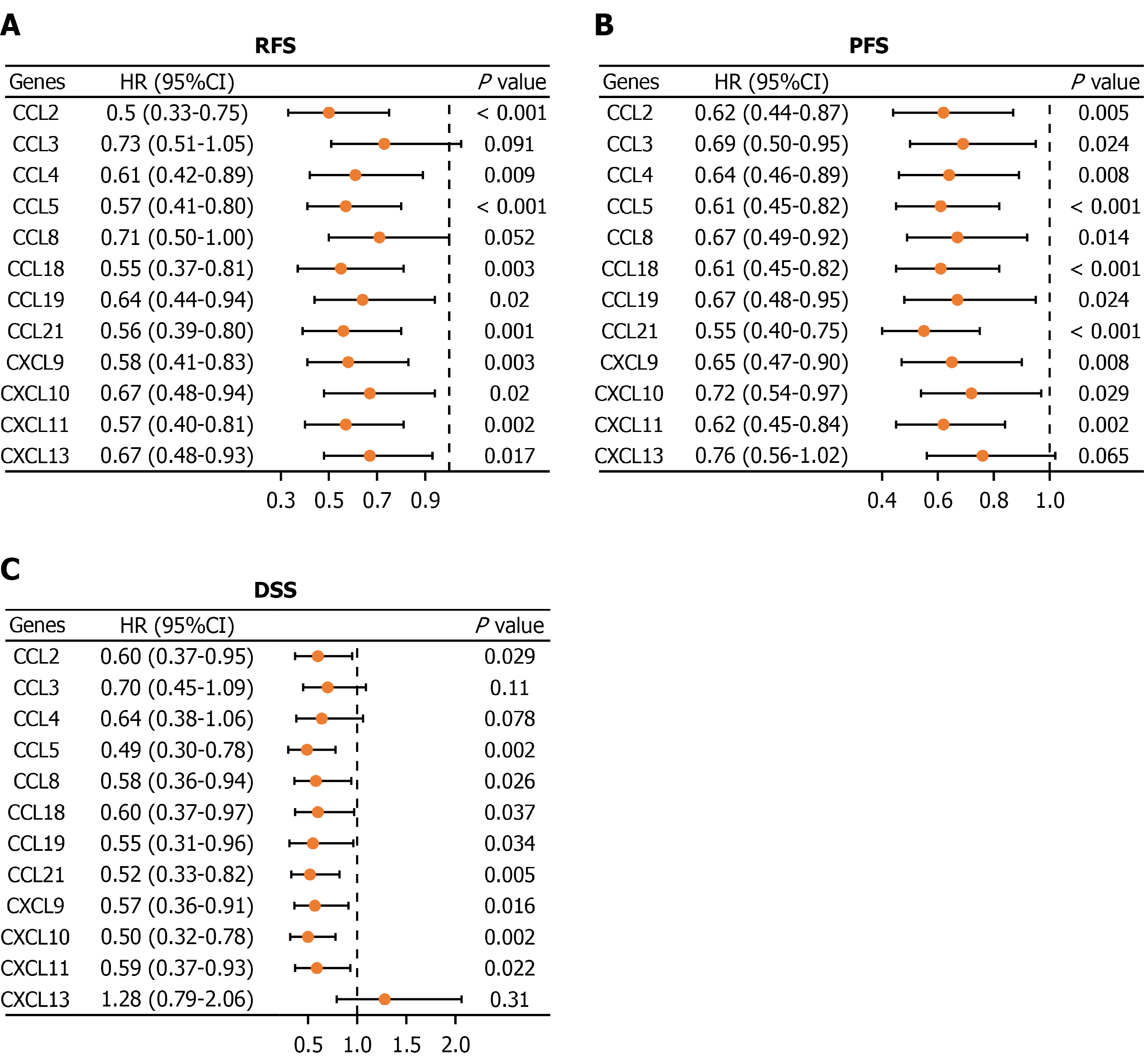
Figure 3 Association of tertiary lymphoid structure-associated chemokine expression with recurrence-free survival, progression-free survival and disease-specific survival.
A-C: Forest plots showing the associations between tertiary lymphoid structure-associated chemokine expression and survival outcomes in hepatocellular carcinoma, including recurrence-free survival (A), progression-free survival (B) and disease-specific survival (C). The prognostic effects of CCL2, CCL3, CCL4, CCL5, CCL8, CCL18, CCL19, CCL21, CXCL9, CXCL10, CXCL11, and CXCL13 are presented as hazard ratios (HRs) with 95%CIs. Orange dots indicate HR estimates, and horizontal lines indicate 95%CIs. The vertical dashed line represents HR = 1.0. P values are shown on the right side of each panel. RFS: Recurrence-free survival; PFS: Progression-free survival; DSS: Disease-specific survival; HR: Hazard ratio.
- Citation: Chen K, Wang YQ, Guo MC, Gu XY, Chen XM, Luo SS, Liu S. Tertiary lymphoid structure-associated chemokine programs define an immune-organized tumor microenvironment with prognostic relevance in hepatocellular carcinoma. World J Gastrointest Oncol 2026; 18(12): 126440
- URL: https://www.wjgnet.com/1948-5204/full/v18/i12/126440.htm
- DOI: https://dx.doi.org/10.4251/wjgo.126440