
















Copyright: ©Author(s) 2026.
World J Gastrointest Oncol. Nov 15, 2026; 18(11): 123962
Published online Nov 15, 2026. doi: 10.4251/wjgo.123962
Published online Nov 15, 2026. doi: 10.4251/wjgo.123962
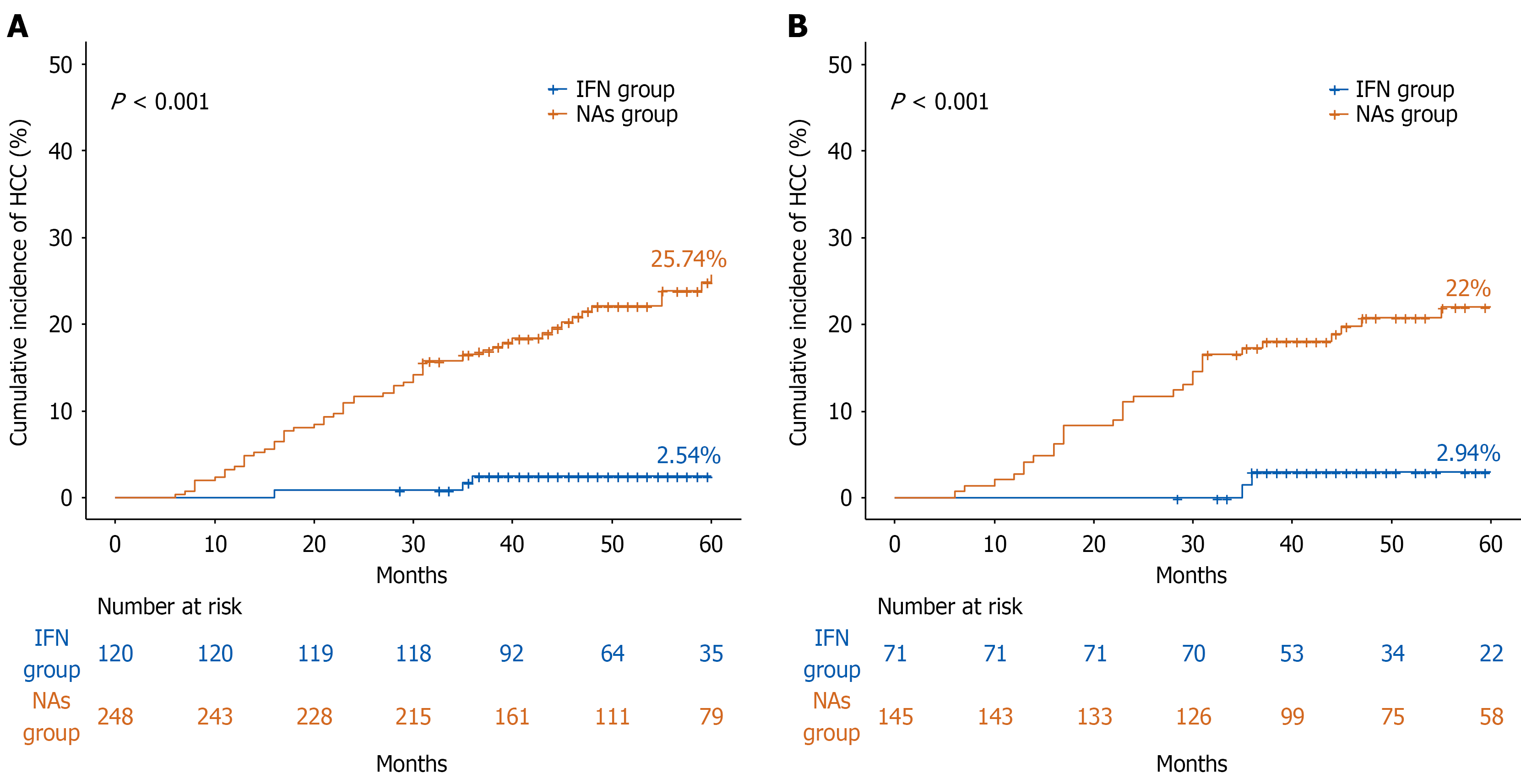
Figure 2 Cumulative incidence of hepatocellular carcinoma over 5 years of follow-up in patients treated with nucleos(t)ide analogs vs interferon-based therapy.
A: Before propensity score matching: The 5-year cumulative incidence was 25.74% (64/248) in the nucleos(t)ide analogs group and 2.54% (3/120) in the interferon group (P < 0.001, log-rank test); B: After propensity score matching (1:3 matching): The 5-year cumulative incidence was 22.0% (30/145) in the nucleos(t)ide analogs group and 2.94% (2/71) in the interferon group (P < 0.001, log-rank test). Shaded areas represent 95% confidence intervals. HCC: Hepatocellular carcinoma; NAs: Nucleos(t)ide analogs; IFN: Interferon.
- Citation: Hao M, Liu CR, Zhang M, Zhou XQ, Jiang ZC, Gao XH, Zhang X, Wang WJ, Wang YK, Jia XL, Li YP, Dang SS. Interferon therapy reduces incidence of hepatocellular carcinoma in patients with high risk of hepatitis B virus-related hepatocellular carcinoma. World J Gastrointest Oncol 2026; 18(11): 123962
- URL: https://www.wjgnet.com/1948-5204/full/v18/i11/123962.htm
- DOI: https://dx.doi.org/10.4251/wjgo.123962