
















Copyright: ©Author(s) 2026.
World J Gastrointest Oncol. Nov 15, 2026; 18(11): 123187
Published online Nov 15, 2026. doi: 10.4251/wjgo.123187
Published online Nov 15, 2026. doi: 10.4251/wjgo.123187
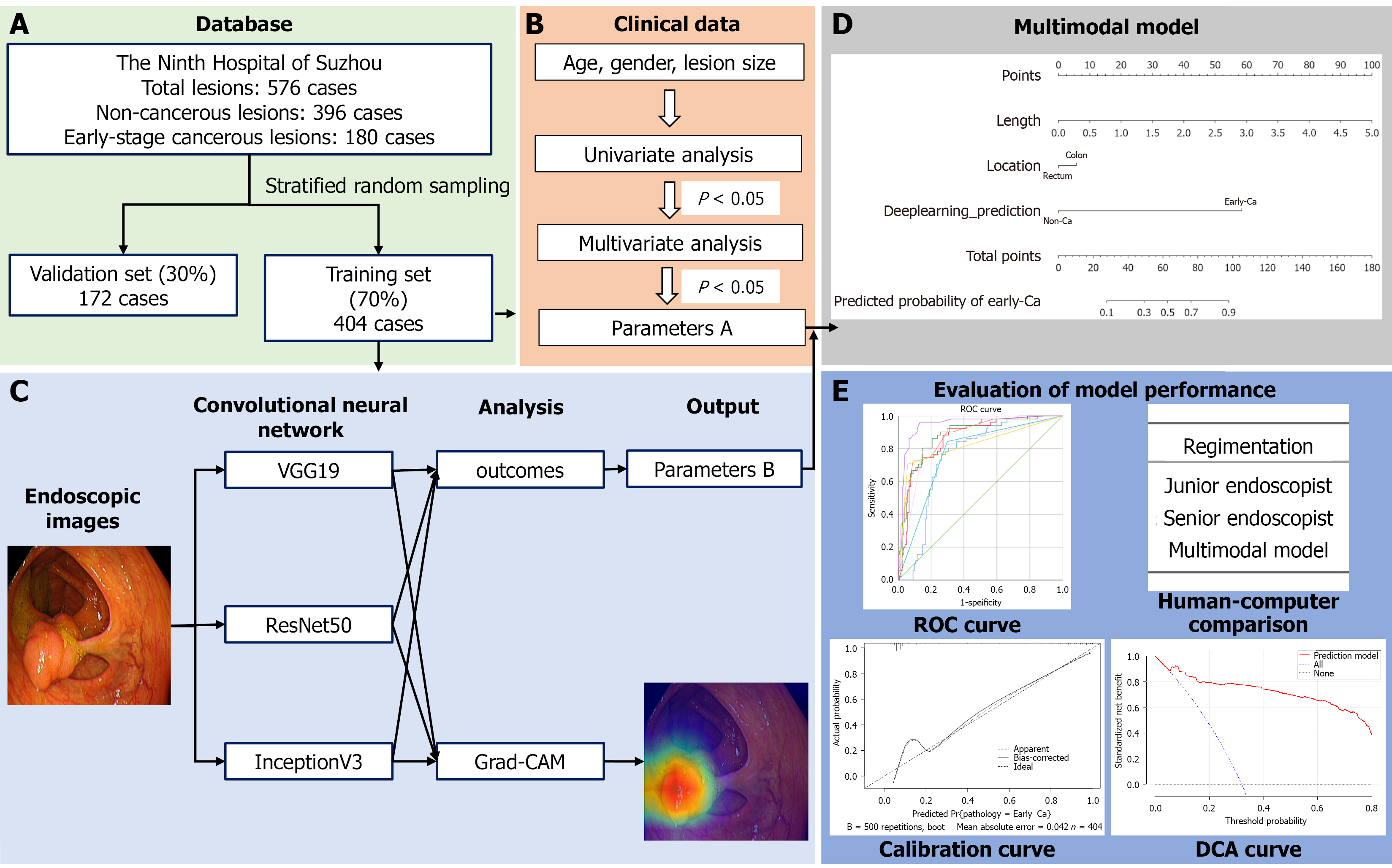
Figure 1 Flowchart of this study.
A: Dataset composition and stratified random split into training and validation sets (7:3 ratio); B: Univariate and multivariate logistic regression analyses of clinical data in the training set to identify independent risk factors for early colorectal cancer; C: Deep learning model training using VGG19, ResNet50, and InceptionV3 architectures on endoscopic images from the training set, followed by Gradient-weighted Class Activation Mapping visualization for model interpretability; D: Construction of the multimodal nomogram integrating clinical variables and ensemble deep learning prediction.; E: Comprehensive evaluation of the multimodal model using receiver operating characteristic curves, calibration curves, decision curve analysis, and comparison with endoscopists of varying experience levels. ROC: Receiver operating characteristic; DCA: Decision curve analysis; Grad-CAM: Gradient-weighted Class Activation Mapping.
- Citation: Dong WH, Ling X, Chen XD, Qian JP, Jin Y, Gu YJ. Establishment and validation of a multimodal model using deep learning for the recognition of early colorectal cancer. World J Gastrointest Oncol 2026; 18(11): 123187
- URL: https://www.wjgnet.com/1948-5204/full/v18/i11/123187.htm
- DOI: https://dx.doi.org/10.4251/wjgo.123187