
















©The Author(s) 2025.
World J Gastrointest Oncol. Dec 15, 2025; 17(12): 113289
Published online Dec 15, 2025. doi: 10.4251/wjgo.v17.i12.113289
Published online Dec 15, 2025. doi: 10.4251/wjgo.v17.i12.113289
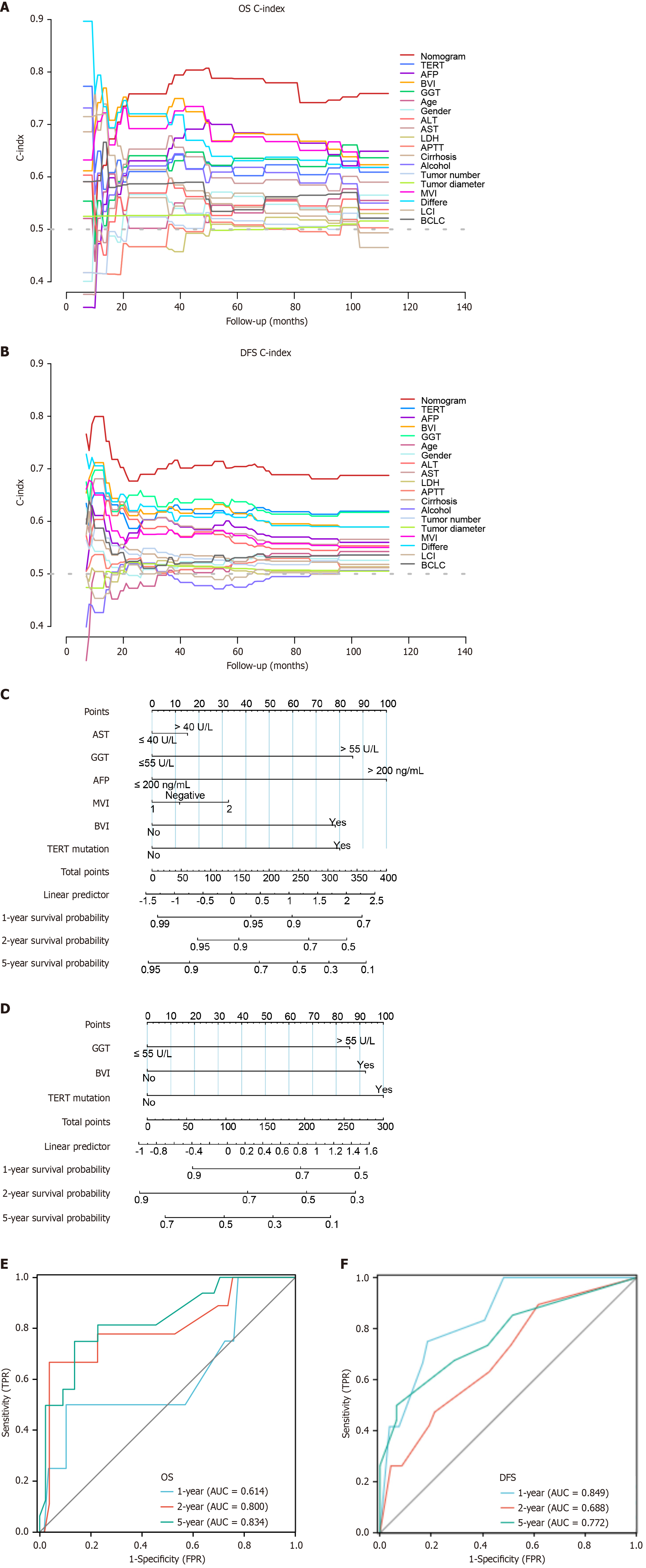
Figure 6 Construction and validation of overall survival and disease-free survival nomograms.
A and B: The prognostic performance between the telomerase reverse transcriptase mutation status and different conventional clinical characteristics was compared by calculating the overall survival (OS) and disease-free survival (DFS) C-index. The maximum C-index of the OS and DFS nomogram model was 0.7651 and 0.6899, respectively. The maximum C-index of telomerase reverse transcriptase (TERT) mutation in OS and DFS was 0.6224 and 0.6228, respectively; C: OS-nomogram was used to predict aspartate aminotransferase, gamma-glutamyl transferase, microvascular invasion, blood vessel invasion and TERT mutation status; D: DFS-nomogram was used to predict gamma-glutamyl transferase, blood vessel invasion and TERT mutation status; E and F: Receiver operating characteristic curves showed the 1-, 2-, and 5-year predictive efficiency of the OS and DFS nomogram model. OS: Overall survival; DFS: Disease-free survival; AST: Aspartate aminotransferase; GGT: Gamma-glutamyl transferase; AFP: Alpha fetoprotein; MVI: Microvascular invasion; BVI: Blood vessel invasion; TERT: Telomerase reverse transcriptase; AUC: Areas under the curve; TPR: True positive rate; FPR: False positive rate.
- Citation: Aizimuaji Z, Hu N, Li HY, Wang XJ, Ma S, Wang YR, Zheng RQ, Li Z, Zhao H, Rong WQ, Xiao T. Optimized digital polymerase chain reaction enables detection of telomerase reverse transcriptase C228T mutation for prognostic assessment in hepatocellular carcinoma. World J Gastrointest Oncol 2025; 17(12): 113289
- URL: https://www.wjgnet.com/1948-5204/full/v17/i12/113289.htm
- DOI: https://dx.doi.org/10.4251/wjgo.v17.i12.113289