
















©The Author(s) 2025.
World J Gastrointest Oncol. Dec 15, 2025; 17(12): 112873
Published online Dec 15, 2025. doi: 10.4251/wjgo.v17.i12.112873
Published online Dec 15, 2025. doi: 10.4251/wjgo.v17.i12.112873
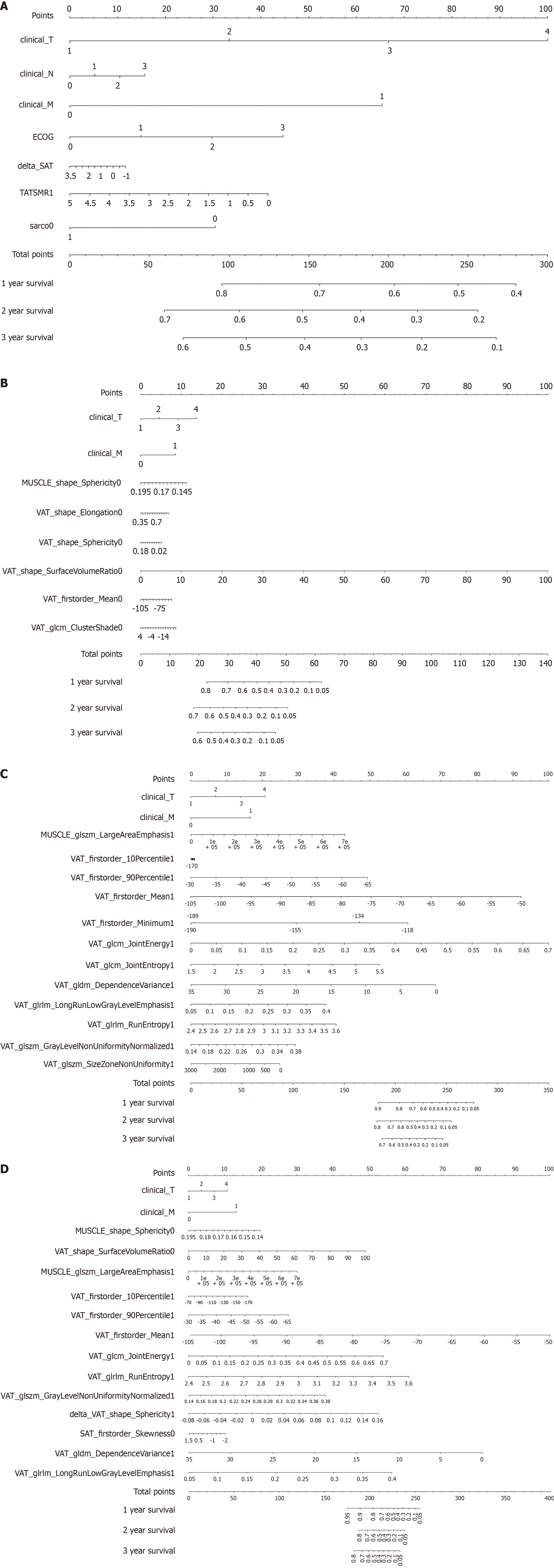
Figure 4 Nomogram: Estimating overall survival for 1-year to 3-year by using feature subset 1, subset 2, subset 3, subset 4 as input data.
A: Nomogram: Estimating overall survival (OS) for 1-year to 3-year by using feature subset 1 as input data; B: Nomogram: Estimating OS for 1-year to 3-year by using feature subset 2 as input data; C: Nomogram: Estimating OS for 1-year to 3-year by using feature subset 3 as input data; D: Nomogram: Estimating OS for 1-year to 3-year by using feature subset 4 as input data. ECOG: Eastern Cooperative Oncology Group; TATSMR1: Total adipose tissue index/skeletal muscle index ratio; sarco: Sarcopenia; 0: Pretreatment; VAT: Visceral adipose tissue; 1: Follow-up; glcm: Gray-level co-occurrence matrix; SAT: Subcutaneous adipose tissue; glszm: Gray-level size zone matrix; glrlm: Gray-level run length matrix; gldm: Gray-level dependence matrix.
- Citation: Liu MC, Cheng YY, Lin SC, Lin CH, Chuang CY, Chen WH, Liao CH, Hsieh CH, Hsieh MF, Liu YJ. Machine learning survival prediction in esophageal cancer using radiomics and body composition from pretreatment and follow-up T12-level computed tomography. World J Gastrointest Oncol 2025; 17(12): 112873
- URL: https://www.wjgnet.com/1948-5204/full/v17/i12/112873.htm
- DOI: https://dx.doi.org/10.4251/wjgo.v17.i12.112873