
















©The Author(s) 2025.
World J Gastrointest Oncol. Oct 15, 2025; 17(10): 110661
Published online Oct 15, 2025. doi: 10.4251/wjgo.v17.i10.110661
Published online Oct 15, 2025. doi: 10.4251/wjgo.v17.i10.110661
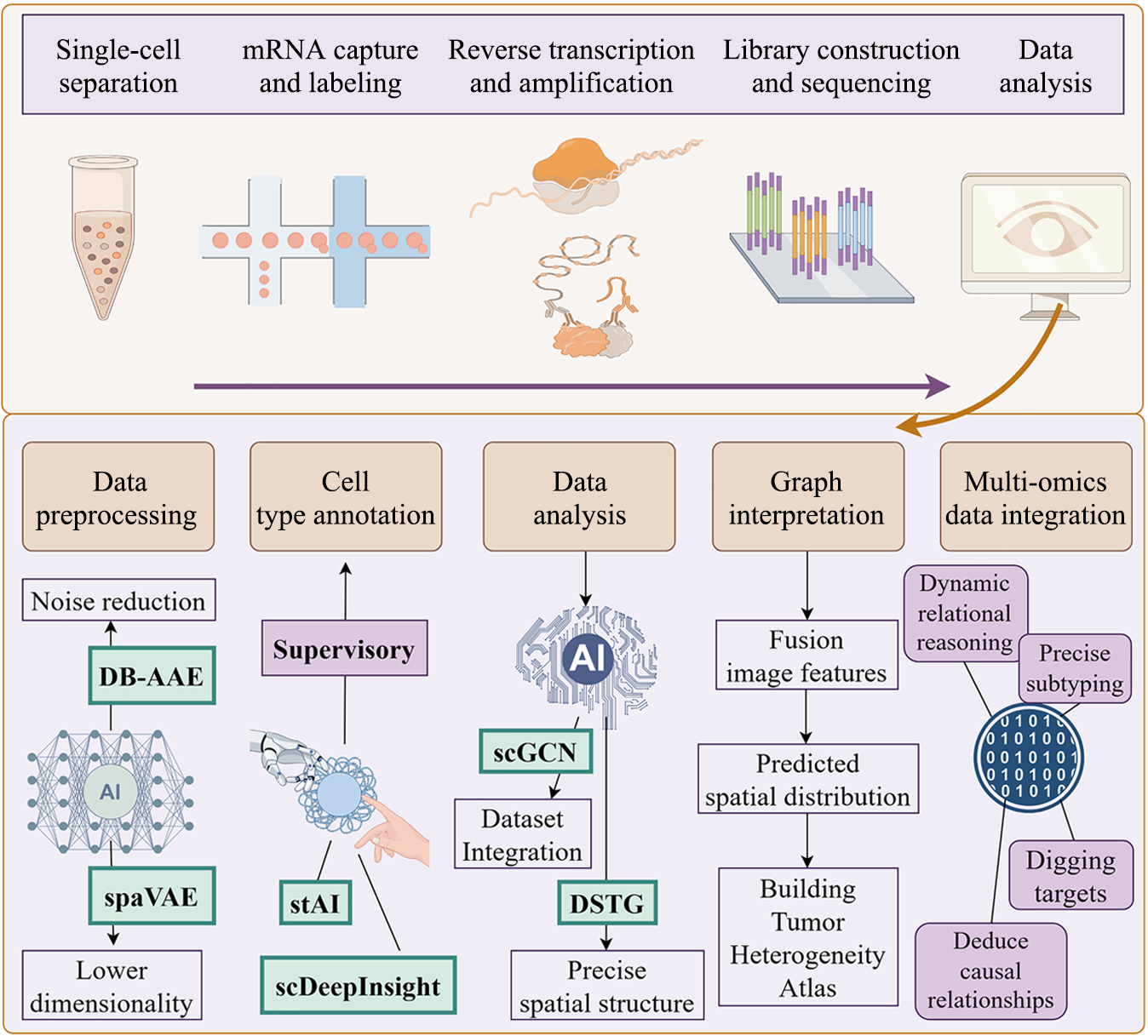
Figure 3 Artificial intelligence-powered analytical framework for single-cell RNA sequencing and spatial transcriptomics in colorectal cancer heterogeneity.
Standard transcriptomics workflow: Illustrates sequential steps from single-cell separation through messenger RNA capture and labeling. Reverse transcription and amplification, library construction and sequencing, to data analysis. Artificial intelligence (AI)-enhanced analytics: AI transforms multi-modal data interpretation through: Advanced data preprocessing (noise reduction and lower dimension via AI models such as dynamic batching adversarial autoencoder and spatial variational autoencoder); Cell type annotation (supervision, supplementation, and optimization through deep learning models such as stAI and scDeepInsight); Data analysis (dataset integration via single-cell graph convolutional network and accurate resolution of spatial information through deconvoluting spatial transcriptomics data through graph-based convolutional networks); Ensemble image features for accurate prediction; Integrating multi-omics analysis for causal analysis, target prediction, and precision medicine. mRNA: Messenger RNA; DB-AAE: Dynamic batching adversarial autoencoder; spaVAE: Spatial variational autoencoder; AI: Artificial intelligence; scGCN: Single-cell graph convolutional network; DSTG: Deconvoluting spatial transcriptomics.
- Citation: Luan WY, Zhao Q, Zhang Z, Xu ZX, Lin SX, Miao YD. Multidimensional decoding of colorectal cancer heterogeneity: Artificial intelligence-enabled precision exploration of single-cell and spatial transcriptomics. World J Gastrointest Oncol 2025; 17(10): 110661
- URL: https://www.wjgnet.com/1948-5204/full/v17/i10/110661.htm
- DOI: https://dx.doi.org/10.4251/wjgo.v17.i10.110661