











BPG is committed to discovery and dissemination of knowledge
Observational Study
Copyright: ©Author(s) 2026.
World J Hepatol. Aug 27, 2026; 18(8): 124436
Published online Aug 27, 2026. doi: 10.4254/wjh.124436
Figure 4
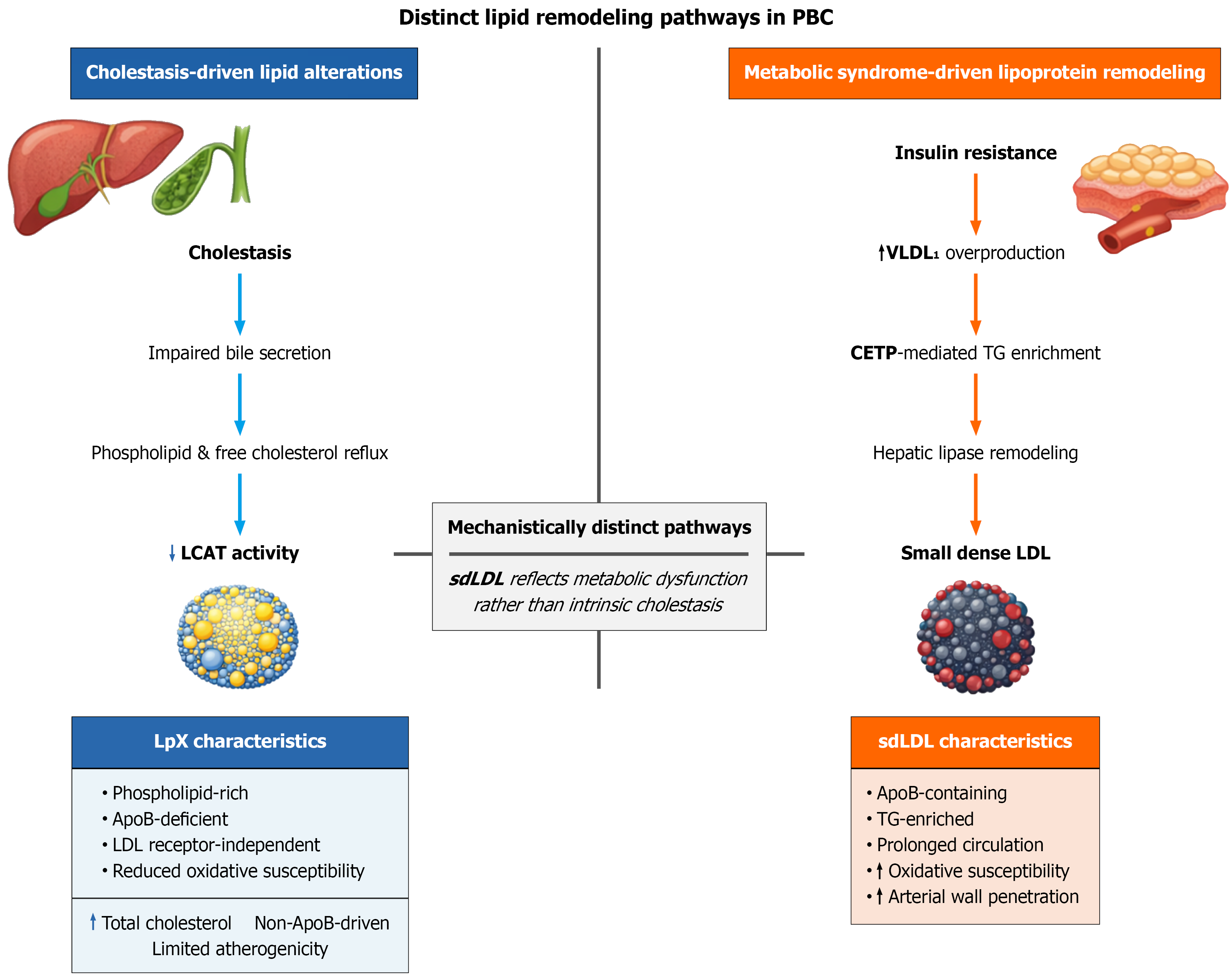
Figure 4 Mechanistically distinct lipid remodeling pathways in primary biliary cholangitis. Left panel: Cholestasis impairs bile acid secretion and disrupts biliary phospholipid transport, leading to reflux of phospholipids and free cholesterol into the circulation and reduced lecithin-cholesterol acyltransferase activity. These alterations promote the formation of lipoprotein X, a phospholipid-rich, apolipoprotein B (ApoB)-deficient particle that contributes to hypercholesterolemia but does not reflect classical ApoB-driven atherogenic dyslipidemia. Right panel: In contrast, insulin resistance associated with metabolic syndrome promotes hepatic overproduction of triglyceride-rich very low-density lipoprotein 1 particles. Subsequent cholesteryl ester transfer protein-mediated lipid exchange and hepatic lipase-dependent remodeling generate small dense low-density lipoprotein (sdLDL), an ApoB-containing lipoprotein subfraction characterized by prolonged circulation time, increased oxidative susceptibility, and enhanced arterial wall penetration. These pathways are mechanistically distinct and support the concept that sdLDL levels in primary biliary cholangitis primarily reflect superimposed metabolic dysfunction rather than intrinsic cholestatic activity. Created by the authors for illustrative purposes (OpenAI 1.3.2026). LCAT: Lecithin-cholesterol acyltransferase; LpX: Lipoprotein X; PBC: Primary biliary cholangitis; sdLDL: Small dense low-density lipoprotein; LDL: Low-density lipoprotein; VLDL: Very low-density lipoprotein; ApoB: Apolipoprotein B; CETP: Cholesteryl ester transfer protein; TG: Triglycerides.


Write to the Help Desk