
















Copyright: ©Author(s) 2026.
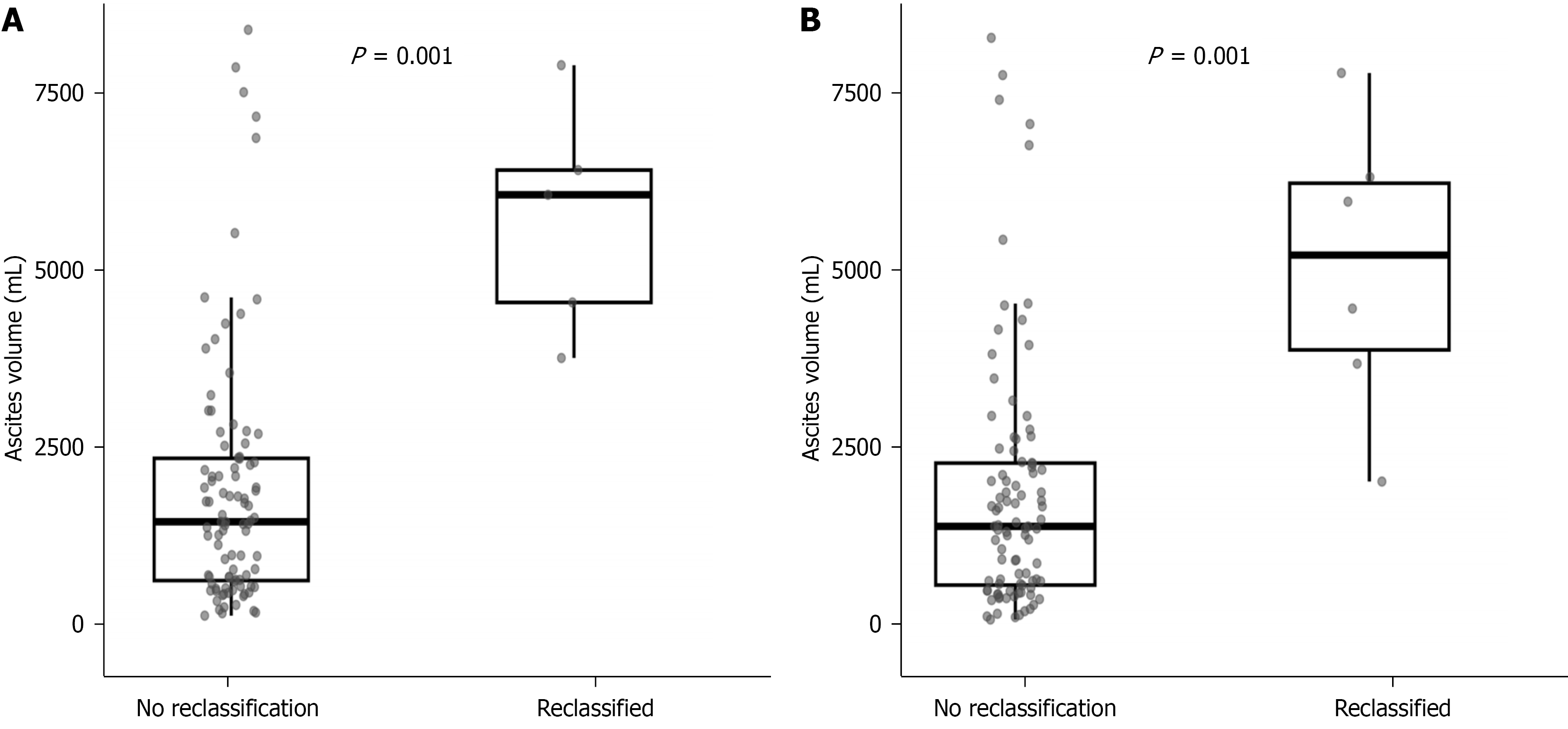
Figure 3 Comparison of ascites volume according to low body mass index and Global Leadership Initiative on Malnutrition-defined malnutrition reclassification based on the actual body weight method and computed tomography-sensitive corrected method in patients with cirrhosis and ascites.
A: Comparison of the ascites volume between patients with and without low- body mass index (BMI) reclassification based on the actual body weight method vs the computed tomography (CT)-sensitive corrected method. Low-BMI reclassification was defined as discordant low-BMI classification between the two methods. The ascites volume is presented as boxplots with individual data points. Groups were compared using the Wilcoxon rank-sum test. Patients with a low-BMI reclassification had a significantly larger ascites volume than those without reclassification (P = 0.001); B: Comparison of the ascites volume between patients with and without Global Leadership Initiative on Malnutrition (GLIM)-defined malnutrition reclassification based on the actual body weight method vs the CT-sensitive corrected method. GLIM-defined malnutrition reclassification was defined as a discordant GLIM classification between the two methods. The ascites volume is presented as boxplots with individual data points. Groups were compared using the Wilcoxon rank-sum test. Patients with GLIM-defined malnutrition reclassification had a significantly larger ascites volume than those without reclassification (P = 0.001).
- Citation: Zhao HJ, Su LH, Lu FH, Gao F, Sai JH, Li P, Shi JL, Wang L, Li SJ, Zhou F, Zhou LM, Wang N, He PY. Computed tomography-based correction of the body mass index improves malnutrition detection in patients with cirrhosis and ascites. World J Hepatol 2026; 18(7): 122692
- URL: https://www.wjgnet.com/1948-5182/full/v18/i7/122692.htm
- DOI: https://dx.doi.org/10.4254/wjh.122692