











BPG is committed to discovery and dissemination of knowledge
Opinion Review
Copyright: ©Author(s) 2026.
World J Hepatol. Jun 27, 2026; 18(6): 120591
Published online Jun 27, 2026. doi: 10.4254/wjh.120591
Figure 1
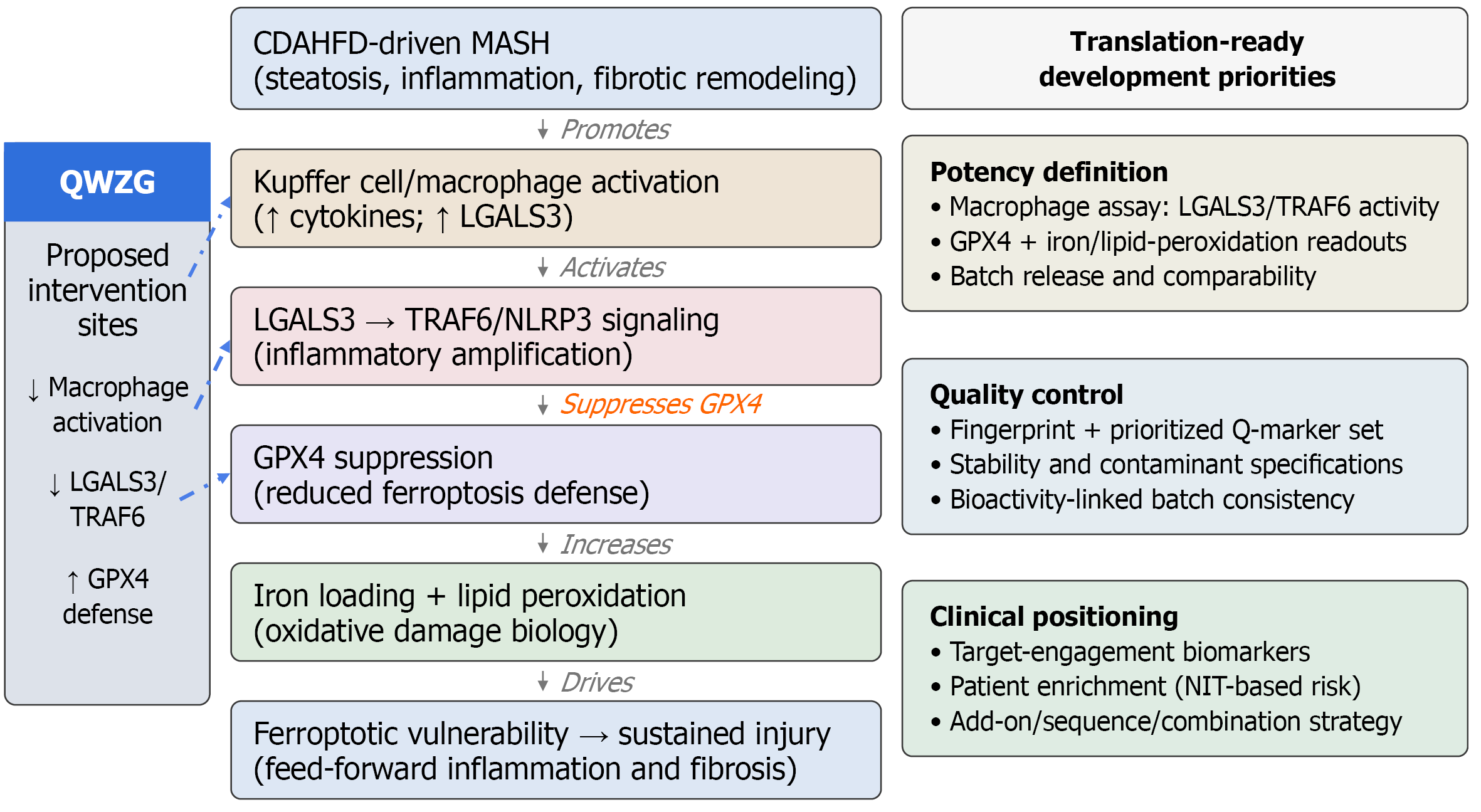
Figure 1 Proposed macrophage-centered LGALS3-TRAF6-GPX4 axis and translation-ready development priorities in metabolic dysfunction-associated steatohepatitis. The left panel maps out the biological events connecting choline-deficient, L-amino acid-defined, high-fat diet-induced steatohepatitis to macrophage activation. In this setting, Kupffer cells increase cytokine release and drive up LGALS3 expression. LGALS3 then pushes TRAF6/NLRP3 inflammatory signals forward while simultaneously shutting down GPX4 ferroptosis defenses. This dual disruption leaves the liver highly vulnerable to iron accumulation and lipid peroxidation, fueling continuous tissue damage. Qiweizhigan (QWZG) apparently intervenes across several of these pathological nodes. The formula calms overall macrophage activity, cuts off the LGALS3/TRAF6 signal, and restores GPX4 protective functions. The right panel shifts focus to the practical steps required for clinical translation. Developers must establish potency tests based on this exact mechanism and enforce strict quality-control rules to ensure batch consistency. The final phase involves determining the right clinical fit. Researchers will need target-engagement biomarkers and noninvasive risk scores to figure out if the therapy works best as an add-on, sequential, or combination treatment. Solid arrows track the underlying biological chain of events. Blue dashed lines pinpoint exactly where QWZG disrupts the cascade. CDAHFD: Choline-deficient, L-amino acid-defined high-fat diet; MASH: Metabolic dysfunction-associated steatohepatitis; NIT: Noninvasive test; QWZG: Qiweizhigan granule.


Write to the Help Desk