
















Copyright: ©Author(s) 2026.
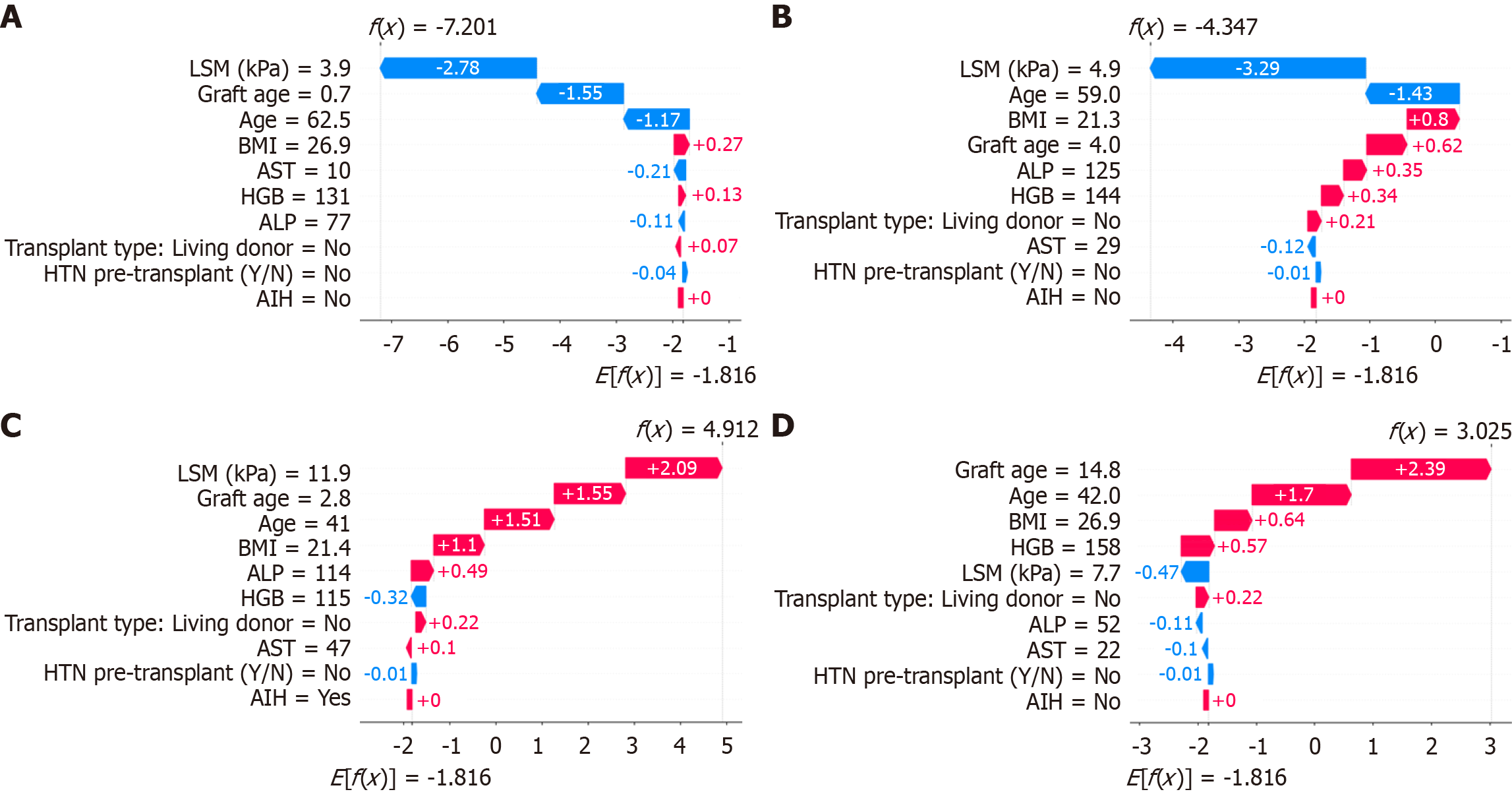
Figure 3 Contributing factors in extreme gradient boosting decision-making for 4 random patients by SHapley Additive exPlanation analysis.
Features highlighted in red signify an increased risk of graft fibrosis, while those depicted in blue indicate protective factors against fibrosis. A: No fibrosis (model prediction: No fibrosis): A 63-year-old patient, eight months post-deceased donor liver transplant, with no pre-transplant or post-transplant hypertension, diabetes, or cardiovascular disease. The indication for transplant was unknown. Body mass index (BMI) at time of Fibroscan was 26.9. Liver stiffness measured 3.9 kPa. Biopsy showed no fibrosis; B: No fibrosis (model prediction: No fibrosis): A 59-year-old patient, four years post-deceased donor liver transplant for hepatitis C. No pre-transplant comorbidities but developed both hypertension and diabetes post-transplant. BMI at time of Fibroscan was 21.3. Liver stiffness was 4.9 kPa. Biopsy showed no fibrosis; C: Significant fibrosis (model prediction: Fibrosis): A 41-year-old patient, 2.8 years post-deceased donor liver transplant for autoimmune hepatitis. No pre-transplant comorbidities. Developed both hypertension and diabetes post-transplant. BMI at time of Fibroscan was 21.4. Liver stiffness measured 11.9 kPa. Biopsy confirmed significant fibrosis; D: Significant fibrosis (model prediction: Fibrosis): A 42-year-old patient, 15 years post-deceased donor liver transplant for hepatitis C. No pre-transplant hypertension, diabetes, or cardiovascular disease. Developed both hypertension and diabetes post-transplant. Body mass index at time of Fibroscan was 26.9. Liver stiffness was 7.7 kPa. Biopsy showed significant fibrosis. SHapley Additive exPlanation analysis showed that graft age was the most important predictor of significant fibrosis in this patient, as opposed to the patient examples where liver stiffness measurement was most important. LSM: Liver stiffness measurement; BMI: Body mass index; AST: Aspartate aminotransferase; HGB: Hemoglobin; ALP: Alkaline phosphatase; HTN: Hypertension; Y: Yes; N: No; AIH: Autoimmune hepatitis.
- Citation: Koivu A, Azarfar G, Shojaee M, Hlaing NKT, Rizvi S, Sharma D, Maleki S, Bhat M. Machine learning model integrating transient elastography and clinical data for prediction of graft fibrosis after liver transplantation. World J Hepatol 2026; 18(6): 120258
- URL: https://www.wjgnet.com/1948-5182/full/v18/i6/120258.htm
- DOI: https://dx.doi.org/10.4254/wjh.120258