
















©The Author(s) 2026.
World J Hepatol. Feb 27, 2026; 18(2): 113775
Published online Feb 27, 2026. doi: 10.4254/wjh.v18.i2.113775
Published online Feb 27, 2026. doi: 10.4254/wjh.v18.i2.113775
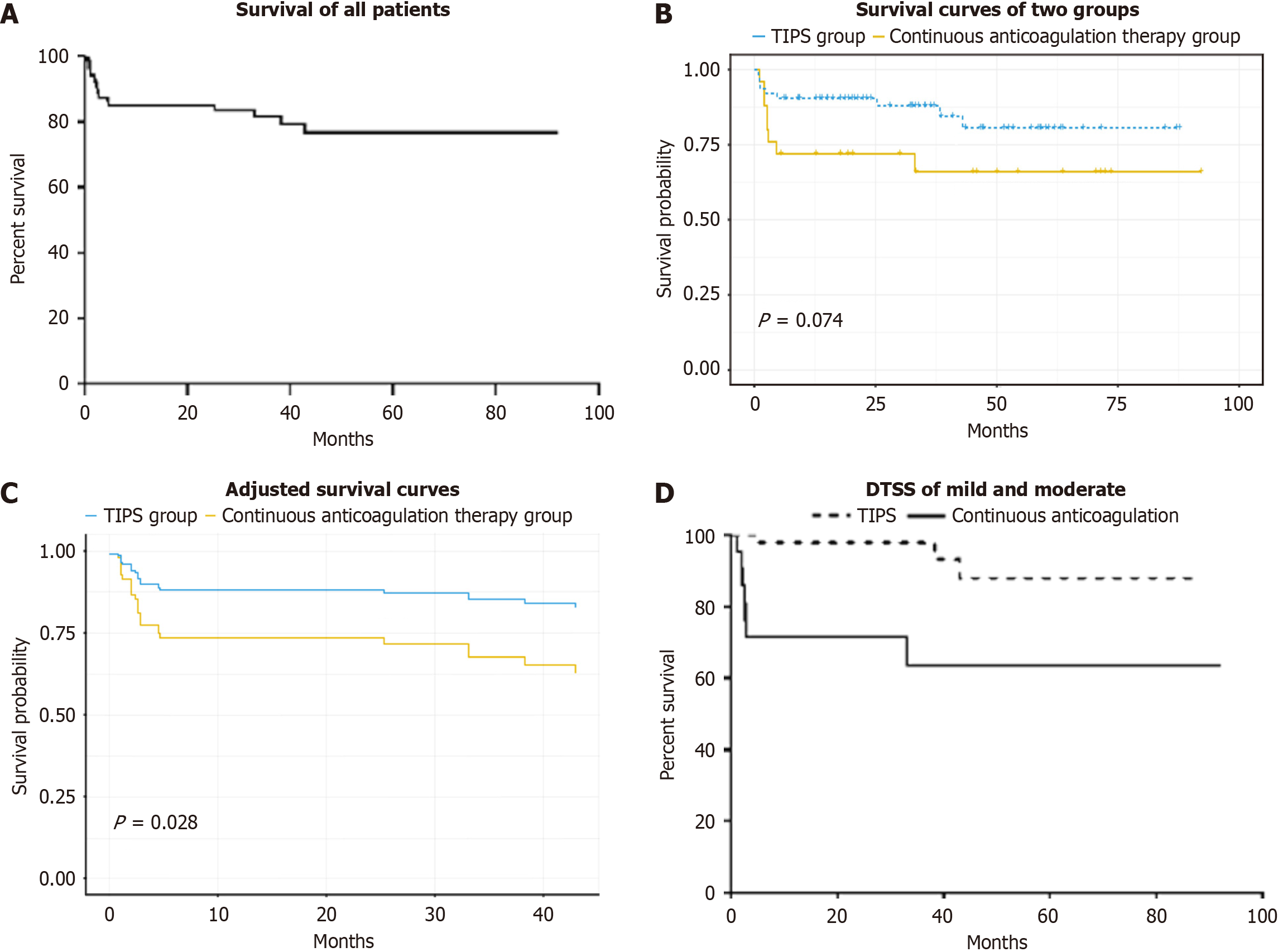
Figure 2 Transplant-free survival.
A: Survival of all patients. The 1-year, 2-year and 3-year overall survival rates were 85.2%, 85.2% and 81.5%, respectively; B: Survival curves. It has the trend that the survival rate of transjugular intrahepatic portosystemic shunts (TIPS) group is higher than that of the continuous anticoagulation therapy group (P = 0.074); C: Adjusted survival curves. In order to exclude the influence of covariates, we adjust for survival rate based on covariate distribution and display it in graphs. The adjusted survival rate between the TIPS group and the continuous anticoagulation therapy group showed statistical significances (P = 0.028); D: Drum-Tower Severity Scoring of mild and moderate grade. The Continuous anticoagulation therapy group: The survival rates of 1-year, 2-year and 3-year were 71.4%, 63.5%, 63.5%, respectively. The TIPS group: The survival rates of 1-year, 2-year and 3-year were 97.8%, 97.8% and 97.8%, respectively. The survival rate of TIPS group is significantly higher than that of the continuous anticoagulation therapy (P = 0.003). DTSS: Drum-Tower Severity Scoring; TIPS: Transjugular intrahepatic portosystemic shunts.
- Citation: Tu JJ, Zhang H, Kong DR, Feng YH, Yu YC, Li TS, Zhang F, Zhang W, Xu H, Yin Q, Wang L, Zhang M, Xiao JQ, Zhuge YZ. Transjugular intrahepatic portosystemic shunt improves survival in anticoagulation-resistant hepatic sinusoidal obstructive syndrome patients: A multicenter retrospective study. World J Hepatol 2026; 18(2): 113775
- URL: https://www.wjgnet.com/1948-5182/full/v18/i2/113775.htm
- DOI: https://dx.doi.org/10.4254/wjh.v18.i2.113775