
















Copyright: ©Author(s) 2026.
World J Hepatol. Nov 27, 2026; 18(11): 125990
Published online Nov 27, 2026. doi: 10.4254/wjh.125990
Published online Nov 27, 2026. doi: 10.4254/wjh.125990
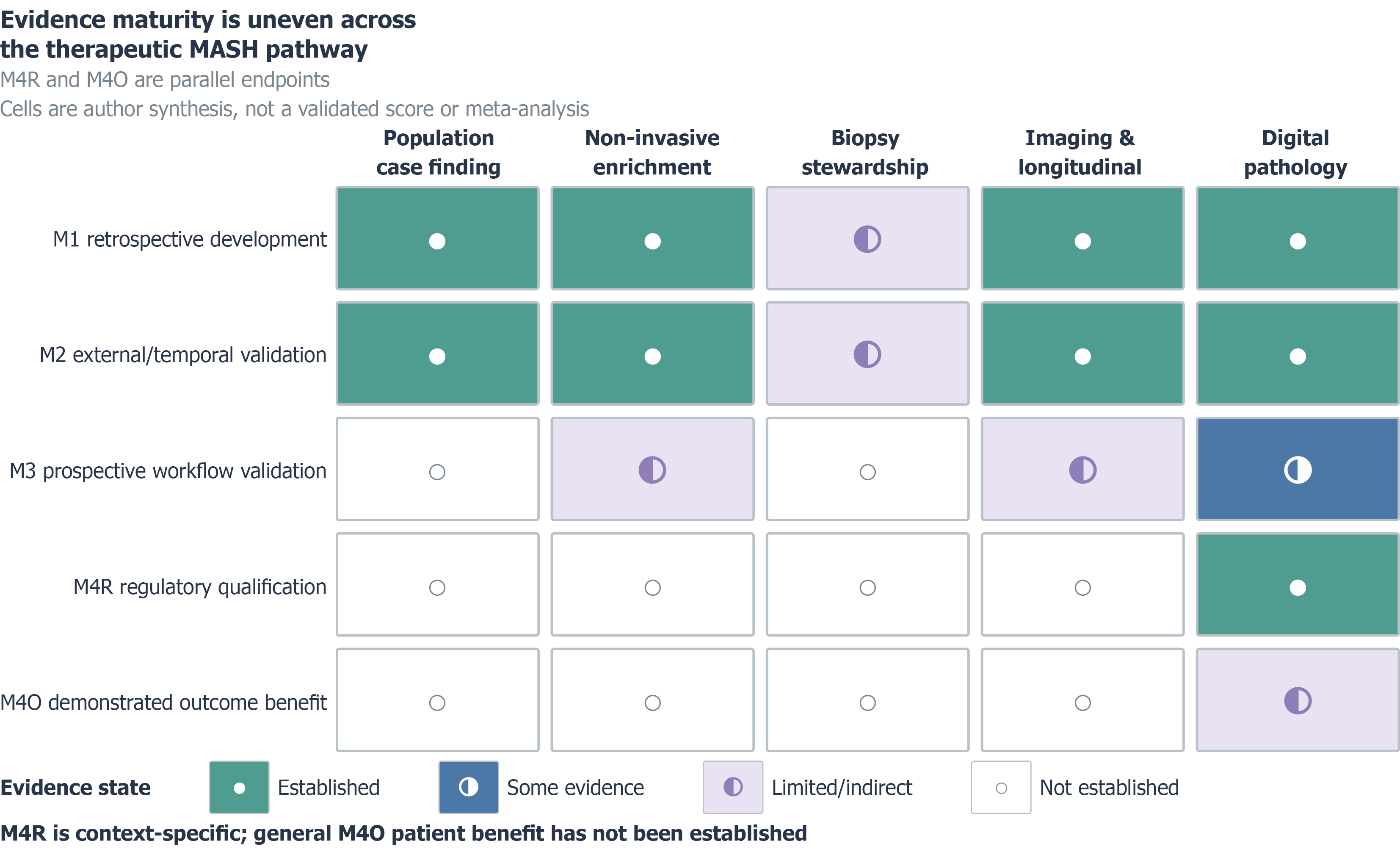
Figure 3 Evidence maturity matrix for artificial intelligence across the therapeutic metabolic dysfunction-associated steatohepatitis pathway.
The matrix maps five decision domains to a descriptive maturity framework proposed in this review. M1 denotes retrospective development or internal validation; M2, independent external or temporal validation; M3, prospective workflow or assisted-reader validation; M4R, regulatory qualification in a specified context of use; and M4O, demonstrated patient or trial-outcome benefit from model-guided action. Colour and symbol states indicate established evidence, some evidence, limited or indirect evidence, or no established evidence. M4R and M4O are parallel endpoints: Regulatory qualification does not by itself demonstrate patient benefit. Digital pathology reaches M4R only for the qualified human-reviewed trial context; general M4O benefit is not established. Cells represent an author synthesis of the reviewed evidence and are neither a validated score nor a meta-analysis. MASH: Metabolic dysfunction-associated steatohepatitis.
- Citation: Liu YH, Li SY, Zhang ST, Zhu ZX. Translational artificial intelligence in therapeutic-era metabolic dysfunction-associated steatohepatitis: The ACTION framework. World J Hepatol 2026; 18(11): 125990
- URL: https://www.wjgnet.com/1948-5182/full/v18/i11/125990.htm
- DOI: https://dx.doi.org/10.4254/wjh.125990