
















Copyright: ©Author(s) 2026.
World J Hepatol. Oct 27, 2026; 18(10): 124997
Published online Oct 27, 2026. doi: 10.4254/wjh.124997
Published online Oct 27, 2026. doi: 10.4254/wjh.124997
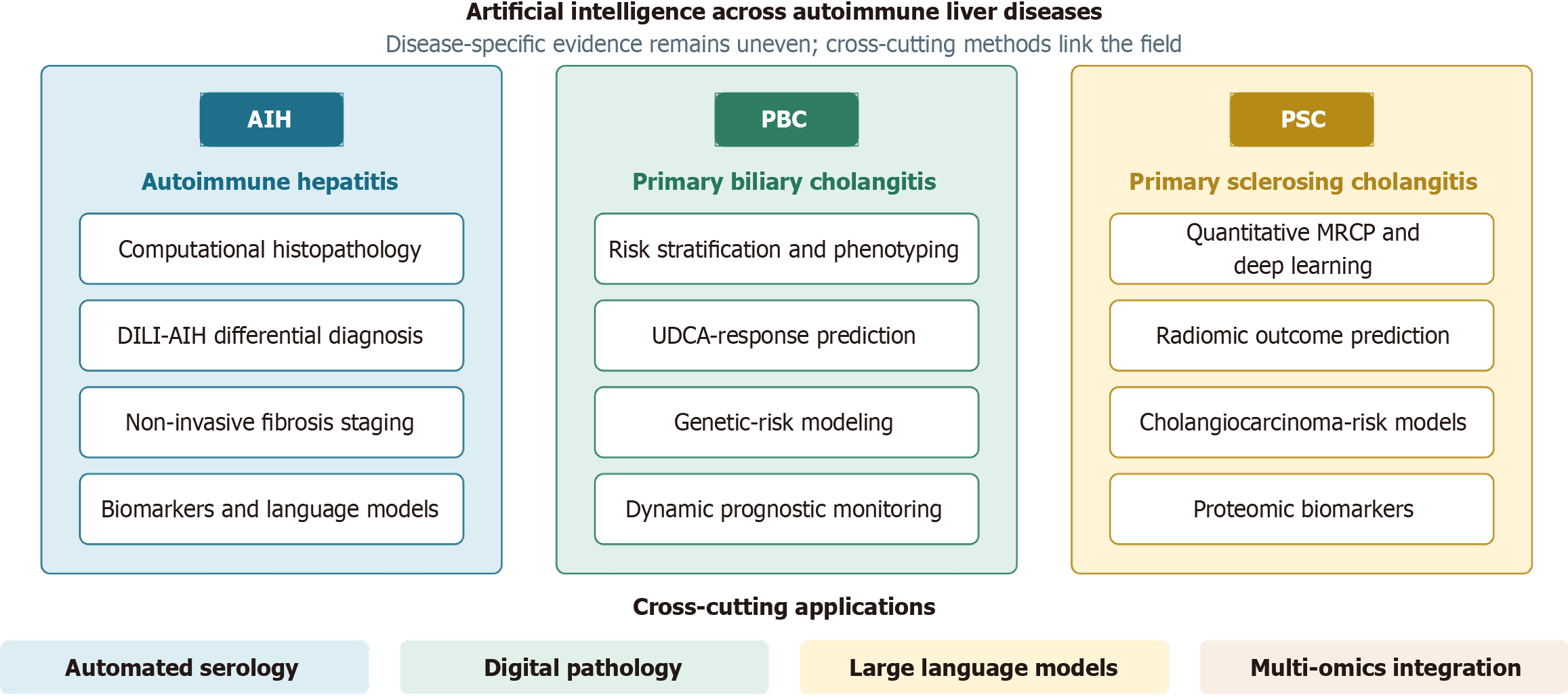
Figure 1 Artificial intelligence applications across the three autoimmune liver diseases.
Representative applications are shown for autoimmune hepatitis (computational histopathology, differential diagnosis, non-invasive fibrosis staging, and biomarker- and language-model-based tools), primary biliary cholangitis (risk stratification and sub-phenotyping, treatment-response prediction, genetic-risk modeling, and prognostic and dynamic monitoring), and primary sclerosing cholangitis (quantitative and artificial intelligence-enhanced imaging, radiomic and topological prognostication, cholangiocarcinoma-risk modeling, and proteomic biomarkers). Cross-cutting applications (automated serological interpretation, digital pathology, large language models, and multi-omics integration) apply across all three diseases. AIH: Autoimmune hepatitis; PBC: Primary biliary cholangitis; PSC: Primary sclerosing cholangitis; DILI: Drug-induced liver injury; MRCP: Magnetic resonance cholangiopancreatography; UDCA: Ursodeoxycholic acid.
- Citation: Salman A. Artificial intelligence in autoimmune liver diseases: Diagnosis, risk stratification, and personalized care. World J Hepatol 2026; 18(10): 124997
- URL: https://www.wjgnet.com/1948-5182/full/v18/i10/124997.htm
- DOI: https://dx.doi.org/10.4254/wjh.124997