
















Copyright: ©Author(s) 2026.
World J Hepatol. Oct 27, 2026; 18(10): 124709
Published online Oct 27, 2026. doi: 10.4254/wjh.124709
Published online Oct 27, 2026. doi: 10.4254/wjh.124709
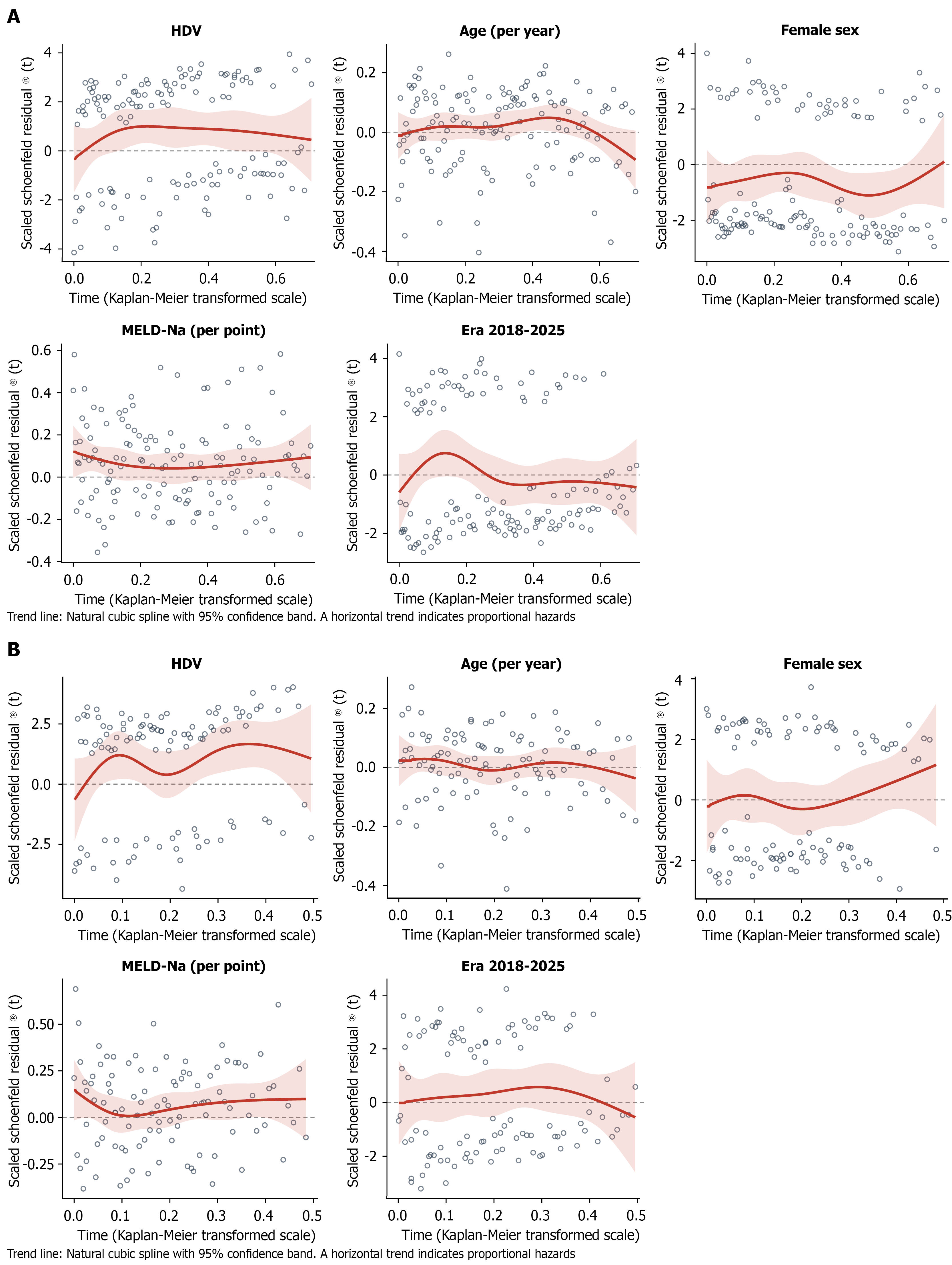
Figure 5 Assessment of the proportional hazard assumption for the cause-specific Cox model.
A: For Waiting-list death. Scaled Schoenfeld residuals are plotted against Kaplan-Meier-transformed follow-up time for each covariate. Open circles represent the residuals, solid lines show smoothed time-varying effects, and dashed lines indicate 95% confidence bands. Approximately horizontal trends support the proportional hazards assumption. No significant time-dependent effect was observed for hepatitis delta virus infection (P = 0.479) or for the model overall (global test, P = 0.819). Minor fluctuations late in follow-up should be interpreted cautiously because of the smaller number of patients at risk and greater uncertainty; B: For liver transplantation. Most covariates showed no relevant variation in their effects over follow-up. Hepatitis D virus (HDV) infection displayed a modest upward trend, consistent with a stronger transplantation effect after the first year and a Schoenfeld test that approached, but did not reach, statistical significance (P = 0.061). This finding suggests a possible temporal variation in the HDV-associated transplantation hazard without providing formal evidence of non-proportionality. HDV: Hepatitis delta virus; MELD-Na: Model for end-stage liver disease–sodium.
- Citation: Peltec A, Buga D, Hotineanu A, Wedemeyer H. Impact of hepatitis delta virus infection on waiting list outcomes: A competing-risks analysis. World J Hepatol 2026; 18(10): 124709
- URL: https://www.wjgnet.com/1948-5182/full/v18/i10/124709.htm
- DOI: https://dx.doi.org/10.4254/wjh.124709