
















Copyright: ©Author(s) 2026.
World J Hepatol. Oct 27, 2026; 18(10): 124709
Published online Oct 27, 2026. doi: 10.4254/wjh.124709
Published online Oct 27, 2026. doi: 10.4254/wjh.124709
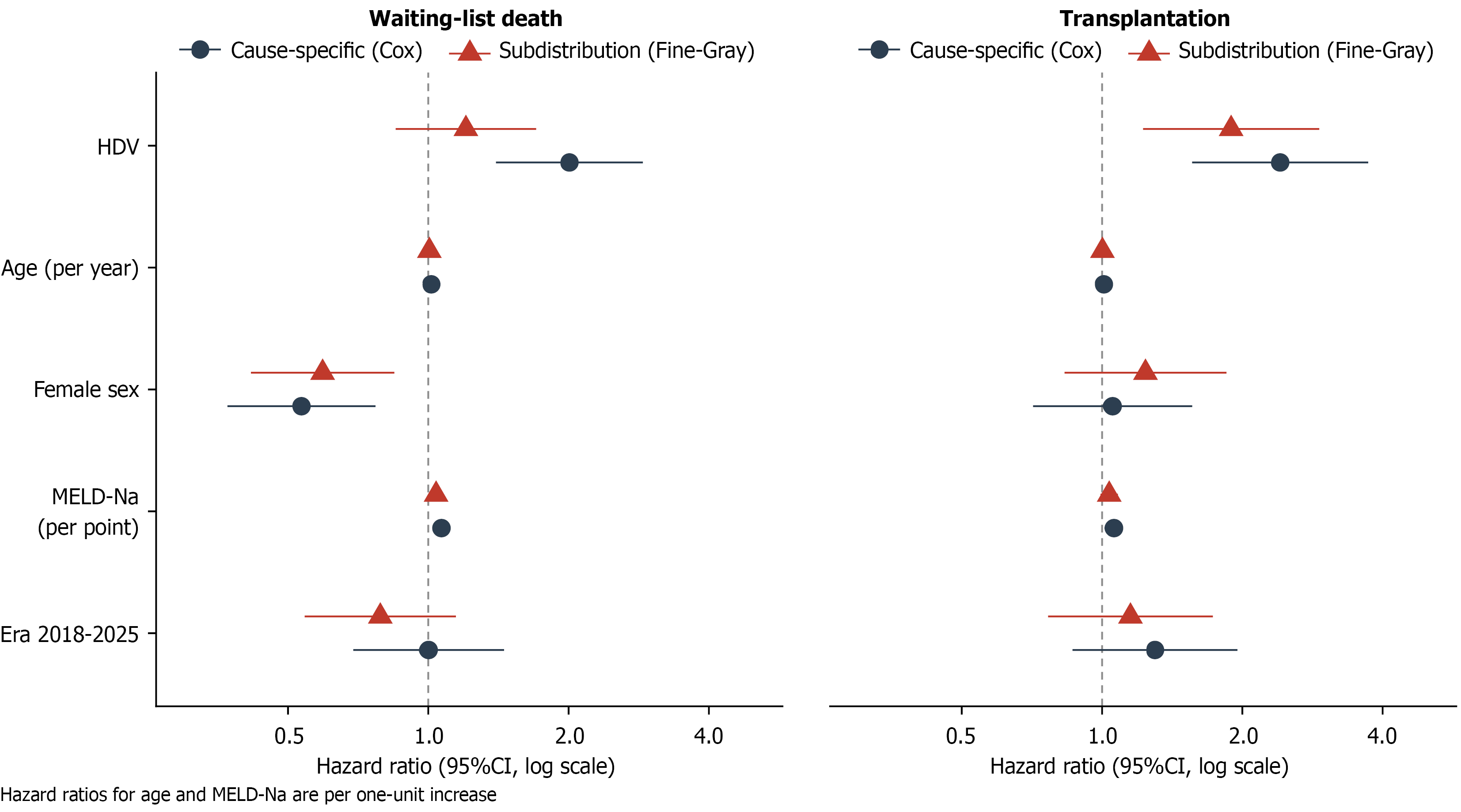
Figure 3 Multivariable cause-specific and subdistribution hazard models for waiting-list death and liver transplantation.
The forest plot presents adjusted cause-specific hazard ratios from Cox regression and adjusted subdistribution hazard ratios from Fine-Gray regression in 313 patients (all cohort). Hepatitis D virus (HDV) infection was associated with an approximately twofold higher cause-specific hazard of death, whereas the corresponding subdistribution hazard ratio was closer to unity, indicating attenuation of the cumulative incidence of death by the competing effect of more frequent transplantation in patients with HDV. For transplantation, HDV infection was associated with hazard ratios above unity in both models, indicating higher instantaneous and cumulative transplantation rates. Female sex was associated with a lower hazard of waiting-list death. Age and model for end-stage liver disease-sodium were modeled per one-year and one-point increase, respectively. Circles indicate cause-specific hazard ratios, triangles indicate subdistribution hazard ratios, and horizontal bars represent 95%CI. Estimates are shown on a logarithmic scale, with the dashed vertical line at 1 indicating no association. HDV: Hepatitis delta virus; MELD-Na: Model for end-stage liver disease–sodium.
- Citation: Peltec A, Buga D, Hotineanu A, Wedemeyer H. Impact of hepatitis delta virus infection on waiting list outcomes: A competing-risks analysis. World J Hepatol 2026; 18(10): 124709
- URL: https://www.wjgnet.com/1948-5182/full/v18/i10/124709.htm
- DOI: https://dx.doi.org/10.4254/wjh.124709