
















©The Author(s) 2025.
World J Hepatol. Oct 27, 2025; 17(10): 109807
Published online Oct 27, 2025. doi: 10.4254/wjh.v17.i10.109807
Published online Oct 27, 2025. doi: 10.4254/wjh.v17.i10.109807
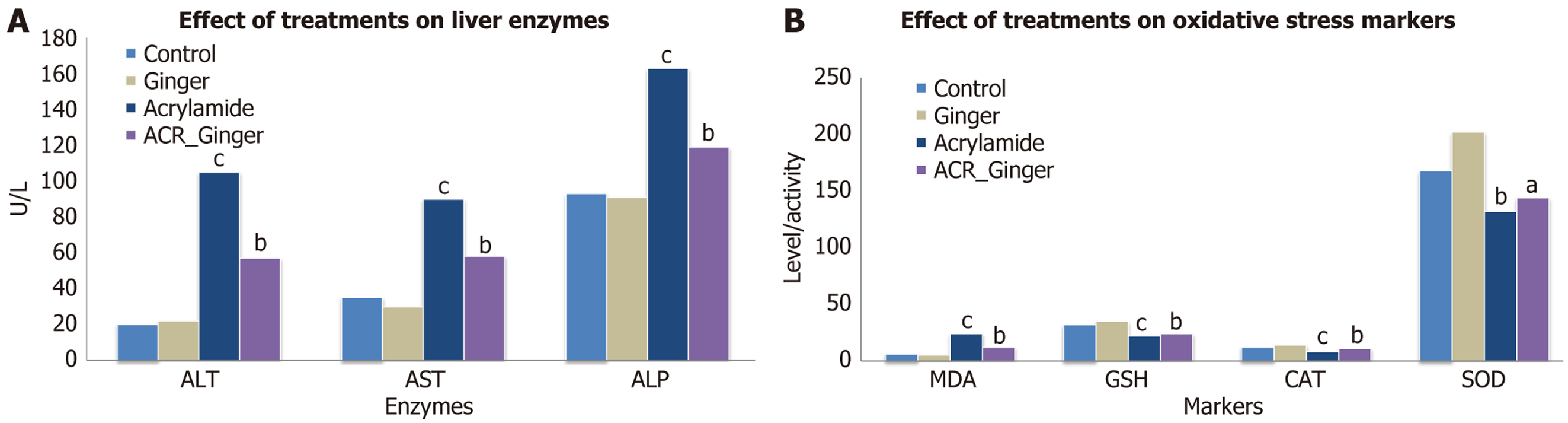
Figure 1 Effect of treatments.
A: Liver enzymes [alanine aminotransferase (ALT), aspartate aminotransferase (AST), alkaline phosphatase (ALP)]. The graph shows a marked elevation in liver enzymes (ALT, AST, ALP) in the acrylamide (ACR)-treated group, indicating hepatocellular damage. Co-treatment with ginger significantly reduced enzyme levels, suggesting a protective effect. No significant difference was found between ginger alone and control groups; B: Oxidative stress markers [malondialdehyde (MDA), glutathione, catalase, superoxide dismutase]. Oxidative stress markers reveal increased lipid peroxidation and reduced antioxidant activity in the ACR group. Ginger significantly restored antioxidant levels and reduced MDA, indicating its antioxidant and protective potential. aP < 0.05 vs control, bP < 0.01 vs control, cP < 0.05 vs ACR group. ACR: Acrylamide; ALP: Alkaline phosphatase; ALT: Alanine aminotransferase; AST: Aspartate aminotransferase; CAT: Catalase; GSH: Glutathione; MDA: Malondialdehyde; SOD: Superoxide dismutase.
- Citation: Nour El Deen AES, Rashed F, Osman A, Khalil Farag O, Abdel Ghany AF, Elsayed AM, Mansour SMA, Mohammed MAA, Taha RS, Basha SAZ, Mohamed MMY, Taha A. Ginger mitigates acrylamide-induced hepatotoxicity through antioxidant and anti-inflammatory mechanisms in rats. World J Hepatol 2025; 17(10): 109807
- URL: https://www.wjgnet.com/1948-5182/full/v17/i10/109807.htm
- DOI: https://dx.doi.org/10.4254/wjh.v17.i10.109807