
















Copyright: ©Author(s) 2026.
World J Stem Cells. Aug 26, 2026; 18(8): 123046
Published online Aug 26, 2026. doi: 10.4252/wjsc.123046
Published online Aug 26, 2026. doi: 10.4252/wjsc.123046
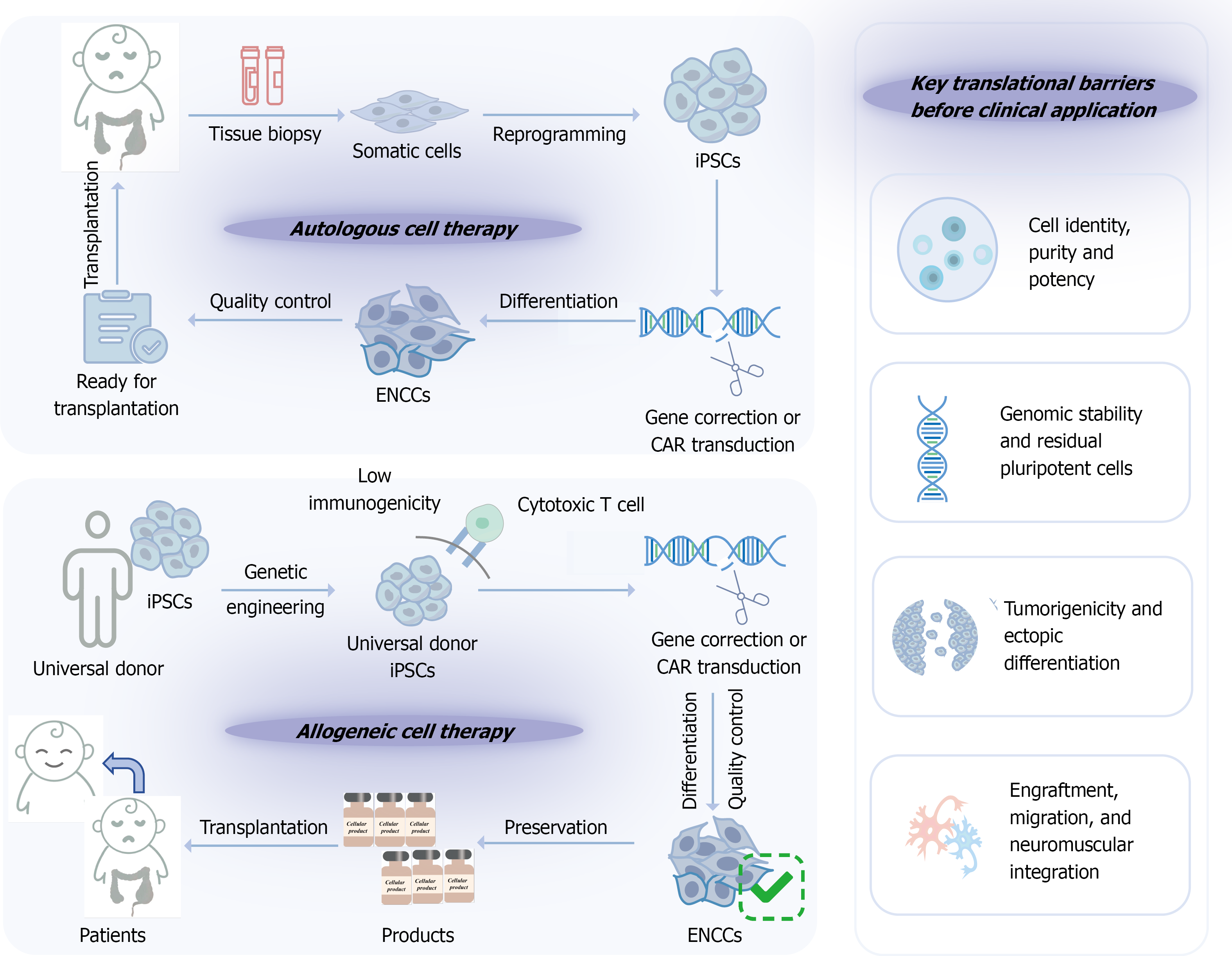
Figure 4 Translational strategies and major barriers for induced pluripotent stem cell-based cell therapy in Hirschsprung disease.
This schematic illustrates two major preclinical strategies for induced pluripotent stem cell (iPSC)-based enteric neural cell replacement. In autologous cell therapy, somatic cells are obtained from an individual patient, reprogrammed into patient-derived iPSCs, genetically modified when appropriate through gene correction or chimeric antigen receptor (CAR) transduction, differentiated into enteric neural crest cells (ENCCs), subjected to quality control, and then considered for transplantation back into the patient. This approach offers potential advantages in genetic matching and reduced immune rejection, but it remains individualized, time-consuming, and difficult to scale. In allogeneic or universal donor strategies, donor-derived iPSC lines may undergo genetic engineering, including gene correction or CAR transduction, before differentiation into ENCC products that may be preserved and used as off-the-shelf cell sources. Regardless of the source, iPSC-derived ENCC products require rigorous preclinical evaluation before clinical application. Key translational barriers include cell identity, purity, and potency; genomic stability and absence of residual pluripotent cells; tumorigenicity and ectopic differentiation; and durable engraftment, migration, and neuromuscular integration within the host bowel. These requirements are particularly important in the pediatric setting, where long-term safety, intestinal growth, and tissue remodeling must be considered before clinical translation can be attempted. iPSC: Induced pluripotent stem cell; ENCC: Enteric neural crest cell; CAR: Chimeric antigen receptor.
- Citation: Qiu YX, Zhi ZK, Leng YM, Zhang XT, Du CX, Tang J, Li HX, Tang WB. Induced pluripotent stem cells in Hirschsprung disease: Modeling, mechanisms, and translational challenges. World J Stem Cells 2026; 18(8): 123046
- URL: https://www.wjgnet.com/1948-0210/full/v18/i8/123046.htm
- DOI: https://dx.doi.org/10.4252/wjsc.123046