
















Copyright: ©Author(s) 2026.
World J Stem Cells. Aug 26, 2026; 18(8): 123046
Published online Aug 26, 2026. doi: 10.4252/wjsc.123046
Published online Aug 26, 2026. doi: 10.4252/wjsc.123046
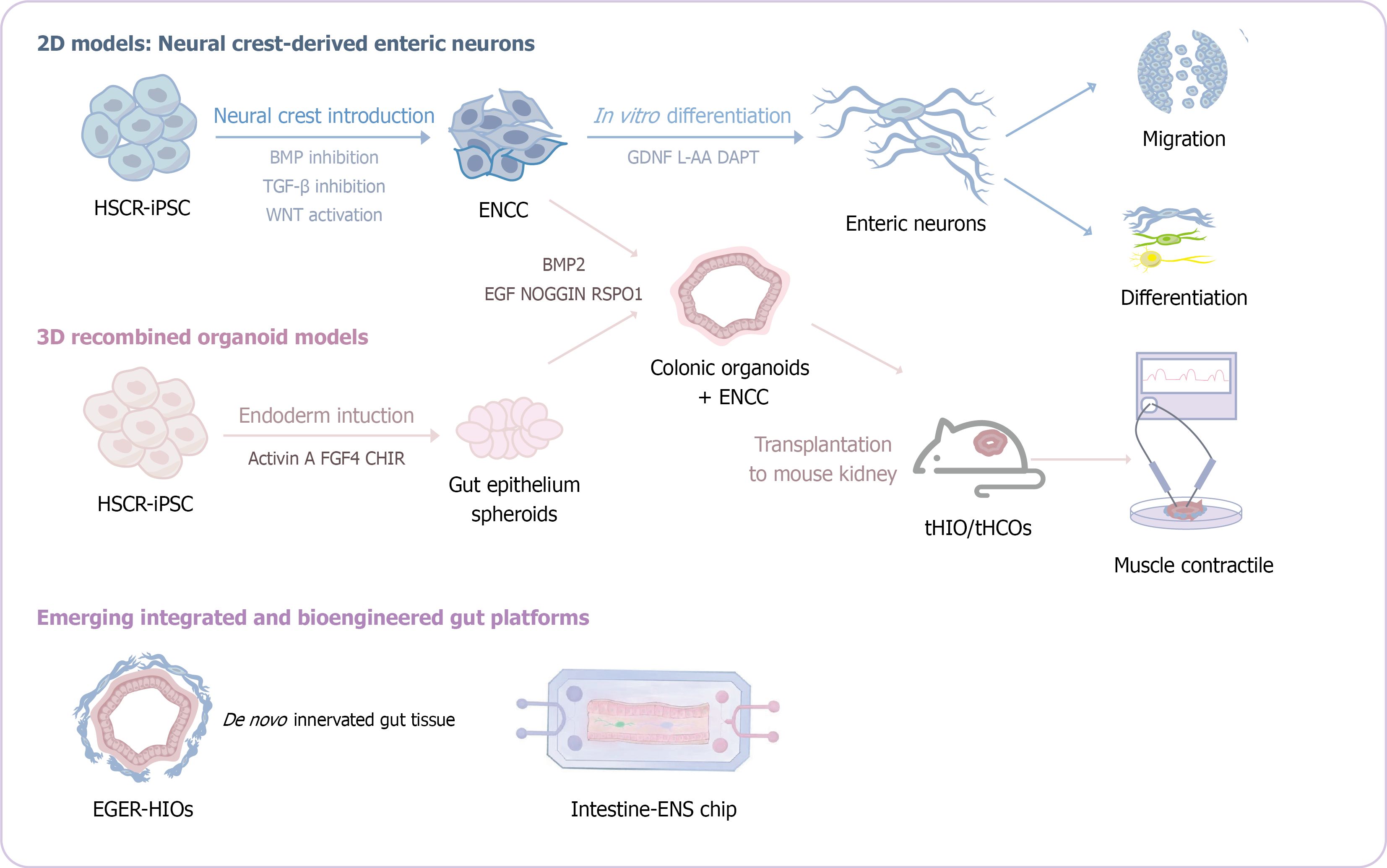
Figure 3 Induced pluripotent stem cell-based modeling platforms relevant to Hirschsprung disease research.
The figure summarizes three major categories of human induced pluripotent stem cell (iPSC)-based and emerging gut models used to study Hirschsprung disease (HSCR). In two-dimensional models, HSCR patient-derived iPSCs are directed toward enteric neural crest cells (ENCCs) through neural crest induction using developmental signaling modulation, such as bone morphogenetic protein inhibition, transforming growth factor-beta inhibition, and WNT pathway activation. ENCCs can then be differentiated into enteric neurons and assessed using cellular phenotypes such as migration and neuronal differentiation. In three-dimensional recombined organoid models, iPSC-derived gut epithelial spheroids or intestinal and colonic organoids are combined with ENCCs to generate innervated organoid systems. These models allow assessment of ENCC colonization, neuroepithelial interaction, in vivo maturation after transplantation, and tissue-level readouts such as contractile responses. Emerging integrated and bioengineered gut platforms include de novo innervated gut tissues and intestine-enteric nervous system microphysiological systems. These platforms may provide additional opportunities to study epithelial-neural communication, mechanical stimulation, barrier function, and dynamic multicellular interactions. Overall, these model systems are complementary rather than hierarchical, and each should be selected according to the biological question and required functional endpoint. 2D: Two-dimensional; 3D: Three-dimensional; HSCR: Hirschsprung disease; iPSC: Induced pluripotent stem cell; BMP: Bone morphogenetic protein; TGF: Transforming growth factor; ENCC: Enteric neural crest cell; GDNF: Glial cell line-derived neurotrophic factor; L-AA: L-ascorbic acid; EGF: Epidermal growth factor; FGF4: Fibroblast growth factor 4; RSPO1: R-spondin 1; HIOs: Human intestinal organoids; HCOs: Human colonic organoids.
- Citation: Qiu YX, Zhi ZK, Leng YM, Zhang XT, Du CX, Tang J, Li HX, Tang WB. Induced pluripotent stem cells in Hirschsprung disease: Modeling, mechanisms, and translational challenges. World J Stem Cells 2026; 18(8): 123046
- URL: https://www.wjgnet.com/1948-0210/full/v18/i8/123046.htm
- DOI: https://dx.doi.org/10.4252/wjsc.123046