
















Copyright: ©Author(s) 2026.
World J Stem Cells. Jun 26, 2026; 18(6): 119118
Published online Jun 26, 2026. doi: 10.4252/wjsc.119118
Published online Jun 26, 2026. doi: 10.4252/wjsc.119118
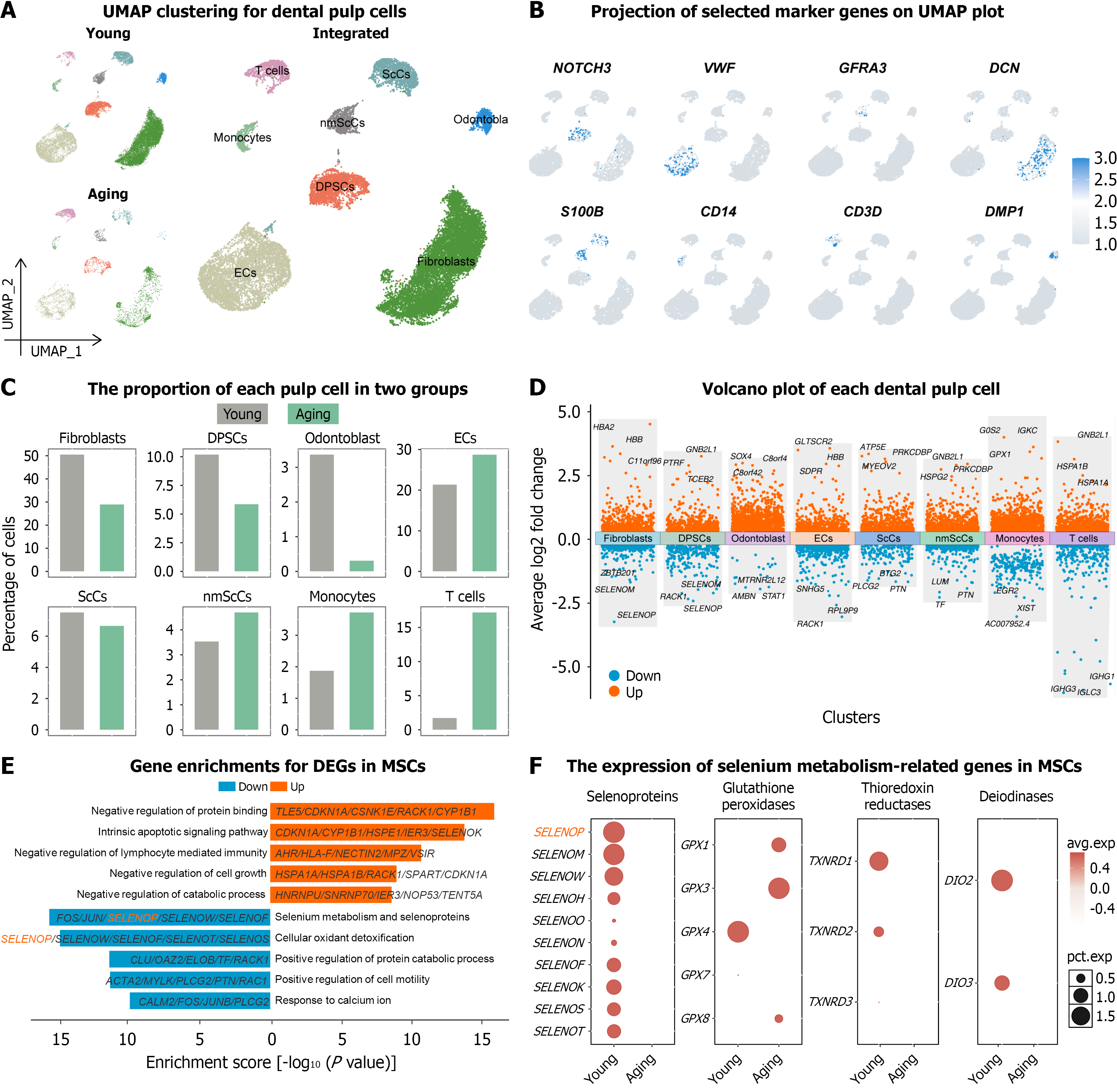
Figure 1 Integrated single-cell RNA-sequencing analysis reveals erosion of the selenium-dependent antioxidant program in aged dental pulp mesenchymal stem cell populations.
A: Uniform manifold approximation and projection plot showing integrated clustering of cells from young and aged human dental pulp tissues; major cell populations are annotated based on canonical markers; B: Uniform manifold approximation and projection split by age group (young vs aging), showing age-related changes in cell distribution across clusters; C: Quantitative cell composition analysis showing the relative proportion of major cell populations, including contraction of the dental pulp stem cell/mesenchymal stem cell compartment in aged pulp; D: Gene Ontology enrichment analysis of downregulated genes in the mesenchymal lineage from aged pulp, highlighting redox-related biological processes; E: Pathway enrichment summary showing suppression of selenium metabolism/glutathione-related pathways in aged mesenchymal cells; F: Heatmap or dot plot showing reduced expression of selenium transport and selenium-dependent antioxidant genes in aged mesenchymal cells, including selenoprotein P, glutathione peroxidase 1/4, thioredoxin reductase 1/3, and DIO2/3. Data are presented as mean ± SD. UMAP: Uniform manifold approximation and projection; DPSCs: Dental pulp stem cells; ECs: Endothelial cells; ScCs: Schwann cells; nmScCs: Nonmyelinating Schwann cells; DEGs: Differentially expressed genes; MSC: Mesenchymal stem cell; GPx: Glutathione peroxidase; TXNRD: Thioredoxin reductase; SELENOP: Selenoprotein P.
- Citation: Zhang RQ, Chu WH, Bai JB, Lei YH, Zhou D. Selenoprotein P attenuates oxidative senescence and ferroptosis-associated lipid peroxidation in dental pulp stem cells through a FOXM1-dependent program. World J Stem Cells 2026; 18(6): 119118
- URL: https://www.wjgnet.com/1948-0210/full/v18/i6/119118.htm
- DOI: https://dx.doi.org/10.4252/wjsc.119118