
















Copyright: ©Author(s) 2026.
World J Stem Cells. Apr 26, 2026; 18(4): 118621
Published online Apr 26, 2026. doi: 10.4252/wjsc.v18.i4.118621
Published online Apr 26, 2026. doi: 10.4252/wjsc.v18.i4.118621
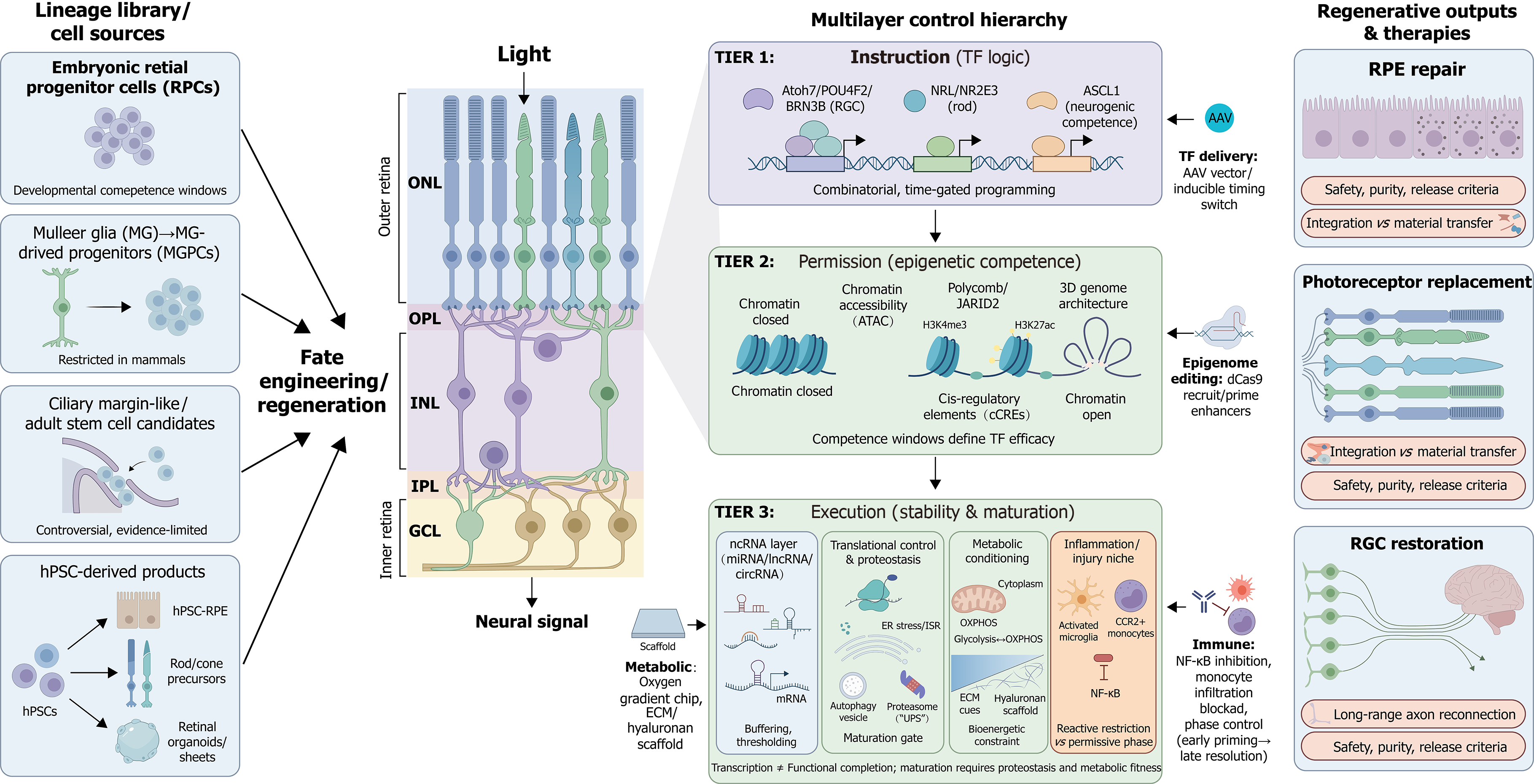
Figure 3 The multilayered fate-control paradigm for retinal regeneration: From lineage sources to therapeutic outputs.
This schematic illustrates the hierarchical framework governing retinal cell fate engineering. The lineage library: Distinct cell sources available for regeneration, ranging from developmental references (embryonic retinal progenitor cells) and endogenous candidates (Müller glia, ciliary marginal zone-like cells) to scalable manufacturing sources (human pluripotent stem cell-derived retinal pigment epithelium, organoids, and photoreceptors) (left). The multilayer control hierarchy: Successful fate engineering requires the convergence of three regulatory tiers: (1) Instruction (tier 1): Lineage-determining transcription factors (e.g., Atoh7, neural retina leucine-zipper, ASCL1) that provide combinatorial and time-gated programming logic; (2) Permission (tier 2): The epigenetic landscape (chromatin accessibility, histone modifications, 3D architecture) that defines competence windows and determines whether transcription factor instructions can access cis-regulatory elements; and (3) Execution (tier 3): The stabilization and maturation layer, comprising non-coding RNAs, translational/proteostatic control, metabolic conditioning (e.g., glycolysis/OXPHOS balance), and the immune microenvironment (e.g., inflammation phase control), which collectively ensure the functional completion of the transcriptional program (middle). Regenerative outputs & therapies: The application of this logic to specific clinical targets - retinal pigment epithelium repair, photoreceptor replacement, and retinal ganglion cell restoration - highlighting key translational bottlenecks such as synaptic integration, long-range axon guidance, and safety/purity release criteria (right). hPSC: Human pluripotent stem cell; RPE: Retinal pigment epithelium; RGC: Retinal ganglion cell; NRL: Neural retina leucine-zipper; ATAC: Assay for transposase-accessible chromatin; TFs: Transcription factors; miRNA: MicroRNA; lncRNA: Long non-coding RNA; circRNA: Circular RNA; ECM: Extracellular matrix; ER: Endoplasmic reticulum; CCR2+: C-C chemokine receptor type 2-positive; NF-κB: Nuclear factor kappa B; AAV: Adeno-associated virus; dCas9: Catalytically dead Cas9.
- Citation: Xie QQ, Zeng MQ, Mao LN, Han SJ, Sun D, Zheng ZG. Multilayered control of retinal stem/progenitor cell fate in the single-cell and organoid era: Developmental blueprints and regenerative opportunities. World J Stem Cells 2026; 18(4): 118621
- URL: https://www.wjgnet.com/1948-0210/full/v18/i4/118621.htm
- DOI: https://dx.doi.org/10.4252/wjsc.v18.i4.118621