
















Copyright: ©Author(s) 2026.
World J Stem Cells. Nov 26, 2026; 18(11): 128748
Published online Nov 26, 2026. doi: 10.4252/wjsc.128748
Published online Nov 26, 2026. doi: 10.4252/wjsc.128748
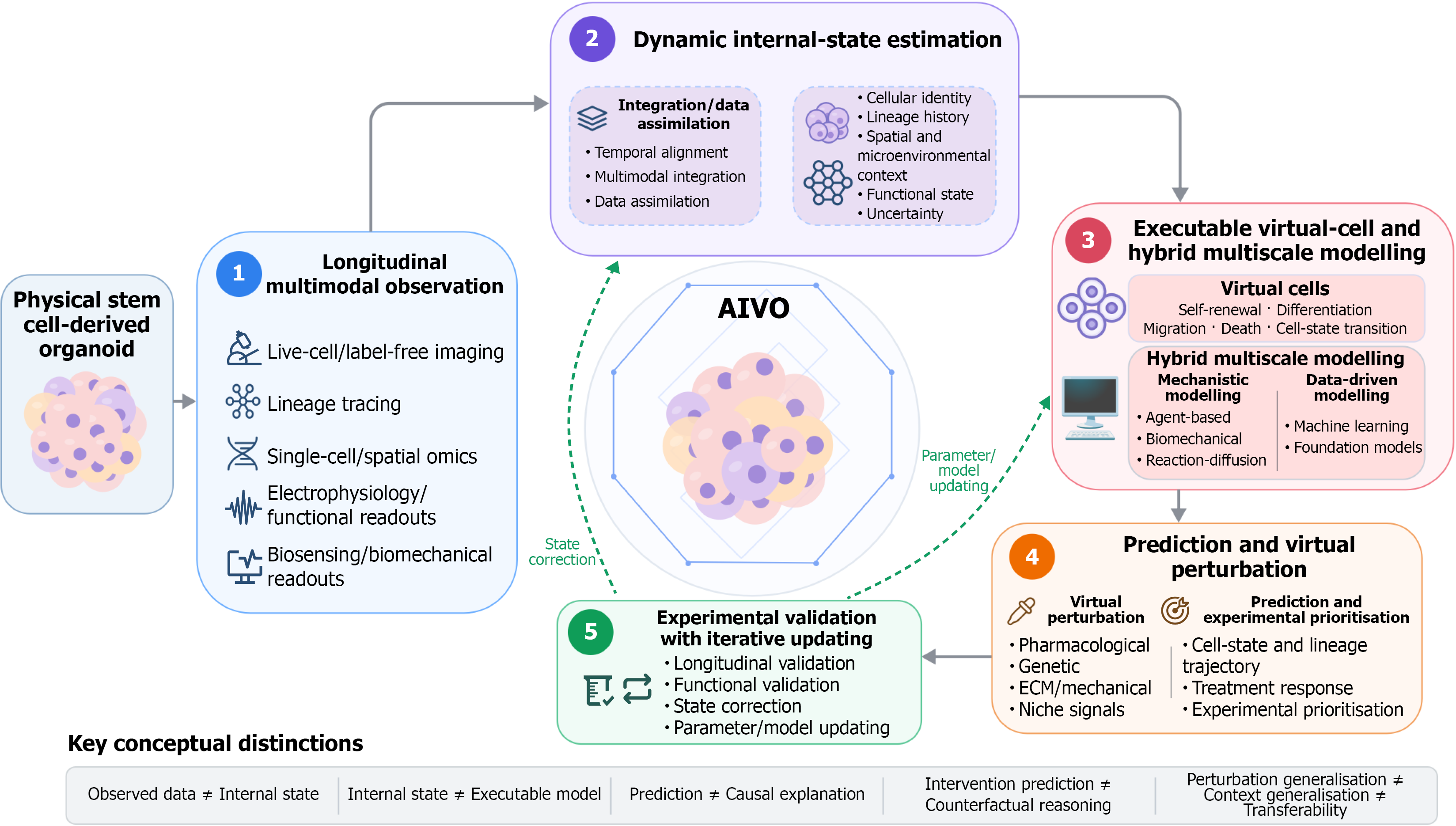
Figure 1 Proposed conceptual framework for the architecture of artificial intelligence-enabled virtual organoids.
Artificial intelligence-enabled virtual organoids are conceived as dynamically updated, biologically constrained, and executable digital representations linked to corresponding physical stem cell-derived organoids. The framework comprises five linked stages: (1) Longitudinal multimodal observation; (2) Dynamic internal-state estimation through temporal alignment, multimodal integration, and data assimilation; (3) Executable virtual-cell and hybrid multiscale modelling that combines mechanistic and data-driven approaches; (4) Prediction and virtual perturbation, including pharmacological, genetic, extracellular matrix/mechanical, and niche interventions, together with experimental prioritisation; and (5) Experimental validation with iterative updating through longitudinal and functional validation, state correction, and parameter/model updating. State correction and parameter/model updating feed back to internal-state estimation and executable modelling, respectively. The framework further distinguishes observed data from inferred internal states, internal states from executable models, prediction from causal explanation, intervention prediction from counterfactual reasoning, and perturbation generalisation from context generalisation and transferability. AIVO: Artificial intelligence-enabled virtual organoid; ECM: Extracellular matrix.
- Citation: Zhang CQ, Yan PY, Wang HF, Guo YX, Fan X, Guo ZD, Liu YX, Liu C. Artificial intelligence-enabled virtual organoids: Digital-twin frameworks for predictive stem cell biology and precision regenerative medicine. World J Stem Cells 2026; 18(11): 128748
- URL: https://www.wjgnet.com/1948-0210/full/v18/i11/128748.htm
- DOI: https://dx.doi.org/10.4252/wjsc.128748