
















Copyright: ©Author(s) 2026.
World J Stem Cells. Nov 26, 2026; 18(11): 126709
Published online Nov 26, 2026. doi: 10.4252/wjsc.126709
Published online Nov 26, 2026. doi: 10.4252/wjsc.126709
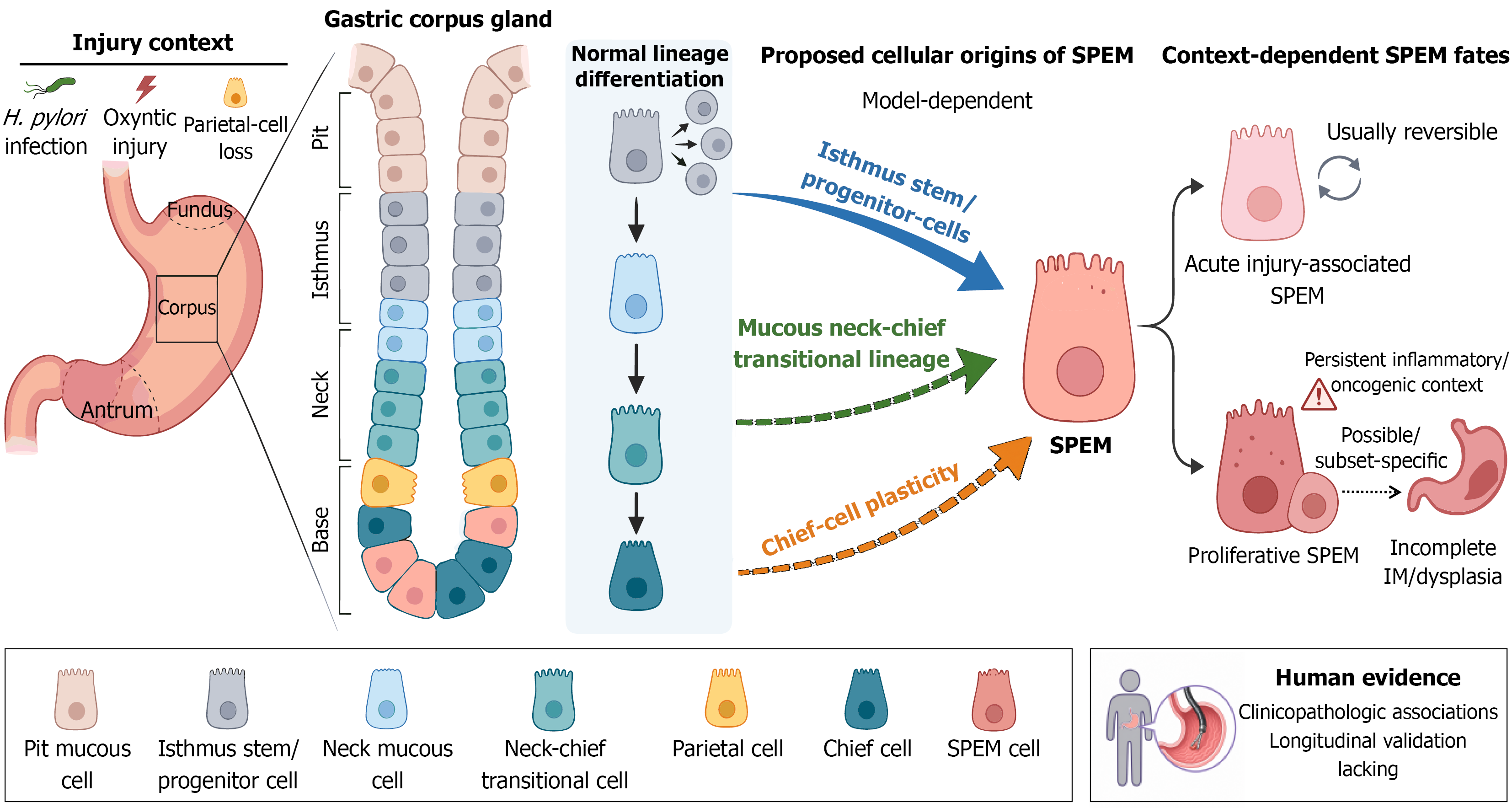
Figure 1 Model-dependent cellular origins and context-dependent fates of spasmolytic polypeptide-expressing metaplasia.
Proposed cellular origins of spasmolytic polypeptide-expressing metaplasia (SPEM) include isthmus stem/progenitor cells, the mucous neck-chief transitional lineage, and chief-cell plasticity. Acute injury-associated SPEM is generally transient and reversible in experimental models, whereas persistent inflammatory or oncogenic contexts may support proliferative SPEM, which may be associated with incomplete intestinal metaplasia or dysplasia in a subset of lesions. These pathways are model dependent and do not represent an obligatory temporal sequence. Evidence for isthmus stem/progenitor contributions derives mainly from Tff2- and Mist1-based lineage-tracing and oncogenic models, whereas chief-cell plasticity and neck-chief transitional contributions are supported by model-dependent evidence from injury/regeneration and lineage-tracing studies. In the schematic, solid arrows indicate direct lineage-tracing evidence in experimental models, dashed arrows indicate model-dependent or indirect evidence, and dotted arrows indicate possible or subset-specific associations. Human evidence is primarily clinicopathological, and longitudinal validation of these lineage and progression relationships remains lacking. SPEM: Spasmolytic polypeptide-expressing metaplasia.
- Citation: Zhang WJ, Huang YZ, Chen Q, Zheng ST, Yuan HS, Chen XB, Liang YZ, Hong XX, Xu YF, Li HW, Gao Y, Guo SJ. Proliferative spasmolytic polypeptide-expressing metaplasia in gastric carcinogenesis: Stem cell origins, lineage plasticity, and clinical implications. World J Stem Cells 2026; 18(11): 126709
- URL: https://www.wjgnet.com/1948-0210/full/v18/i11/126709.htm
- DOI: https://dx.doi.org/10.4252/wjsc.126709