










BPG is committed to discovery and dissemination of knowledge
Minireviews
Copyright: ©Author(s) 2026.
World J Stem Cells. Oct 26, 2026; 18(10): 125689
Published online Oct 26, 2026. doi: 10.4252/wjsc.125689
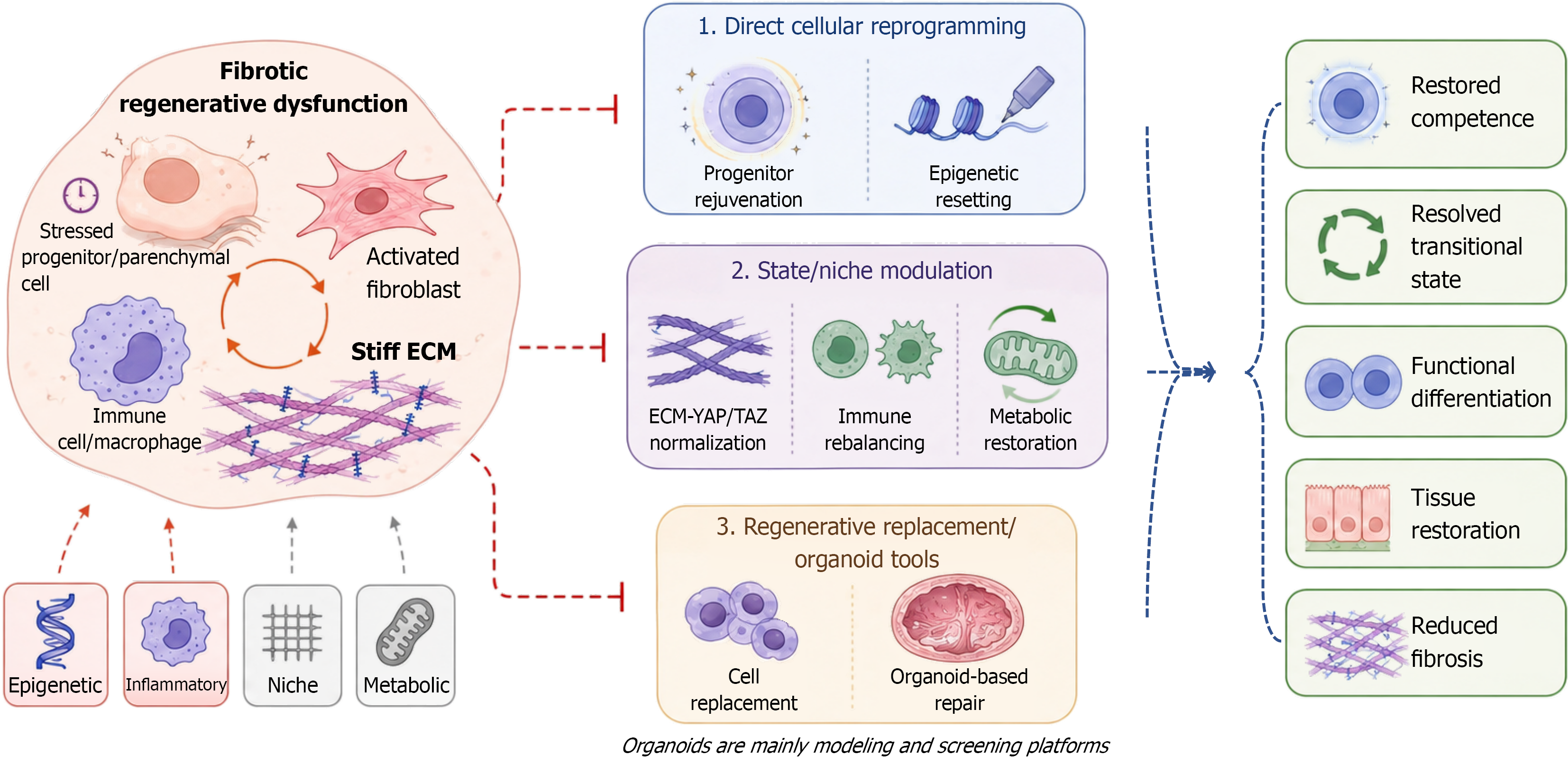
Figure 2
Figure 2 Therapeutic strategies targeting regenerative dysfunction and their conditional outcomes in organ fibrosis. In this review, therapeutic reprogramming is reserved for interventions intended to produce a controlled and durable correction of a pathological cellular state, identity, or differentiation trajectory. Direct epigenetic reprogramming, lineage conversion, and durable progenitor-state rejuvenation meet this definition. Senolytic depletion, conventional pathway inhibition, extracellular matrix normalization, immunomodulation, cell replacement, and organoid testing are biologically distinct; they are classified as complementary state-modifying, niche-modifying, replacement, or research strategies rather than automatically labeled as reprogramming. Fibrotic regenerative dysfunction is sustained by pathological cellular states and altered epigenetic, inflammatory, mechanical/niche, and metabolic signals. Candidate interventions are grouped into three conceptually distinct categories: (1) Direct cellular reprogramming, including progenitor-state rejuvenation and epigenetic resetting; (2) State and niche modulation, including extracellular matrix-Yes-associated protein/transcriptional coactivator with PDZ-binding motif normalization, immune-state regulation, and metabolic restoration; and (3) Regenerative replacement and organoid-based approaches, including cell replacement and organoid-guided modeling or repair. These strategies are proposed to restore regenerative competence, promote resolution of maladaptive transitional states, recover functional differentiation, support tissue restoration, and reduce fibrosis. Dashed connections indicate hypothesized or experimentally testable relationships rather than established therapeutic effects. Durable benefit requires organ- and disease-stage-specific validation, persistence after treatment withdrawal, functional assessment, and safety evaluation. ECM: Extracellular matrix; YAP/TAZ: Yes-associated protein/transcriptional coactivator with PDZ-binding motif.


Write to the Help Desk