










BPG is committed to discovery and dissemination of knowledge
Minireviews
Copyright: ©Author(s) 2026.
World J Stem Cells. Oct 26, 2026; 18(10): 125689
Published online Oct 26, 2026. doi: 10.4252/wjsc.125689
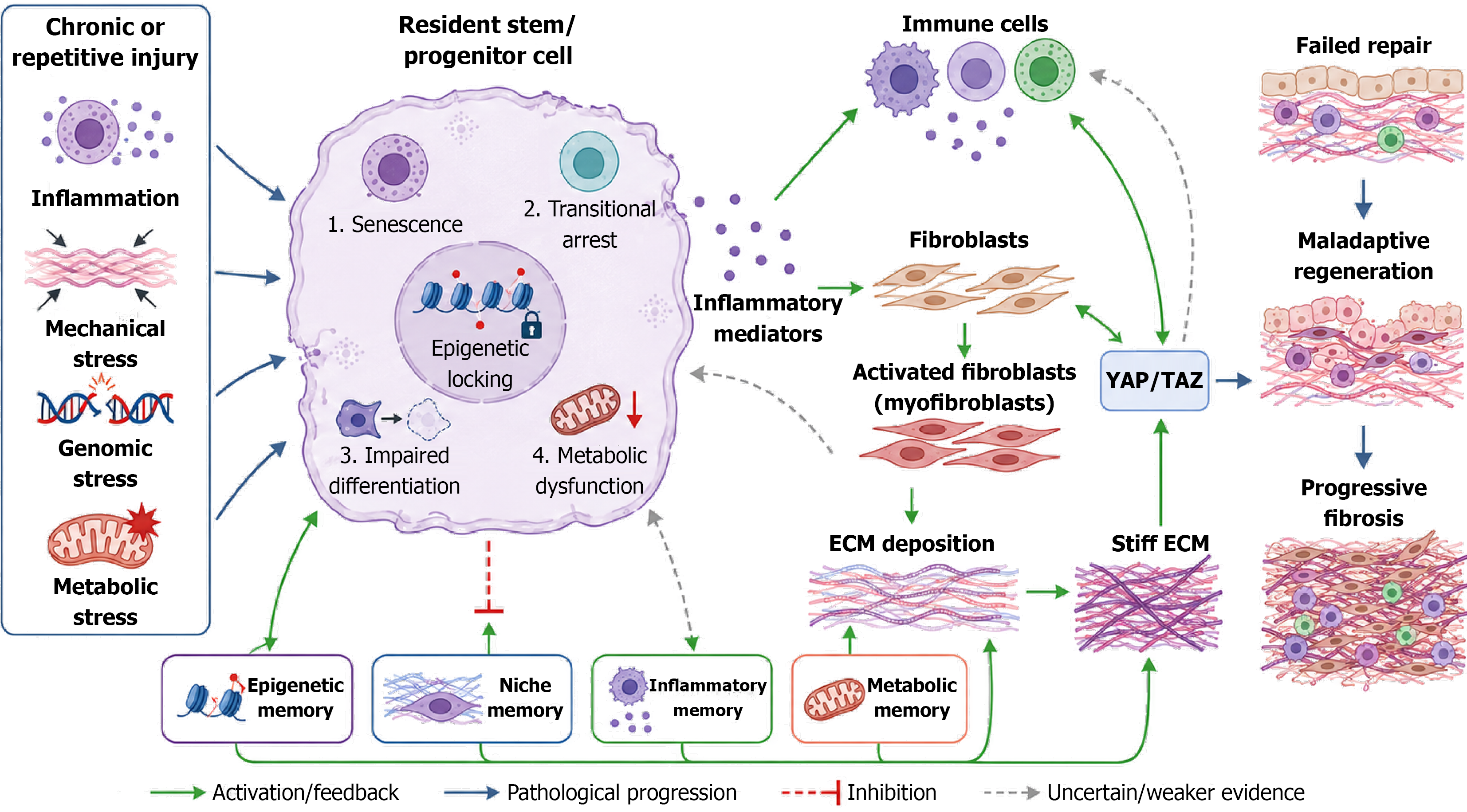
Figure 1
Figure 1 Schematic framework linking chronic injury, maladaptive regeneration, fibrotic memory, and progressive fibrosis. Chronic or repetitive injury, including inflammatory, mechanical, genomic, and metabolic stress, disrupts regenerative cell function and promotes senescence, transitional arrest, impaired differentiation, metabolic dysfunction, and epigenetic locking. These maladaptive cellular states alter inflammatory signaling and interact with immune cells and fibroblasts, promoting fibroblast activation, extracellular matrix (ECM) deposition, matrix stiffening, and Yes-associated protein/transcriptional coactivator with PDZ-binding motif-dependent mechanotransduction. Reciprocal signaling among regenerative cells, immune cells, fibroblasts, and the ECM can reinforce failed repair, maladaptive regeneration, and progressive fibrosis. Epigenetic, niche, inflammatory, and metabolic memory are shown as candidate mechanisms that may sustain pathological responses after the initiating injury has been reduced. Green solid arrows indicate supported activation or feedback relationships, blue solid arrows indicate pathological progression, red dashed lines indicate inhibitory relationships, and gray dashed arrows indicate proposed or less well-established connections. The strength and persistence of these mechanisms are context-, cell type-, and organ-dependent, and the different memory layers should not be interpreted as having equivalent levels of evidence. ECM: Extracellular matrix; YAP/TAZ: Yes-associated protein/transcriptional coactivator with PDZ-binding motif.


Write to the Help Desk