
















©The Author(s) 2025.
World J Stem Cells. Nov 26, 2025; 17(11): 112702
Published online Nov 26, 2025. doi: 10.4252/wjsc.v17.i11.112702
Published online Nov 26, 2025. doi: 10.4252/wjsc.v17.i11.112702
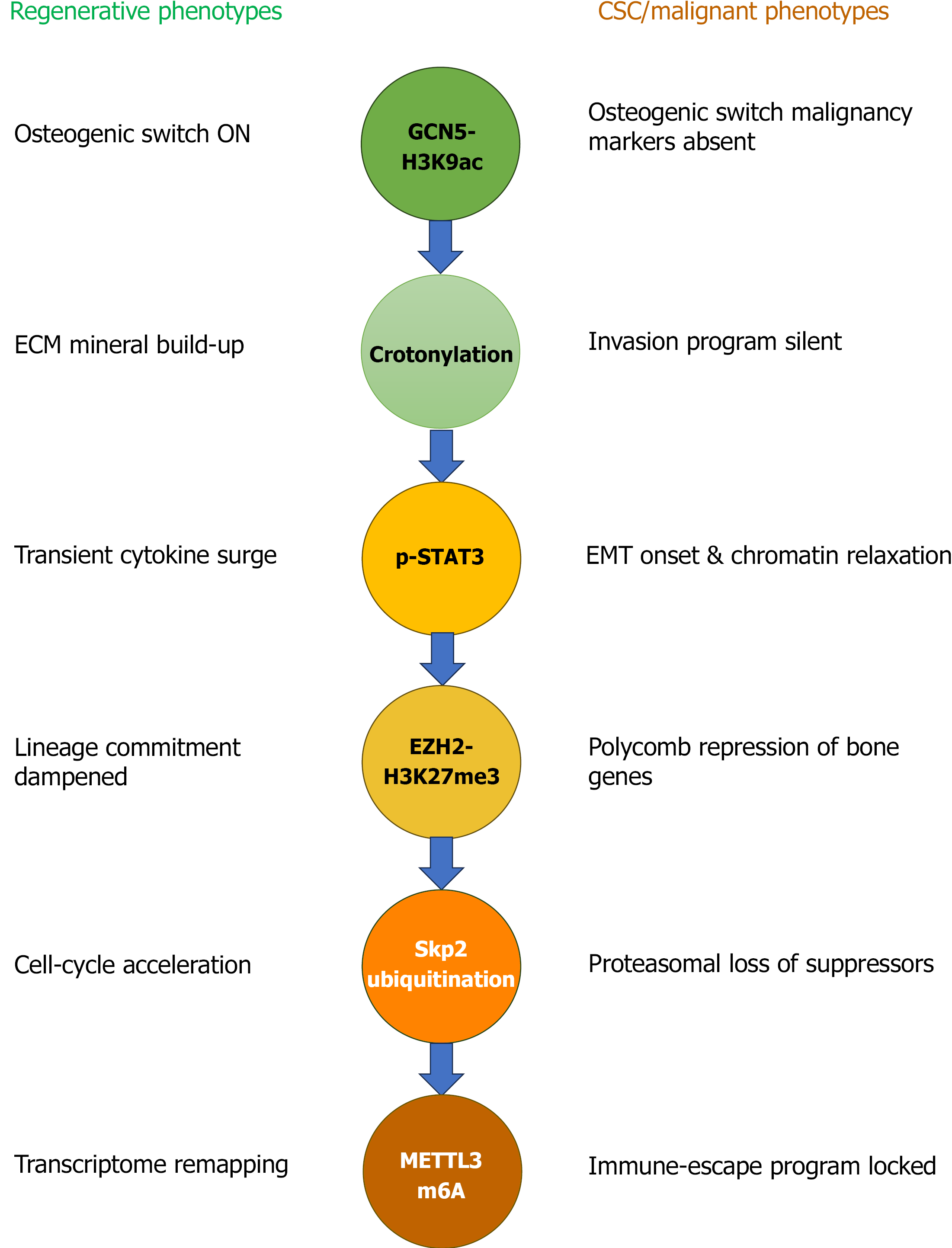
Figure 2 Sequential post-translational modification cascade driving the shift from regeneration to malignancy in dental-derived mesenchymal stem cells.
A vertical timeline (centre) depicts six key post-translational modifications (PTMs) that accumulate in a fixed order: General control non-depressible 5-mediated histone-H3 lysine-9 acetylation, lysine crotonylation, signal transducer and activator of transcription 3 tyrosine-705 phosphorylation, enhancer of zeste homolog 2-catalysed histone-H3 lysine-27 trimethylation, S-phase kinase-associated protein 2-directed K48-linked ubiquitination, and methyltransferase-like 3-dependent N6-methyladenosine RNA methylation. Left-hand annotations summarize regenerative outcomes of each modification (e.g., osteogenic switch-on, extracellular-matrix mineral build-up), whereas right-hand annotations indicate the corresponding cancer stem cell or malignant traits that emerge as the same PTMs intensify (e.g., invasion programme silent → epithelial-mesenchymal transition onset, polycomb repression of bone genes, immune-escape programme locked). The downward arrow signifies temporal progression: Early, reversible PTMs support tissue repair; late, irreversible PTMs consolidate oral squamous cell carcinoma cancer stem cell phenotypes. CSC: Cancer stem cell; GCN5: General control non-depressible 5; H3K9ac: Histone H3 lysine-9 acetylation; ECM: Extracellular matrix; STAT3: Signal transducer and activator of transcription 3; EMT: Epithelial-mesenchymal transition; EZH2: Enhancer of zeste homolog 2; H3K27me3: Histone H3 lysine-27 trimethylation; Skp2: S-phase kinase-associated protein 2; METTL3: Methyltransferase-like 3; m6A: N6-methyladenosine.
- Citation: Liu W, Yang YY, Shi ZJ. Post-translational modifications in the oral microenvironment: Stem cell regulation from periodontal regeneration to oral cancer therapy. World J Stem Cells 2025; 17(11): 112702
- URL: https://www.wjgnet.com/1948-0210/full/v17/i11/112702.htm
- DOI: https://dx.doi.org/10.4252/wjsc.v17.i11.112702