
















Copyright: ©Author(s) 2026.
World J Gastroenterol. Jan 21, 2027; 33(3): 125206
Published online Jan 21, 2027. doi: 10.3748/wjg.125206
Published online Jan 21, 2027. doi: 10.3748/wjg.125206
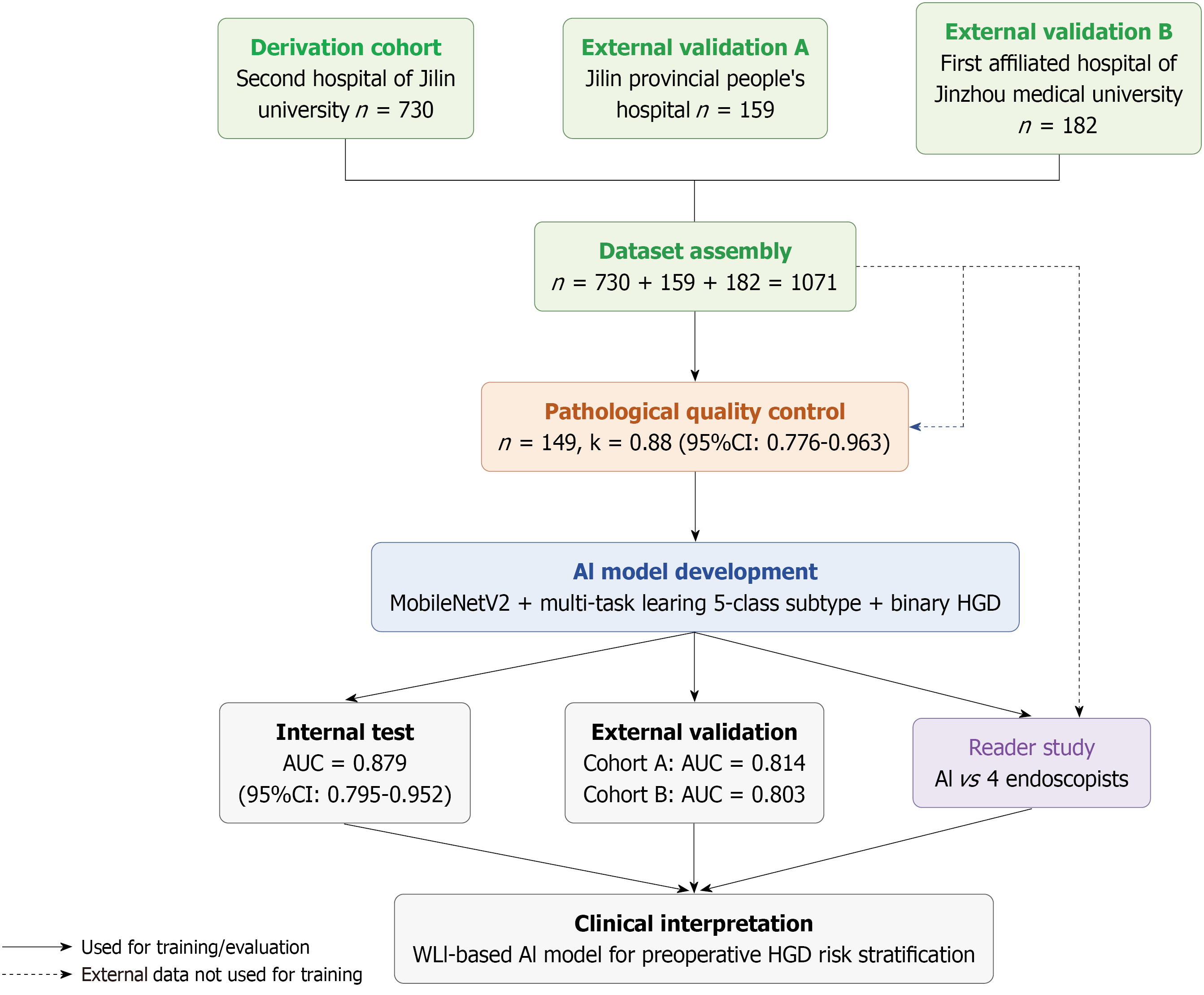
Figure 1 Overall study workflow.
The study comprised six phases: (1) Data collection from three participating centers (derivation cohort, n = 730; external validation cohort A, n = 159; and external validation cohort B, n = 182); (2) Dataset assembly (n = 1071); (3) Pathological quality control review (n = 149, κ = 0.88, 95% confidence interval: 0.776-0.963); (4) Artificial intelligence model development using MobileNetV2 with multi-task learning (5-class subtype classification and binary high-grade dysplasia prediction); (5) Model evaluation including internal testing, external validation, and a reader study comparing artificial intelligence with four endoscopists; and (6) Clinical interpretation of the white-light imaging-based model for preoperative high-grade dysplasia risk stratification. Dashed arrows indicate external validation data that were not used for model development or training. CI: Confidence interval; HGD: High-grade dysplasia; AUC: Area under the curve; AI: Artificial intelligence; WLI: White-light imaging.
- Citation: Zhang Y, Yan S, Li YJ, Li QX, Wei LJ. Deep learning for predicting high-grade dysplasia in colorectal polyps using white-light endoscopy. World J Gastroenterol 2027; 33(3): 125206
- URL: https://www.wjgnet.com/1007-9327/full/v33/i3/125206.htm
- DOI: https://dx.doi.org/10.3748/wjg.125206